
Last updated: May 24, 2026
Quick Answer
Panel vans are compact, suitable for everyday use and inexpensive to maintain—ideal for couples and solo travelers. Alcoves offer maximum sleeping space on a small footprint and are the classic family choice. Integrated motorhomes score points with a sense of space and comfort, but cost significantly more and require more horsepower. Which type is best depends on travel style, travel group and budget.
Key Takeaways
- 🚐 Panel van are the most affordable and maneuverable option — new prices starting from approx. €40,000, easy to drive with a class B driving license.
- Bed Alcove offer the best sleeping space ratio for families, but are more susceptible to wind due to the overhang and more difficult to drive.
- 🏠 Integrated motorhomes offer the most generous sense of space and the highest quality features — new prices start at approximately €70,000–80,000.
- ⛽ Panel vans are the most economical (approx. 9–12 l/100 km), integrated models sometimes need 14–16 l/100 km.
- 👨👩👧👦 For families with children, the alcove is the classic recommendation—the alcove sleeping area is perfect for children.
- ❄️ With a well-equipped panel van, winter camping is absolutely possible—pay attention to a parking heater and good insulation.
- Integrated motorhomes need at least 130–150 HP, better 180 HP or more, for comfortable driving.
- 💡 The most common buying mistake: not planning for enough payload — the permissible gross weight is often underestimated.
- 🌍 Those who want to try out different types of RVs before buying can easily Rent a camper and test.
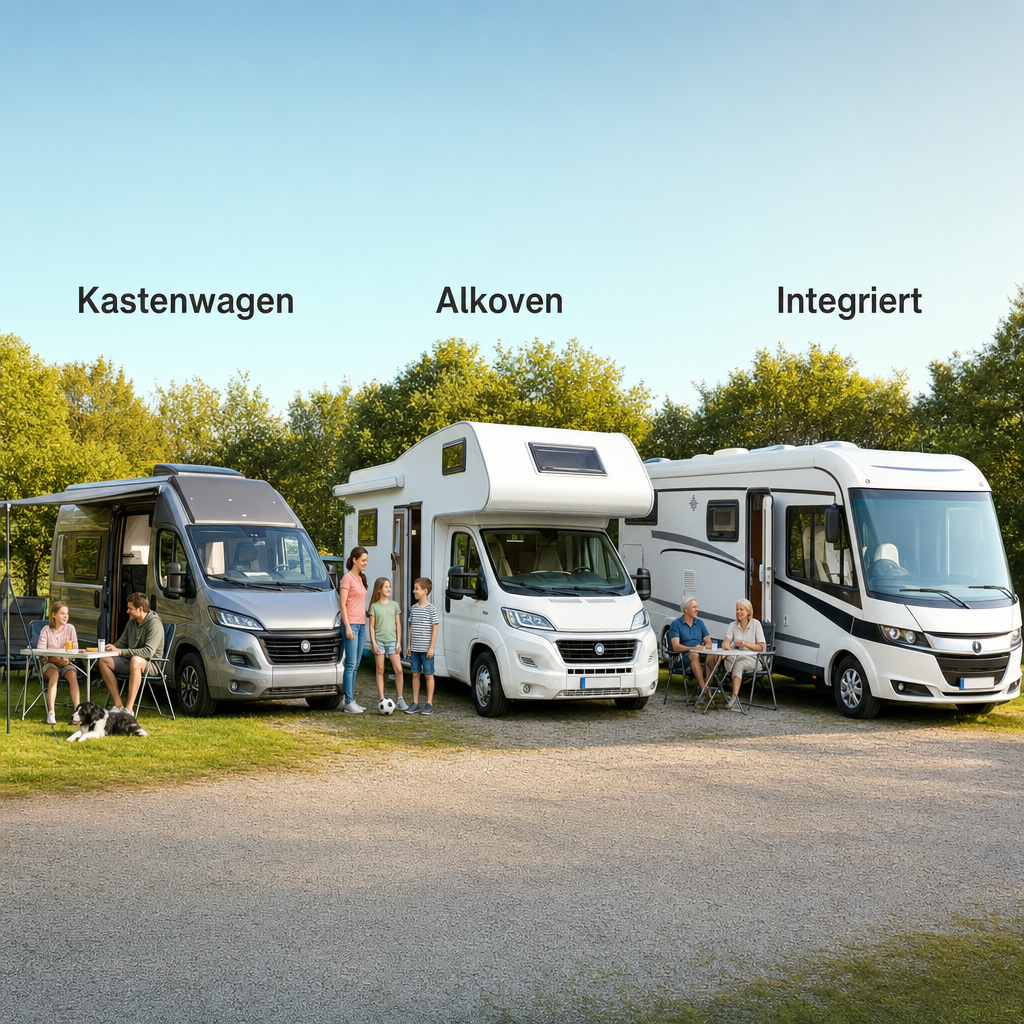
What are the differences between camper vans and integrated motorhomes?
Panel vans are based on a production van. (usually a Fiat Ducato, Mercedes Sprinter, or Volkswagen Crafter), which is converted into a camper van inside. The driver's cab remains original, and the outer shell is closed and robust. Integrated motorhomes, on the other hand, have a completely redesigned driver's cab that seamlessly transitions into the living area — with a huge panoramic window, a pull-down bed above the driver's cab, and significantly more width.
The most important differences at a glance:
| Characteristic | Panel van | Integrated motorhome |
|---|---|---|
| Vehicle base | Series delivery van | Special chassis design |
| Length typical | 5.4–7 m | 7-9 m |
| Width | ~2.0–2.2 m | ~2.3–2.5 m |
| Sleeping berths | 2-4 | 4–6 |
| New price from | ~40.000 € | ~€70,000–€80,000 |
| Driving licence | Class B (up to 3.5 t) | Class B or B96/BE |
| Suitability for everyday use | High | Low |
Decision rule: Anyone who wants to drive their motorhome in everyday life or park in the city is clearly better off with a panel van. Anyone looking for maximum living comfort on trips and who mainly uses the vehicle at campsites will opt for an integrated motorhome.
Which type of RV is the cheapest?
The panel van is by far the most affordable type of motorhome. — both in terms of purchase and ongoing operation. Used panel vans can be found from around €15,000–25,000, while new vehicles start at around €40,000–55,000 depending on the configuration.
For comparison:
- Panel van new: approx. €40,000–65,000
- Alcove new: approx. €45,000–75,000
- Integrated motorhome new: approx. €70,000–130,000 and more
In addition, there are ongoing costs: panel vans consume less fuel, have cheaper insurance premiums and are often cheaper to repair in the workshop because they are based on production vehicles. If you are still unsure which type is the right one, you can first rent as a campervan and test them on vacation — that saves you from expensive wrong purchases.
Important: With alcoves, it's worth taking a close look at the payload. Inexpensive models often only have a payload of 300–400 kg when the vehicle is fully occupied — that quickly becomes tight. More on this in the section on common buying mistakes.
Advantages and Disadvantages of Alcove Motorhomes
Alcove motorhomes have a characteristic structure above the driver's cab, which is used as an additional sleeping space. This makes them the most space-saving solution for families with children — on a vehicle length of 6–7 meters, they often offer 4–6 sleeping spaces.
Advantages:
- Maximum sleeping capacity on a compact footprint.
- Alcove bed ideal for children (separated, adventurous)
- Often more affordable than comparable-sized integrated motorhomes
- Living space remains free during the day (no bed conversion needed)
Disadvantages:
- High center of gravity due to superstructure—more susceptible to wind on the highway
- Worse aerodynamics, resulting in higher consumption.
- Alcove beds are often uncomfortable for adults (low entry, cramped).
- Driver's field of vision restricted by superstructure
- Visually outdated—the alcove is considered a "grandpa RV" in some circles.
Are alcove motorhomes still up-to-date? Yes – for families with several children, they will continue to be one of the most sensible solutions in 2026. However, the market has shifted: semi-integrated vehicles and large panel vans are catching up in terms of sleeping spaces. Those who don't have children will hardly need the overcab bed.
Good alcove brands: Bürstner (e.g. Averso series), Knaus (Sport & Fun), Dethleffs (Esprit), Hymer (Tramp) and Carado offer solid alcove models in various price ranges. Hymer stands for premium quality, while Carado and Knaus are recommended for good value for money.
How much space do I really need in a camper?
The honest answer: Most travelers overestimate how much space they need. A well-planned panel van with a length of 6 meters is perfectly adequate for two people on long journeys—provided the spatial concept is right.
Rough orientation by travel group:
- Solo or couple: Panel vans from 5.4 m — sufficient if a fixed bed and good storage spaces are available
- Couple with dog or lots of equipment: Panel van 6–7 m or semi-integrated motorhome
- Family with 1–2 children: Alcove or large semi-integrated motorhome from 6.5 m
- Family with 3+ children: Alcove or integrated motorhome from 7.5 m
What really counts isn't the square footage, but: fixed bed vs. convertible bed, number of belted seats, storage space for outdoor equipment, and the bathroom size. For example, if you want to travel through Tuscany in a motorhome, like in our Travelogue through Tuscany as described, also works wonderfully with a compact van.
Which type of RV is best suited for families?
For families with children, the alcove is traditionally the first choice. — the alcove bed above the driver's cab is a real highlight for children and gives parents more privacy below. Alternatively, large semi-integrated motorhomes with bunk beds now offer similar sleeping capacities with better handling.
What families should consider when buying:
- At least 4 seats with seat belts (mandatory for children)
- Sufficient payload — families with luggage quickly reach 400–600 kg of payload.
- Separates bath or at least shower and toilet separated
- Storage space for bicycles, strollers, toys
Common mistake: Families buy a motorhome with 4 berths but forget that the payload of inexpensive models is barely enough for 4 people plus luggage. Be sure to Topic: Overloading and Payload Read before buying.
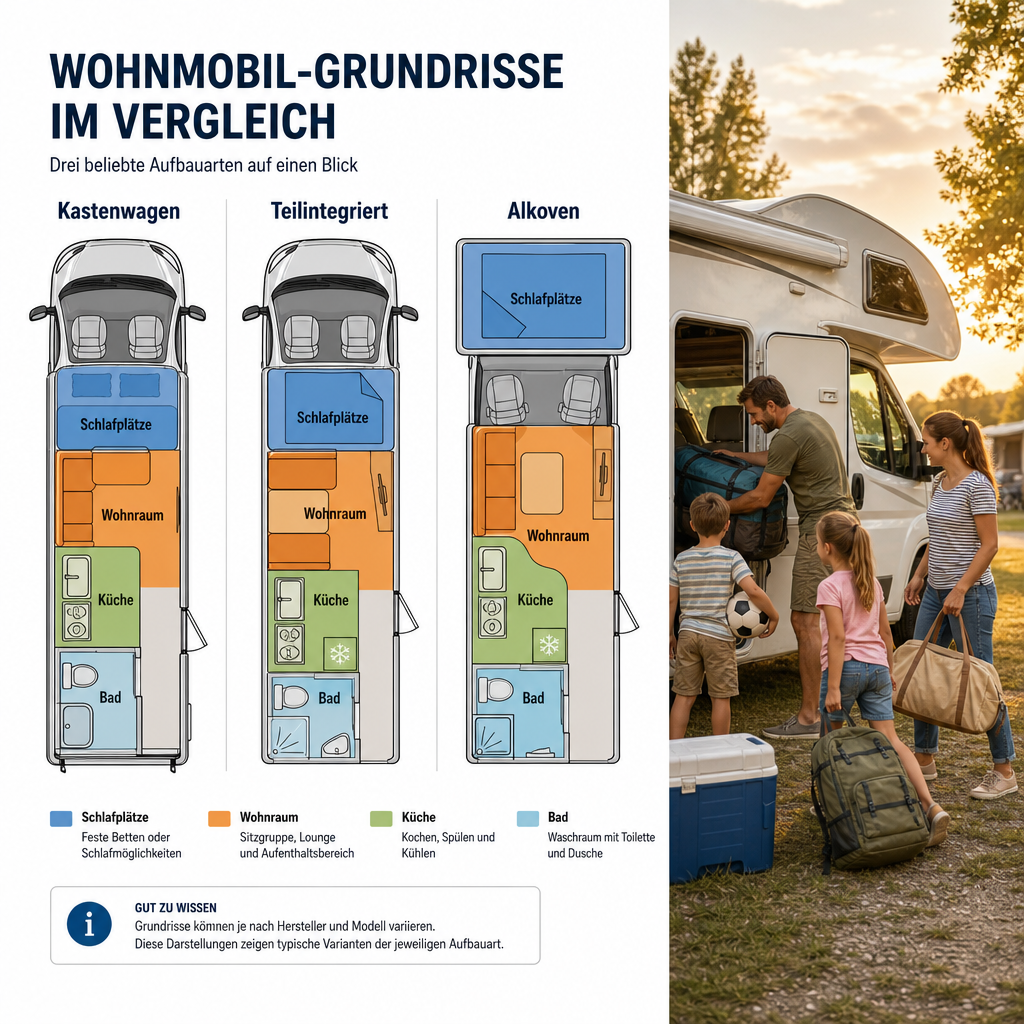
How much does a new integrated motorhome cost?
New integrated motorhomes will start in Germany in 2026 at around €70,000–80,000. for entry-level models and, in premium brands such as Hymer, Niesmann+Bischoff or Concorde, extend well beyond €200,000. The market average for a well-equipped integrated motorhome is approximately €100,000–€130,000.
What drives the price:
- Length and weight of the vehicle
- Engine (130 HP vs. 180 HP)
- Equipment (solar system, lithium batteries, automatic leveling)
- Brand and quality of the body.
Used integrated motorhomes can be found from around €30,000–50,000, but with older vehicles you should pay attention to moisture damage and defects noted on the TÜV (technical inspection) report — a TÜV inspection from the sixth year is particularly important when buying used.
Can I also camp in winter with a panel van?
Yes, winter camping with a panel van is possible — but only with the right equipment. Standard van conversions are often not designed for sub-zero temperatures. If you want to travel in winter, you absolutely need a parking heater (diesel or gas heater), good insulation of the walls and double floors, and frost-proof water tanks.
What to consider when winter camping in a panel van:
- Parking heater: Webasto or Eberspächer are proven systems
- Insulation: Vehicles with high roofs and double floors retain heat better
- Window: Thermal windows or interior blinds significantly reduce heat loss
- Water system: Frost-proof tanks or heating cables for pipes
Panel vans even have an advantage over alcoves and integrated motorhomes when it comes to winter camping: they are more maneuverable, fit in more pitches and can be heated up faster because the volume is smaller.
Which type of RV is easiest to drive?
The panel van is by far the easiest to drive. It is based on a production van, has similar dimensions to a large transporter, and fits into parking garages and narrow alleys. Many models remain under 3.5 tons and can therefore be driven with a normal Class B driving license.
Driveability in comparison:
- Panel van: Like a large transporter van – also well-suited for novice drivers
- Alcove: Due to the superstructure being higher and more susceptible to wind, crosswinds on the highway are noticeable.
- Integrated motorhome: Wider, longer, heavier—takes some getting used to, especially when reversing.
Good to know: The new EU driving license regulation allows driving motorhomes up to 4.25 tons with class B under certain conditions — more on that in the current driving licence regulations for motorhomes.
Which RV types are the most fuel-efficient?
Panel vans are the most fuel-efficient RVs. — due to lower weight, better aerodynamics and smaller engines. Realistic consumption values:
- Panel van: approx. 9–12 l/100 km (Diesel)
- Alcove: approx. 11–14 l/100 km
- Integrated motorhome: approx. 13–16 l/100 km
The difference in fuel consumption between a panel van and an integrated motorhome can quickly amount to €200–400 on a long journey. Those who drive a lot and want to keep an eye on fuel costs are clearly at an advantage with the panel van.
How much horsepower does an integrated motorhome need?
For an integrated motorhome starting at 3.5 tons, it should have at least 130–150 HP. — everything below that feels overwhelmed on the autobahn and on inclines. 160–180 HP is recommended, especially if the vehicle is heavily loaded or frequently crosses mountain passes.
Rule of thumb: Approximately 40–50 hp per ton of vehicle weight. A 5-ton vehicle therefore needs at least 200 hp for relaxed driving. Many manufacturers offer their models with 130, 160, and 180 hp — the surcharges for more power are almost always worth it with large vehicles.
Common mistakes when buying a motorhome
The most frequent and costly mistake is insufficient payload. Many buyers look at sleeping accommodations and features, but forget that the permissible total weight is quickly reached — especially with families or travelers with a lot of equipment.
Other typical mistakes:
- Floor plan not tested in a real vehicle. — Photos are deceiving, measurements on paper too
- Used purchase without moisture measurement — Water damage is the most common and expensive defect
- Vehicle too big for the travel style — an 8-meter vehicle is a real burden in Corsica or Scandinavia
- Equipment overrated — many extras are rarely used, but drive up weight and price
- Driver's license class not checked — different rules apply from 3.5 tons
Tip before buying: Just try different types first. rent as a campervan and test on a real trip. That's the surest way to find out what really fits—before investing five- or six-figure sums.
FAQ: Panel Van, Alcove or Integrated — the Most Frequently Asked Questions
Which type of RV is best for beginners?
The panel van. It drives like a large transporter, fits into normal parking spaces and can be driven with class B license. Ideal for anyone who doesn't have experience with large vehicles yet.
Is an alcove motorhome still up to date?
Yes, for families with children. The alcove sleeping area is attractive and practical for children. For couples without children, there are better alternatives with more comfort available today.
Do I need a special driver's license for an integrated motorhome?
That depends on the weight. Class B is sufficient up to 3.5 tons. Class B is also possible up to 4.25 tons under certain conditions (new EU regulation). Beyond that, class C1 is required.
What is a semi-integrated motorhome?
A semi-integrated motorhome sits between a camper van and an integrated motorhome: it has its own living area, but the driver's cabin is still from the production vehicle. Wider than a camper van, cheaper than an integrated motorhome—a good compromise for many travelers.
How long does an RV last?
Well-maintained RVs last 20–30 years. Crucially, protection against moisture is key — this is the most common cause of early depreciation.
Can two people travel comfortably in a panel van?
Absolutely. Modern camper van conversions offer a fixed bed, kitchen, bathroom, and seating area in a small space — perfectly sufficient for couples, especially if you're traveling a lot and spending little time in the vehicle.
Which brands build good panel vans?
Well-known panel van manufacturers include Westfalia, Hymer (B-Class), Dethleffs, Carado, Sunlight, and Globecar. For premium conversions based on the VW Crafter or Mercedes Sprinter, there are also smaller specialists such as Pössl and Dreamer.
Is it worth buying a motorhome or is it better to rent?
That depends on how often you use it. If you travel 4–6 weeks a year, renting is often cheaper — without depreciation, insurance, and maintenance costs. If you travel more frequently and spontaneously, owning your own vehicle may be worthwhile.
What is the difference between an alcove and a semi-integrated motorhome?
The alcove model has an overhang above the driver's cab with an additional sleeping area. The semi-integrated model doesn't have this overhang — the driver's cab ends at the front, and the living area begins behind it. Semi-integrated models drive better but offer fewer sleeping spaces.
Conclusion: The right type of RV for your adventure
Panel van, alcove or integrated — the large motorhome type comparison shows: There is no universally best type, but a clear recommendation for every travel group and every style.
- Panel van for couples, solo travelers, and anyone who appreciates flexibility and affordability
- Alcove for families with children who need maximum sleeping spaces in a manageable length
- Integrated motorhome for everyone who prioritizes comfort above all else and is willing to invest in it
Anyone who is not yet sure which type really suits them should definitely test drive different vehicles before buying. On Campcruisers.com Panel vans, semi-integrated motorhomes, and large motorhomes can be booked from professional rental partners worldwide — perfect for getting to know your dream type on real trips before you buy. After all, the best decision is made not in the showroom, but on the road. 🚐
Quellen
- Caravaning Industry Association (CIVD): Market Data Motorhomes Germany, 2023, https://www.civd.de
- ADAC: Motorhome Guide and Type Comparisons, 2024 https://www.adac.de/rund-ums-fahrzeug/wohnmobil-wohnwagen/
- Promobil: Motorhome types explained, 2023, https://www.promobil.de
Meta Title: Panel Van, Alcove or Integrated? Motorhome Types in Comparison
Meta Description: Panel van, alcove or integrated? This comprehensive motorhome type comparison shows costs, advantages and disadvantages, driving characteristics and which type suits you.
Tags: RV Types Comparison, Camper Van, Alcove RV, Integrated RV, Buy RV, Rent RV, Rent Camper, Semi-Integrated RV, Family RV, RV Guide, Camping Tips, RV Costs


 English
  German
  Spanish
  Italian
  Polish
  Dutch
Dutch  French
  Danish