
Last updated: May 24, 2026
Quick Answer: A motorhome with four sleeping berths does not automatically mean four people can be transported during the journey. The decisive factor is the number of approved seatbelts, which is entered in the vehicle registration document. Anyone who carries more people than there are seatbelts risks fines, loss of insurance cover and, in serious cases, criminal consequences.
Key Takeaways 🚐
- Sleeping berths ≠ Seatbelts: The number of beds in the motorhome says nothing about how many people are legally allowed to travel in it.
- The vehicle registration document is decisive: The permissible number of people is stated in field 1 (number of seats) of the vehicle registration document.
- Many compact motorhomes only have 2 registered seatbelts, although they offer 4 sleeping berths.
- Every passenger needs an approved, seatbelt-safe seat – this is required by law in Germany and throughout the EU.
- Overcrowding is not a minor offence: There are fines, points on your licence and, in the event of damage, problems with liability insurance.
- Retrofitting is possible, but technically complex and must be officially approved.
- When renting be sure to clarify the seatbelts of the vehicle before booking, not just the sleeping berths.
- families with children should check particularly carefully, as child seats require special brackets.
What are seatbelts and sleeping berths in a motorhome?
Sleeping berths are all the lying surfaces in the motorhome where you can sleep: fixed beds, drop-down beds, transverse beds, bunk beds or converted benches. Seatbelts however, only the seats that are equipped with an approved seat belt and officially registered in the vehicle registration document are.
This distinction is the crux of the problem, which many camping enthusiasts only discover when checking the vehicle registration document or – worse – during a police check.
A classic example: a compact panel van such as the Volkswagen California or a Fiat Ducato conversion often offers a double bed in the rear and a fold-out sleeping option above the front seats. Four sleeping places, then. However, the vehicle registration document often only lists two seats: driver and passenger. The bench seat in the living area is either completely absent or is not securely fastened with seat belts and is therefore not registered.
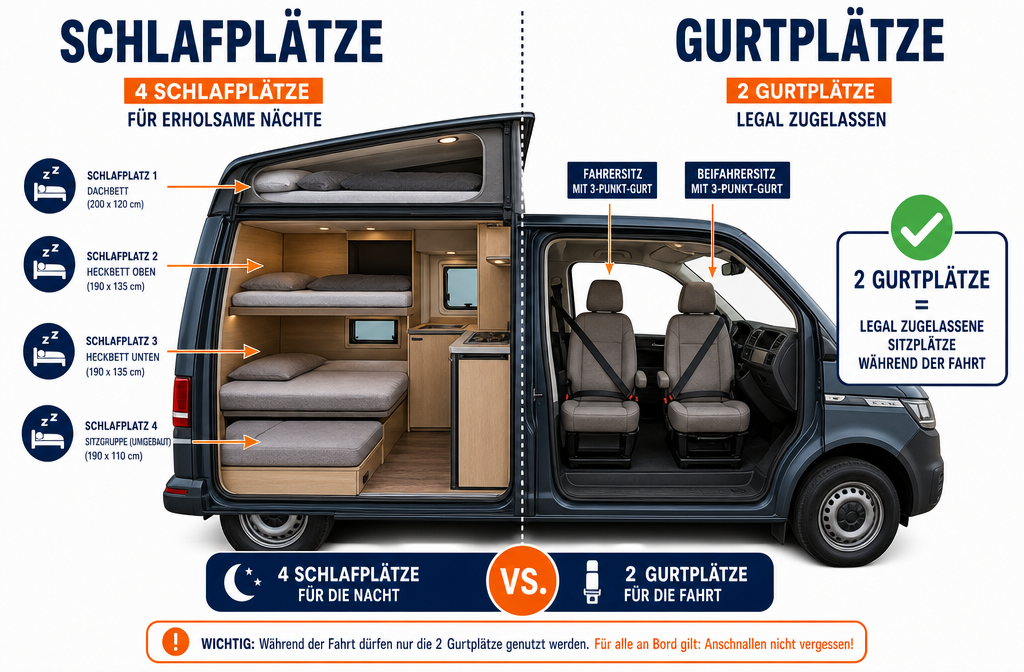
Why can’t all the specified people actually fit into a motorhome?
The reason is simple: sleeping and driving are two completely different states. Manufacturers optimise the layout for living comfort, not for maximum transport capacity. A sleeping surface doesn’t need crash safety, a seat does during the journey.
Specifically, that means:
- Bench seats in the living area are often not bolted to the body or do not comply with the ECE-R14 standard for seat belts.
- Pull-down beds and transverse beds simply cannot be used while driving.
- Many converters offer vehicles with a living area seating arrangement, but these haven't been registered as belted seats due to lack of TÜV approval.
The result: A vehicle that comfortably accommodates four people on the campsite is only legally occupied by two on the motorway.
How many people can I really take in my motorhome?
The permissible number of people is bindingly stated in the vehicle registration document (Registration Certificate Part I), field 1 – "Number of seats". This number includes the driver's seat.
How to read the real person capacity:
- Open the vehicle registration document, look for field 1.
- The number entered there is the maximum number of people allowed during the journey.
- Also check: Is a seatbelt also registered for each seat? (Field "Number of standing places" should be 0.)
- For rental vehicles: Before booking, explicitly ask the rental company about the registered number of seats, not just sleeping places.
Important for families: Children count as full persons. A child without their own belted seat must not travel – not even on an adult's lap.
What safety regulations apply to belted seats in motorhomes?
In Germany and the entire EU: Every occupant of a moving vehicle must be buckled up (§ 21a StVO). The same basic rules apply to motorhomes as to passenger cars, with some vehicle-specific additions.
The most important regulations at a glance:
| Regulation | Content |
|---|---|
| § 21a StVO | Seatbelt obligation for all occupants |
| ECE-R14 | Technical standard for seatbelt anchorages |
| ECE-R16 | Requirements for seatbelts themselves |
| Vehicle registration document Field 1 | Binding specification of the permissible number of seats |
| § 21 StVO | Regulations on the transport of people |
Seats in the living area may only be registered as belted seats if the seat and seatbelt anchorage have passed a TÜV or DEKRA inspection. This is significantly more complex than a simple furniture installation.
For rental motorhomes: The responsibility lies with the driver. Anyone who occupies a rented vehicle with more people than registered is personally liable. You can find more on the legal pitfalls surrounding weight and registration in the Guide to fines for overloading motorhomes up to 3.5 tonnes.
What happens if I let more people travel than allowed?
Over-occupancy is not a trivial matter. The consequences are concrete and can be expensive.
Possible consequences of over-occupancy:
- Fine for the driver: Anyone who transports people without a seatbelt pays a fine of 30 euros per person (as of: current fine catalogue level in Germany). For children without a child seat, it's up to 60 euros plus 1 point in Flensburg.
- Insurance problems: In the event of damage, the liability insurance can reduce or refuse the payment if it is proven that the vehicle was occupied in violation of regulations.
- Criminal responsibility: In the event of an accident with injuries, over-occupancy can be assessed as a contributing factor and lead to criminal prosecution for negligent bodily harm.
- Insurance cover of the rental agreement: In the case of rental vehicles, the additional cover often expires if contractual conditions (e.g. number of persons) are violated.
How can I find out how many people my motorhome can legally carry?
The quickest way: vehicle registration document, field 1. If you are unsure, you can alternatively use the following sources:
- Registration office: Can provide information about registered seating.
- Vehicle manufacturer or converter: Knows the factory configuration and can confirm whether living area seats have been registered.
- TÜV/DEKRA: Can inspect the vehicle and, if necessary, approve and register additional seats.
- Rental company: Must be able to state the registered number of people on request.
Decision rule: If you're not sure and the vehicle registration certificate isn't to hand, when in doubt: only the driver and front passenger. Anything else is a calculated risk.
Difference between theory and practice with motorhome capacities
This is where the real trap lies for many camping enthusiasts. The advertising and brochures state '4 berths' – and that's actually true. But what many don't read: seatbelts are often not mentioned at all in brochures or only in the small print.
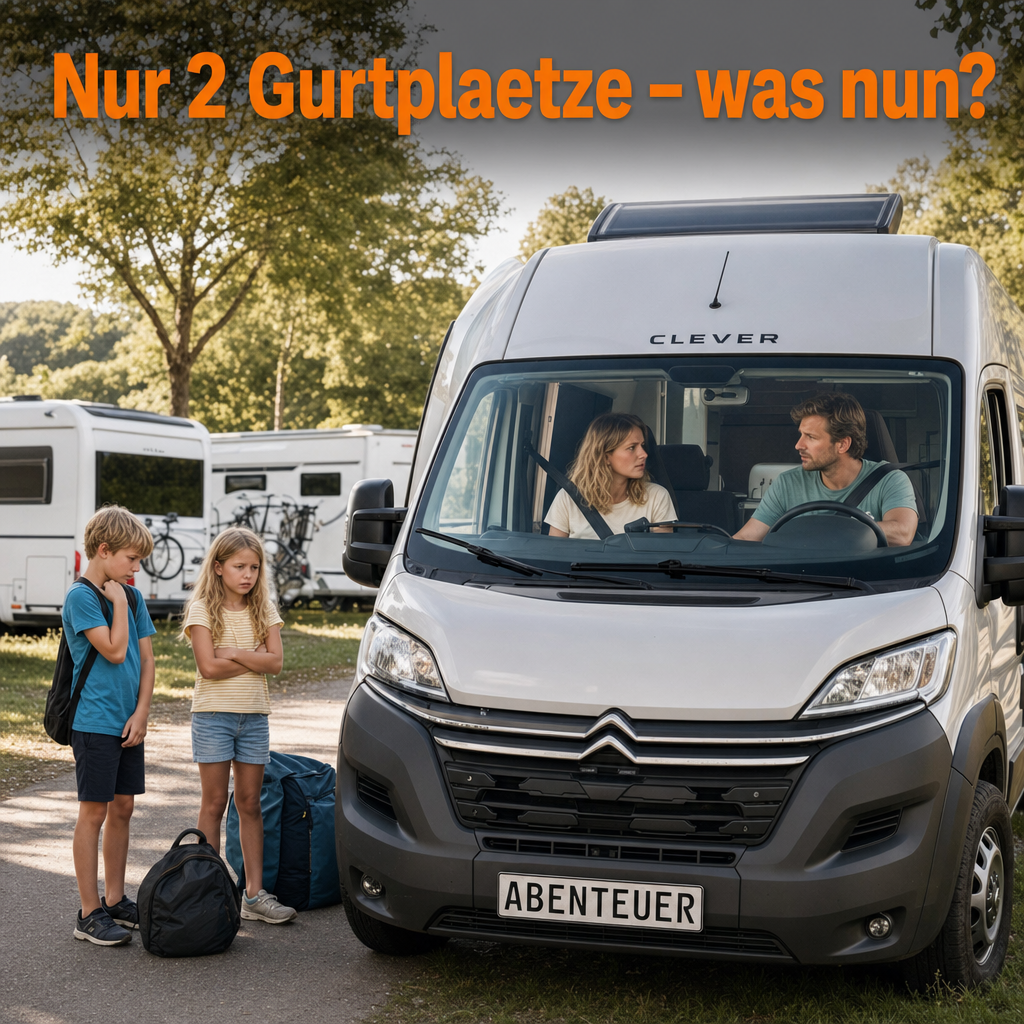
Typical discrepancies in practice:
- Panel van (e.g. VW California, Ford Transit conversion): Usually 2 seatbelts, 2–4 berths.
- Alcove motorhomes: Often 4–6 berths, but only 2–4 seatbelts depending on the model and equipment.
- Integrated motorhomes: Can have up to 6 seatbelts if the seating area is appropriately converted and registered.
- Semi-integrated motorhomes: Varies greatly – between 2 and 5 seatbelts depending on the layout.
Anyone planning a family trip and unfamiliar with the vehicle should always explicitly ask about seatbelts – not berths. This is especially true for Rent a campervan, where you can't physically inspect the vehicle in advance.
Which motorhome models actually offer space for four people?
Motorhomes with genuine four seatbelts do exist, but they are generally larger and heavier than compact panel vans. Anyone who wants to travel legally with four people should consider the following vehicle categories:
- Semi-integrated and integrated motorhomes from approx. 6 metres in length, where the seating area is equipped with three-point seatbelts and registered.
- Alcove motorhomes with converted rear garage and seating area, provided the bench seat is registered as a seatbelt position.
- Larger panel van conversions with a permanently installed rear seating area (e.g. certain Mercedes Sprinter conversions).
Important: Always check the vehicle registration certificate even with these vehicles. The manufacturer can install a seating area, but if it isn't registered, it doesn't count.
For travel inspiration with larger vehicles, it's worth taking a look at Adventure in Tuscany with a motorhome – it shows how much fun a well-planned trip with the right vehicle can be.
Typical pitfalls when planning a family camping trip
Families with two children are particularly often affected by the seatbelt trap. Here are the most common mistakes:
- Only looking for berths – and then discovering on site that two children don't have a seatbelt.
- Not considering child seats – a child seat needs a suitable Isofix point or at least a stable belt with anchorage. Not every registered seat is suitable for child seats.
- Relying on photos – Brochure photos often show the seating area in the living area without indicating whether it is approved as a belted seat.
- Don't read the rental terms – many rental agreements contain explicit information on the number of people, which is binding.
- Underestimate weight – more people mean more luggage, and that can quickly lead to overloading. More on this in the Guide to Overloading in Motorhomes.
Costs for conversion or retrofitting of additional belted seats
Retrofitting an additional belted seat is technically possible, but not a cheap undertaking. The costs depend heavily on the vehicle and the effort involved.
Rough cost estimate (without guarantee, depending on vehicle and workshop):
- Installation of a body-fixed bench seat with three-point seatbelts: approx. £700–2,100
- TÜV/DEKRA inspection and registration: approx. £85–255
- If applicable, adjustment of the vehicle registration document at the registration office: approx. £25–50
Total costs for an additional seat with seatbelt: realistic £850–£2,550, depending on the vehicle and effort involved. This is worthwhile for your own vehicle that you use long term. For a rental vehicle, the way is simpler: just book a vehicle with sufficient seats with seatbelts.
How do I calculate the actual person capacity of my motorhome?
The calculation is actually simple – if you know where to look.
Step-by-step:
- Open the vehicle registration document (registration certificate part I).
- Find field 1 – this states the number of seats including the driver.
- Check whether all seats are equipped with a seatbelt – in older vehicles, there may be seats without a seatbelt (e.g. middle seat).
- Check child seat compatibility – not every seat is suitable for children under 12 years or under 150 cm tall.
- Keep the permissible total weight (PTW) in mind – more people = more weight. The PTW is also stated in the vehicle registration document.
Formula for the maximum number of people:
Maximum number of people = Registered seats (field 1) AND PTW not exceeded
Both conditions must be met simultaneously. Anyone who has four seats with seatbelts but exceeds the PTW due to the weight of the people and luggage is still driving illegally.
By the way: Anyone interested in the current driving licence regulations that apply in 2026 – such as whether a category B driving licence is sufficient for larger motorhomes – can find answers in the Overview of the new EU driving licence regulation.
What safety risks arise from overcrowding?
Overcrowding is not just a bureaucratic problem, but a real safety risk. People without a seatbelt are extremely endangered in an accident – and at the same time endanger other occupants.
Specific risks:
- Unsecured people become projectiles: In an impact at 50 km/h, a force of several tonnes acts on a 70 kg person. Without a seatbelt, this force hits other occupants or the vehicle structure.
- Airbags only protect belted people – they can even become a danger to unsecured occupants.
- Increased weight changes driving behaviour: More people than intended can shift the axle load and worsen braking performance.
- Emergency rescue is made more difficult: Rescue workers rely on the registered number of occupants – additional occupants may be overlooked.
FAQ: Seat Belts vs. Sleeping Berths in a Motorhome
Can a child ride on an adult's lap in a motorhome?
No. Every person, including babies and toddlers, needs their own secured seat with a suitable restraint system. This is required by law in Germany and throughout the EU.
Can I sit in the living area while the RV is moving?
Only if the seat is registered in the vehicle registration document and has an approved seat belt. Otherwise, it is illegal.
How many seatbelts does a typical VW California have?
The standard configuration of the VW California has four seats (two in the front, two in the back on the bench seat), provided the rear bench seat is installed. The actual number is listed in the vehicle registration document of the respective vehicle.
Am I allowed to have more people travel in the rented camper than stated in the rental agreement?
No. The rental agreement is based on the registered seatbelts. Taking more people violates the contract and may void insurance coverage.
Can I have seatbelts installed in my campervan/motorhome after purchase?
Yes, but the installation must be carried out professionally, be approved by TÜV or DEKRA, and be entered in the vehicle registration document. This usually costs between 1,000 and 3,000 euros.
Does the seatbelt requirement also apply on campsites or only on public roads?
The seatbelt requirement only applies while driving on public roads. Different rules apply on the campsite itself.
What happens if I have more people in the vehicle than seat belts during a traffic stop?
The driver receives a fine for each unsecured person. The penalties are higher for children without a child seat. In the event of damage, there may be consequences under insurance law.
Does an alcove bed count as a seat with a seatbelt?
No. An alcove bed is a sleeping space, not a belted seat. No one is allowed to lie or sit there while driving.
How do I recognize when renting a motorhome whether a vehicle has four seatbelts?
Ask the landlord directly about the number of seats listed in the vehicle registration document. Reputable providers will provide this information directly and without detours.
Does the seatbelt law also apply abroad?
Yes. Throughout the EU, seat belts are mandatory for all occupants. Different rules may apply in non-EU countries, but the vehicle registration document remains authoritative.
Conclusion: Plan smart, travel safely 🏕️
The distinction between belted seats vs. sleeping berths is not a bureaucratic detail, but a real safety issue. Anyone planning a vacation with family or a group should always check the registered belted seats first before booking – not the beds.
Concrete next steps:
- Check the vehicle registration certificate: Field 1 provides the binding answer to the question of how many people are legally allowed to travel in the vehicle.
- Ask targeted questions when renting: Always ask about seatbelts, not just sleeping places.
- Plan for child seats: Check if the existing seats have Isofix points or suitable belt anchorages for child seats.
- Keep an eye on the weight: More people mean more weight – the permissible total weight must not be exceeded.
- Choosing the right vehicle: Anyone who really wants to travel as a group of four needs a vehicle with four registered seatbelts.
Whoever is looking for the right motorhome for the whole family will find it on Campcruisers a wide selection of vehicles from professional rental companies worldwide - and can specifically filter according to the appropriate number of people. Simple Rent a campervan and drive off carefree!
It's also worth taking a look at for more camping tips and travel inspiration. The best campsites in Europe - Campcruisers Blog or on the Glamping boom and why independence is more important than ever when camping.
Quellen
- Road Traffic Regulations (StVO), § 21a – Seat belt obligation, § 21 – Passenger transport. Federal Ministry for Digital and Transport.
- ECE Regulation No. 14 – Provisions for safety-belt anchorages. UN Economic Commission for Europe.
- ECE Regulation No. 16 – Provisions for safety belts. UN Economic Commission for Europe.
- Federal Motor Transport Authority (KBA): Registration Certificate Part I – Explanations of the fields.
- German fine catalogue (currently valid version): Violations of the seat belt obligation.
Tags: Seatbelts motorhome, sleeping places motorhome, motorhome passenger capacity, motorhome safety, seatbelt obligation motorhome, motorhome hire family, motorhome vehicle registration document, overloading motorhome, camping safety, family camping trip, retrofitting motorhome seatbelts, camping planning

 English
  German
  Spanish
  Italian
  Polish
  Dutch
Dutch  French
  Danish