
Good binoculars save lives. That sounds dramatic, but on the water, the difference between an obstacle recognized in time and a rock seen too late is often a matter of seconds. Binoculars for skippers are essential equipment because they not only increase safety but also significantly improve navigation, the identification of fairway marks, and the observation of weather fronts. Anyone who goes to sea without binoculars forgoes one of the most important tools a skipper can have.
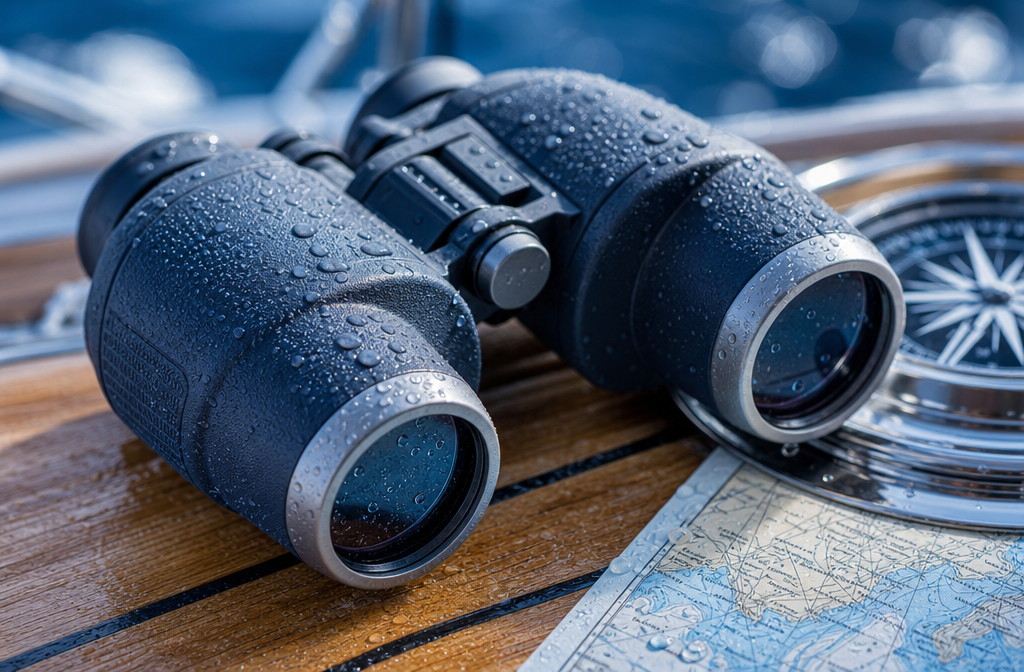
The most important things at a glance
- Marine binoculars are not a luxury, but safety-relevant equipment for every skipper.
- The optimal magnification at sea is 7x, maximum 10x, as higher magnifications become unusable due to boat movements.
- Waterproofness (IPX7 or better) and nitrogen filling are indispensable for maritime binoculars.
- Good entry-level models cost between 80 and 200 Euros, professional marine binoculars 300 to 800 Euros and more.
- Brands like Steiner, Fujinon, and Nikon are considered the gold standard in the maritime sector.
- Normal land binoculars are often unsuitable on a boat, as they are neither waterproof nor sufficiently shock-resistant.
- A built-in compass is a real added value for navigation in marine binoculars.
- Regular cleaning with clear water and a microfiber cloth significantly extends their lifespan.
What are the most important features of marine binoculars?
Marine binoculars must function under conditions that quickly destroy normal binoculars: saltwater, spray, shocks, and changing light conditions. The most important features are waterproofness, shock resistance, good twilight performance, and stable optics at moderate magnification.
The key features at a glance:
| Property | Recommendation for the sea |
|---|---|
| Magnification | 7x (ideal), max. 10x |
| Objective lens diameter | 50 mm (good light gathering) |
| Waterproofness | IPX7 (1 m, 30 Min.) or better |
| Filling | Nitrogen or Argon (no fogging) |
| Prism type | Porro or Roof |
| Compass | Recommended built-in |
| Coating | Fully coated, multi-layered |
An objective lens diameter of 50 mm ensures that sufficient brightness enters the eyepiece even in poor light conditions, i.e., at dusk or on cloudy days. This is not a luxury at sea, but everyday life.
What magnification do I need on a sailboat
On a sailboat, less is often more. A magnification of 7x is the smartest choice at sea, because higher magnifications transmit the boat's movements so strongly that the image jitters and is hardly usable.
Those who are on a motor yacht with a stable stance can consider up to 10x. Anything higher, i.e., 12x or 16x, makes little practical sense on a moving boat because the image shakes too much. For houseboat owners on inland waters, where the movement is significantly less, a 10×50 combination can also work well.
Rule of thumb: 7×50 is the maritime classic. This combination offers the best balance of magnification, light intensity, and image stability on the water.
Are waterproof binoculars really important when sailing
Yes, absolutely. Waterproofness is not an optional extra for marine binoculars, but a basic requirement. Saltwater, rain, and spray can permanently damage non-waterproof binoculars within a few trips.
Pay attention to the IPX protection class. IPX7 means the device can withstand immersion in 1 meter of water for 30 minutes. Some models are even certified to IPX8 and are therefore even more robust. Additionally, the interior should be filled with nitrogen or argon so that no internal fogging occurs due to temperature fluctuations. This is particularly relevant when moving from the cool cockpit to the cabin.
Using non-waterproof binoculars on a boat is like taking a smartphone to the sea without a case. It works for a while, but eventually, it backfires.
Which brands are best for marine binoculars
Three brands dominate the maritime market with consistently good quality: Steiner, Fujinon, and Nikon. Each has its strengths, depending on budget and intended use.
- Steiner (Germany): Considered the benchmark for robust marine binoculars. The Navigator Pro series is widely used by professional skippers and coast guards worldwide. Very shock-resistant, excellent optics.
- Fujinon (Japan): Particularly known for the Polaris series. Very good light transmission and clear image, popular with offshore sailors.
- Nikon (Japan): Offers a very good price-performance ratio for recreational sailors with the Action EX series.
- Leica and Zeiss: Optically excellent, but in the premium price segment. Oversized for most recreational skippers.
For houseboat owners on inland waters who occasionally also venture into coastal areas, Nikon or Bushnell offer solid entry-level options.
How much do good binoculars for sailors cost
Good marine binoculars are available in three price ranges, which differ significantly in quality and durability.
| Preisklasse | Preisspanne | Für wen geeignet |
|---|---|---|
| Beginner | 80 – 200 Euros | Occasional sailors, inland waters |
| Middle class | 200 – 400 Euros | Regular coastal trips |
| Professional | 400 – 800+ Euros | Offshore, professional sailors, long voyages |
Below 80 Euros, it's hard to find anything sensible among genuine marine binoculars with IPX7 certification and decent optics. Those who sail regularly should budget at least 150 to 200 Euros. This is a one-time investment that will last many years with good care.
What should I consider when buying marine binoculars
When buying, five key points are important, which determine usability and durability.
- Waterproofing check: At least IPX7, better IPX8. Always check the certification in the data sheet, not just advertising promises.
- Choose magnification: 7x for sailboats, maximum 10x for motorboats with stable footing.
- Objective lens diameter: 50 mm for good twilight performance, 42 mm as a compact compromise.
- Compass built-in: Very practical for bearings without an additional device.
- Weight and ergonomics: Heavy binoculars tire quickly. Under 900 grams is more comfortable at sea.
A frequently overlooked aspect is the field of view. A wide field of view (at least 100 m at 1000 m) makes it significantly easier to track moving targets on the water.
What mistakes do beginners make when buying marine binoculars?
The most common mistake: buying too much magnification. Beginners think more magnification means better vision, but on a moving boat, the opposite is true. A 10x50 binocular sounds impressive, but on a sailboat in waves, it's often barely usable.
Other typical mistakes:
- Using non-waterproof land binoculars on the boat
- Buying cheap models without nitrogen filling that fog up from the inside
- Forgoing the built-in compass and missing it later
- Underestimating the weight and then struggling with heavy binoculars
- Not checking for strap loops, although a good neoprene strap is essential at sea
Difference between prism binoculars and opera glasses at sea
Prism binoculars (Porro or roof prism) are clearly superior for maritime use. Opera glasses have too little magnification, no waterproofing, and are not designed for the light conditions at sea.
Porro prisms tend to offer better brightness and depth perception at the same price. Roof prisms are more compact and robust, but cost more for comparable optical quality. For sailors without a tight budget limit, roof prism models from Steiner or Fujinon are a good choice. Those who want to save money often get more optics for their money with a Porro prism model.
Can I also use normal binoculars on the boat?
In the short term, yes; in the long term, no. Normal land binoculars are not designed for saltwater, spray, and the humidity at sea. After a few trips, fogging, corrosion, and mold inside can render the device unusable.
Those who are only occasionally on calm inland waters, for example on a houseboat on a river or lake, can get by with robust, splash-proof land binoculars (IPX4). However, as soon as coastal trips, saltwater, or rough conditions are involved, a true marine binoculars with IPX7 is the only sensible choice.
How do I care for and clean my marine binoculars?
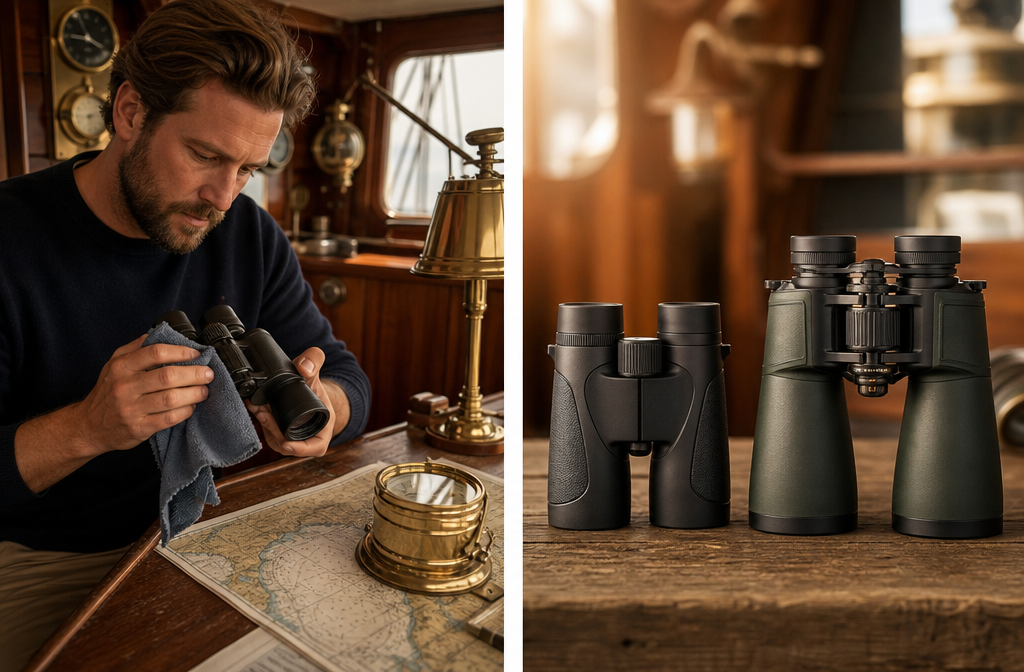
Regular maintenance is the decisive factor for the longevity of marine binoculars. After every trip on saltwater, the binoculars should be rinsed with clear fresh water to remove salt crystals that attack the coatings.
Care instructions step by step:
- After the trip: Rinse the exterior with clear tap water.
- Lenses: Clean only with a clean microfiber cloth or a lens brush, never with paper or clothing.
- Rubber armor: Wipe with a damp cloth, rub dry.
- Storage: Dry, in the supplied bag, not in direct sunlight.
- Once per season: Check if the seals are still intact.
What you should never do: Apply solvents, alcohol, or cleaning sprays to the lenses. This will permanently destroy the coating.
For which types of sailing are high-quality binoculars indispensable?
The more demanding the area, the more important the binoculars. For offshore sailors and long-distance cruisers, high-quality marine binoculars are absolutely indispensable because, in doubt, they decide on the safety of the entire crew.
But they are also more than useful for houseboat owners and coastal cruisers:
- Houseboat owners on inland waters: For early detection of locks, bridges, fairway markings, and other boats.
- Coastal cruisers: For navigation from buoy to buoy and reading lighthouse signals.
- Offshore sailors: For spotting ship traffic, weather formations, and coastlines at long distances.
- Racing sailors: For observing starting lines, marks, and wind shifts on the horizon.
Anyone cruising with a houseboat through the Dutch waterways or the Mecklenburg Lake District will quickly notice how often a good pair of binoculars makes life on board easier.
Are expensive binoculars really better than cheap models?
In most cases yes, but the added value depends heavily on the intended use. Expensive models offer measurably better optical quality, more robust housings, and more reliable seals. This is particularly noticeable in low light and harsh conditions.
For an occasional sailor on calm inland waters, a €150 model from Nikon or Bushnell is perfectly adequate. For someone who regularly sails on the Baltic Sea or the Atlantic, investing in a Steiner or Fujinon model from €300 upwards pays off in the long run because it simply lasts longer and performs better under pressure.
The price-performance sweet spot for most recreational skippers is between €150 and €350.
Frequently asked questions about marine binoculars
What magnification is best at sea? 7x is the maritime standard. Higher magnifications become unusable due to ship movements.
Do I need a built-in compass? Highly recommended. A built-in compass allows for bearings without additional equipment and is a real advantage at sea.
What does IPX7 mean for binoculars? The device is waterproof up to 1 meter deep for 30 minutes. This is sufficient for spray, rain, and brief immersion.
Can I use binoculars with image stabilization on the boat? Yes, and they are very useful, but expensive. For most recreational sailors, a 7×50 without stabilization is the better choice.
How long do good marine binoculars last? With regular care, easily 10 to 20 years. Cheap models often only last 2 to 3 seasons.
Are binoculars with a rangefinder useful? Mostly oversized for leisure skippers. Useful for regatta or professional sailors.
What is the difference between nitrogen and argon filling? Both prevent fogging from the inside. Argon has slightly smaller molecules and seals minimally better, the difference is hardly noticeable in practice.
How do I transport binoculars safely on board? In a padded bag with a neoprene shoulder strap. Always store them secured so they don't fall during rolling movements.
Binoculars for skippers: This is what you should do now
Binoculars for skippers are part of the basic equipment because they combine safety, orientation, and enjoyment of sailing in a single device. Anyone who has been on the water with good 7x50 marine binoculars will never want to be without them again. The investment of 150 to 300 Euros for a solid mid-range model is one of the smartest expenses a skipper can make, considering the lifespan and the increase in safety.
For those who are just planning to try out life on a boat without having to buy their own ship immediately: Houseboats offer the perfect entry. You get to know life on the water, test your equipment, and enjoy the freedom of the water without long-term commitment.
Ready for a houseboat vacation? Book your houseboat now with Campcruisers and experience how good binoculars will elevate your trip to a whole new level.


 English
  German
  Spanish
  Italian
  Polish
  Dutch
Dutch  French
  Danish