
Every year, dozens of boat fires are registered in German waters, and a surprisingly high proportion of them are due to improper grilling. Anyone planning a houseboat vacation who doesn't want to forgo barbecue evenings should know: Grilling on board is absolutely possible, great fun, and for many, it's the best part of the water experience. But grilling on board: Knowing and consistently implementing safety tips for open fires on the water is not an optional extra, but the basic requirement for the evening to remain a pleasant memory.
The most important things at a glance
- Gas grills and electric grills are significantly safer for boats than charcoal or open fire grills
- Maintain a minimum distance of 50 cm between the grill and all flammable surfaces
- A certified fire extinguisher (at least 1 kg, class ABC) must always be readily accessible
- Never grill when the boat is in motion or in strong winds
- In many German states and on certain waterways, open fires on board require a permit or are prohibited
- Heat protection mats under and behind the grill effectively protect the deck and furniture
- Grill brackets with swivel arm and safety lock are part of the standard equipment
- Never leave the grill unattended, not even for a moment
What are the most important safety rules for grilling on a boat?
When grilling on board, the same basic principles apply as on land, but the risks multiply: a burning boat on the water is harder to abandon, harder to extinguish, and often endangers third parties. The three most important rules are: keep your distance, have extinguishing agents ready, and never grill unattended.
The most important safety rules at a glance:
- Choose location: Always place the grill at the stern of the boat, never in enclosed or semi-enclosed areas
- Distance: At least 50 cm distance to terrain, furniture, upholstery, and cable conduits
- Fire extinguisher: Always directly next to the grill, not stowed somewhere else on the boat
- No movement: Only use the grill when the boat is moored
- Consider wind: With wind force 3 or more, it's better to forgo grilling
- Alcohol and fire: Caution, those who have grilled should not steer the boat at the same time
Typical mistake: Many boaters place the grill on the foredeck because there is more space there. This is dangerous because sparks can drift towards the cabin.
Which grill types are best suited for boats?
Gas grills and electric grills are recommended for boats because they produce no embers, no ash, and no uncontrollable sparks. Charcoal is generally problematic on the water.
| Grill type | Security | Practicality | Recommendation |
|---|---|---|---|
| Gas grill (propane/butane) | High | Very good | Best choice |
| Electric grill | Very high | Good (mains power required) | Ideal for houseboats |
| Charcoal grill | Low | Bad | Not recommended |
| Pellet grill | Medium | Medium | Conditionally suitable |
What to look out for with gas grills: Check hose and connections for leaks before each use. Always store gas cylinder upright and outdoors, never in the cabin.
Electric grills are the safest option on houseboats with shore power supply, as there is no open flame and no gas cylinders need to be on board.
How do I prevent fires when grilling on the water?
Fires when grilling on board almost always arise from three causes: too little distance, unattended grilling, and grease fires. Anyone who consistently controls these three points drastically reduces the risk.
Concrete measures for fire prevention:
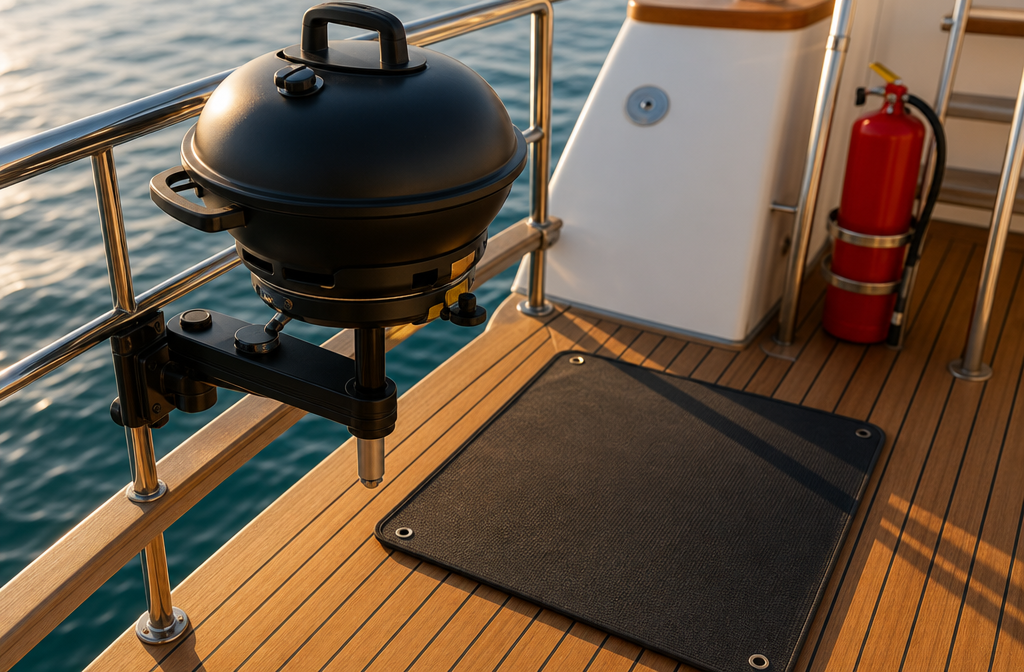
- Place heat protection mats (ceramic fiber reinforced) under and behind the grill
- Use a grill pan with a drip tray to avoid grease drips
- Do not use methylated spirits or liquid grill starters, only solid starters or gas starters
- Keep the grill grate clean so that old grease does not ignite
- Never pour water on a grease fire, always use a fire blanket or fire extinguisher
Decision rule: If the grill would remain unattended for more than 30 minutes, it must be completely switched off, not just throttled down to a low setting.
What do I need to consider for fire prevention on board?
Fire prevention on a boat begins long before lighting the grill. The boat itself must be checked for fire risks before the first barbecue takes place.
Checklist before the first barbecue:
- Check fire extinguisher for expiry date (maintenance every two years)
- Test smoke detectors in the interior of the boat
- Keep a fire blanket readily accessible in the exterior area
- Check gas hoses and connections with leak detection spray
- Keep escape routes clear, do not store grilling equipment in front of doors or hatches
- Remove flammable materials (upholstery, ropes, tarpaulins) from the grill area
Rule of thumb: What is considered a safety distance at a campsite doubles on a boat because escape options are limited.
How much do fire extinguishers for boats cost?
A suitable fire extinguisher for boats costs between 25 and 80 Euros, depending on size and approval. For the grill area on a houseboat, an ABC powder extinguisher or CO2 extinguisher with at least 1 kg content is recommended.
Indicative prices (as of 2026):
- Small ABC powder extinguisher (1 kg): approx. 25-35 Euros
- CO2 extinguisher (2 kg, gentle on electronics): approx. 50-70 Euros
- Fire blanket (additionally recommended): approx. 10-20 Euros
- Maintenance every two years: approx. 15-30 Euros
Important: Not every household fire extinguisher is certified for use on the water. Pay attention to the "Marine" marking or approval according to EN 3. Some boat rental companies provide fire extinguishers, but your own inspection is still mandatory.
What materials are safest for a boat grill?
Stainless steel and enameled cast iron are the safest materials for boat grills. They do not rust, hardly deform under heat, and are easy to clean.
Stay away from grills with plastic handles without heat protection or painted surfaces that can off-gas at high temperatures. The grill mount itself should be made of marine-grade stainless steel and have a swivel arm with a locking mechanism to prevent the grill from tipping due to wave motion.
What are typical mistakes when grilling on a boat?
The most common mistakes are: grilling in the cabin or under the sun deck, charcoal on a plastic deck, storing gas bottles in the cabin, and using the grill while underway.
The seven most common mistakes:
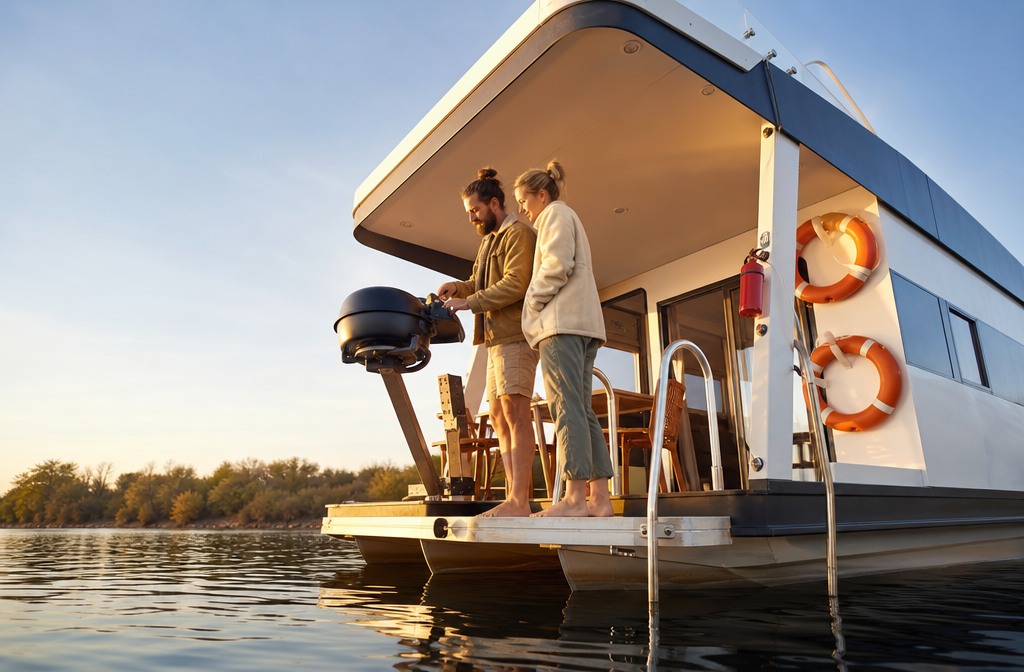
- Setting up the grill on the foredeck instead of the stern
- Using charcoal because "it's faster"
- Not closing the gas bottle after grilling
- Operating the grill on a wobbly folding table without securing it
- Using alcohol as a grill lighter
- Trying to cool the grill with water
- Not having extinguishing agent within reach
How should I behave if the grill on the boat catches fire?
Remain calm, close the gas bottle immediately (if accessible), use a fire blanket or fire extinguisher. Never pour water on a grease fire or gas fire.
Immediate measures in case of a grill fire:
- Send all persons away from the grill area
- Close the gas bottle if safely accessible
- Place a fire blanket over the grill (for grease fires) or use a fire extinguisher
- Call emergency number 110 (police) or 112 (fire department/maritime rescue)
- If the fire cannot be immediately controlled: send all persons into the water or into the dinghy
Critical point: Many people try to throw the burning grill into the water. This can work but carries the risk of burns and should only be chosen as a last resort.
What are the legal regulations for grilling on boats?
In Germany, there is no uniform federal regulation for grilling on boats. The regulations vary considerably depending on the federal state, waterway, and type of boat.
What generally applies:
- On federal waterways (e.g., Rhine, Elbe, Danube), the Inland Navigation Regulations (BinSchStrO) apply, which restrict open fires on board under certain conditions.
- In nature reserves and on certain lakes (e.g., Müritz, Lake Constance), grilling may be completely prohibited.
- Houseboat rental companies often have their own regulations, which are stated in the rental agreement.
- Violations can result in fines, and in serious cases, criminal charges for negligent arson.
Recommendation: Before your houseboat vacation, inquire with the responsible water and shipping authority or the rental company about the rules applicable in your planned cruising area.
Who is grilling on the boat suitable for?
Grilling on board is suitable for experienced boaters and houseboat vacationers who are willing to consistently adhere to safety rules. For families with small children or individuals without experience handling gas appliances, an electric grill is a better choice.
Anyone on a houseboat for the first time should first familiarize themselves with the boat before planning their first barbecue. Many houseboat rental companies offer an introduction where grilling rules are also explained.
How do I protect my boat furniture from grill heat?
Heat protection mats made of fiberglass or ceramic fiber are the most effective solution. They are placed under and behind the grill and protect the deck, upholstery, and wooden surfaces from direct radiant heat and falling embers.
Further protective measures:
- Move cushions and pillows into the cabin while grilling.
- Roll back awnings or sunshades far enough.
- Secure grill mats to the railing with heat-resistant fastening clips.
- After grilling: Let the grill cool down completely before putting on the cover.
Frequently asked questions about grilling on board
Am I allowed to grill on a rented houseboat? This depends on the rental agreement. Many landlords allow grilling with a provided or own gas grill, but prohibit charcoal. Always clarify in writing beforehand.
How do I securely attach a grill to the railing? With a special stainless steel boat grill holder, which is clamped to the railing and has a swivel arm with a locking mechanism. These holders cost between 30 and 80 Euros.
Can I use charcoal on the boat? Generally not recommended. Flying sparks, ash clouds, and difficult-to-control embers make charcoal on boats an unnecessary risk.
What do I do if there is no fire extinguisher on board? Do not grill. A fire extinguisher is not optional equipment, but mandatory as soon as open flames are used on board.
How long do I have to wait for the grill to cool down? For a gas grill, at least 30 minutes after switching it off. For charcoal (if used anyway), at least two hours, preferably overnight.
Is it safe to grill on the water in the rain? Light rain is not a problem for a gas grill if the grill is covered. Always refrain from grilling during thunderstorms or heavy rain.
Do I have to inform the landlord if I want to grill? Yes, absolutely. Many landlords have specific rules and want to be informed. Furthermore, the landlord can give valuable tips on the grilling area of the respective boat.
Conclusion: Grilling evenings on the water are unforgettable if you approach it correctly
Grilling on board: Knowing the safety tips for open flames on the water makes the difference between a perfect evening on the water and an emergency. The good news: with the right type of grill, the appropriate equipment, and a little preparation, a barbecue on a houseboat can be one of the most beautiful moments a water vacation can offer.
Concrete next steps:
- Buy a gas or electric grill with a boat mount or ask the landlord
- Obtain a fire extinguisher (ABC, at least 1 kg) and a fire blanket
- Inquire about the applicable grilling rules for the area with the landlord or the water and shipping authority
- Pack heat protection mats
- Discuss the safety rules with all fellow travelers before the first barbecue starts
Ready for your houseboat vacation? Book your houseboat now with Campcruisers and experience unforgettable barbecues on the water, with all the comforts and the right preparation.


 English
  German
  Spanish
  Italian
  Polish
  Dutch
Dutch  French
  Danish