
Every year, thousands of families experience unforgettable holidays on the water—but according to an analysis by the German Institute for Ship Safety, falling overboard is one of the most common causes of accidents on recreational boats in Europe. Those traveling with children on board bear a special responsibility. Safety on the houseboat: Rules for families with children is not a bureaucratic duty program, but the foundation for a relaxed, happy holiday where everyone arrives back safe and sound.
What are the most important safety rules for children on a houseboat?
The most important rules can be reduced to three principles: Always wear a life jacket, define clear restricted zones on deck, and never leave children unsupervised near the water. Everything else builds on these three points.
Specifically, this means for daily life on board:
- Life jackets are put on before the boat departs and remain on as long as children are on deck.
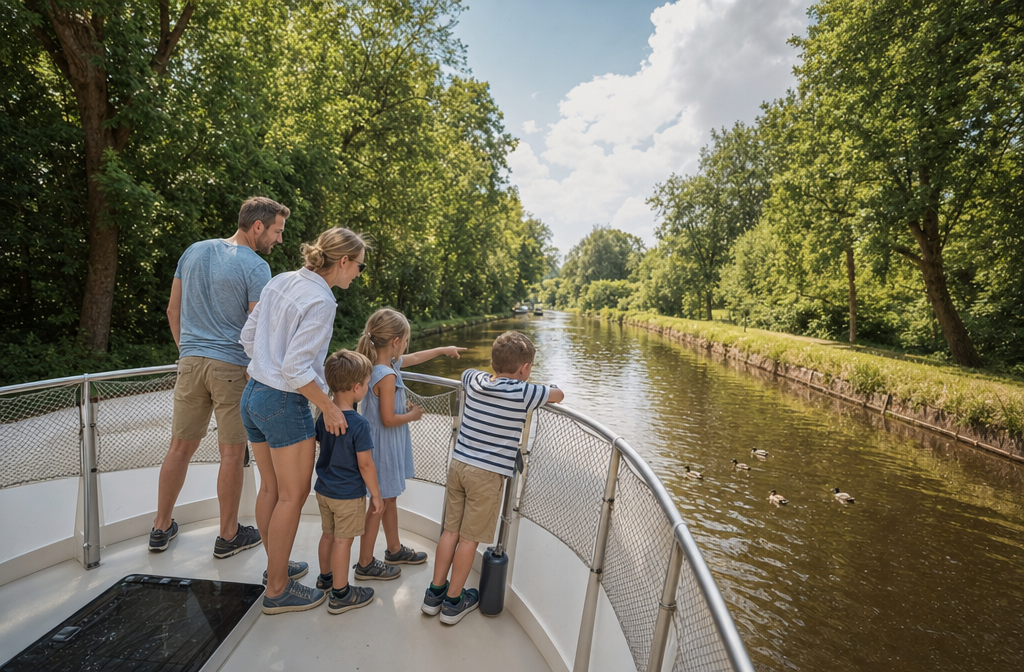
- Safety net or railing must be attached to all open sides of the deck, especially on boats without raised gunwales.
- Communicate clear rules: Children quickly learn which areas are off-limits (helm station without adults, stern during maneuvering).
- Non-slip coverings on the deck significantly reduce the risk of falling, especially when children have wet feet.
- Emergency numbers (110, 112, ADAC Wasserwacht) should be posted clearly visible.
Safety on the houseboat doesn't begin on the water, but when boarding the boat.
Which age groups are best suited for a houseboat holiday?
Houseboat holidays generally work for all age groups, but children from around 4 years old enjoy the experience the most and can actively participate. Toddlers under 2 years old pose the biggest challenge because they have no awareness of danger yet and require constant supervision.
Rough guide by age:
| Age group | Suitability | Special features |
|---|---|---|
| 0–2 years | Possible, but demanding | Maximum supervision, playpen recommended |
| 3–5 years | Good with preparation | Life jacket always, close supervision |
| 6–10 years | Very good | Can understand and follow rules |
| 11+ years | Excellent | Can actively help with steering |
Families with children under 3 years should choose shorter routes and book a boat with a closed lower deck so that toddlers have a safe retreat.
What do I need to pay special attention to with children under 5 years
Children under 5 years cannot assess how quickly they can fall into the water, and even good swimmers at this age can be overwhelmed on a moving boat. Therefore, the rule is: not a single moment without a direct line of sight to an adult.
Additional measures for the youngest:
- Playpen or travel cot with safety harnesses for sleeping and resting periods on board
- Safety lines (harness) for toddlers who are still unsteady on their feet
- Entry hatch and stairs secure with child locks
- Sun protection take particularly seriously, as reflection from the water doubles UV exposure
- Never let children play alone in the cockpit or on the aft deck
How can I prevent my children from falling overboard
The risk of falling overboard can be reduced to a minimum through structural measures and clear behavioral rules. The combination of safety nets, non-slip flooring, and consistent life jacket wear has proven to be the most effective.
Checklist for man overboard situations:
- Safety net or railing at least 60 cm high on all open deck sides
- Non-slip mats on the entire outer deck
- Life jacket with safety harness for children under 8 years old
- Clearly mark "Red Zones" (e.g., with colored tape): areas children are not allowed to enter
- Always have the boarding ladder ready at the stern so that a child can climb back on their own in an emergency
- At least one adult always remains on deck when children are outside
Which life jackets are best suited for children
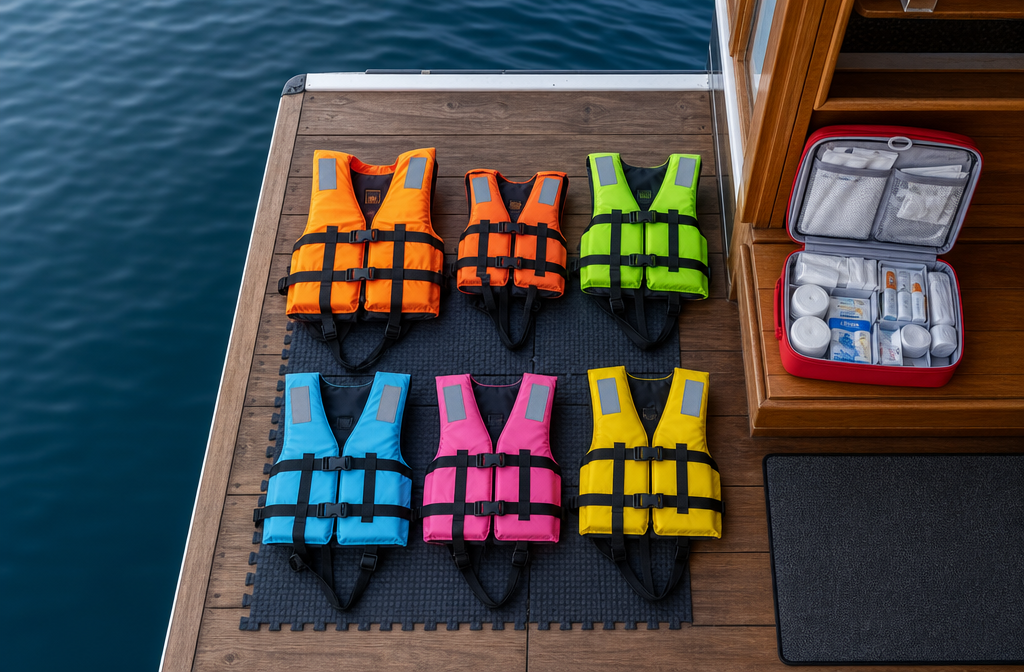
For children on houseboats, experts recommend life jackets of category 100 N or higher, which inflate automatically or keep the head of an unconscious child above water. Cheap foam vests from the supermarket are not sufficient for a houseboat holiday.
What to look for when buying:
- Buoyancy class: At least 100 N for inland waters, 150 N for more open lakes
- Fit: The vest should not slip over the ears — perform the thumb test
- CE marking according to ISO 12402 is mandatory
- Crotch-Strap: Prevents the vest from slipping upwards
- Color: Signal colors (orange, yellow) increase visibility in the water
For small children up to 15 kg, there are special baby life jackets with a headrest. These are more expensive, but indispensable.
Costs for safety equipment on a houseboat
A solid basic set of safety equipment for a family with two children costs between 150 and 400 Euros. Many houseboat rental companies provide basic equipment, but you should always bring your own child life jackets in the correct size or inquire in advance.
Approximate cost points (as of 2026):
- Child life jacket (100–150 N, CE certified): 40–90 Euros per piece
- Safety net for railing (retrofit kit): 30–70 Euros
- Non-slip deck mats: 20–50 Euros
- First-aid kit (maritime): 25–60 Euros
- Safety line/harness for toddlers: 20–40 Euros
Anyone booking a boat through Campcruisers should carefully check the equipment list of the respective boat and obtain any missing safety equipment in good time before departure.
Differences between safety on a river and lake houseboat
River houseboats and lake houseboats present different safety requirements. On rivers, current is the greatest risk; on lakes, sudden gusts of wind and waves can be more dangerous than expected.
River vs. Lake in comparison:
- River: Current can quickly drift children away, locks are danger zones (children always inside during lock operations)
- Lake: Wave height can increase unexpectedly, life jackets with higher buoyancy (150 N) recommended
- Canal: Calmest waters, ideal for families with very young children
- Coastal waters: Recommended for families with children under 10 years only with an experienced skipper
Are there houseboat routes that are particularly family-friendly
Yes, and the choice of route is one of the most important safety decisions of all. Quiet canal and river routes in Germany, the Netherlands, and France are considered particularly family-friendly because the current is low, locks are well-developed, and many moorings with playgrounds are available.
Top regions for families:
- Mecklenburg Lake District (Germany): Many calm lakes, well-developed marinas, shallow water
- Brandenburg (Germany): Widely branched canal network, hardly any current
- Friesland (Netherlands): Shallow waters, child-friendly infrastructure
- Burgundy (France): Slow canals, picturesque villages, relaxed pace
On Campcruisers you will find houseboats for exactly these regions, filtered by family suitability.
How do I prepare my children for a safe houseboat holiday
Preparation begins at home, not at the jetty. Children who know what to expect and which rules apply behave significantly safer on board than those who board unprepared.
Practical preparation steps:
- Learn to swim: Children from 4 years of age should at least have basic knowledge
- Discuss rules in advance: Life jacket, Red zones, Behavior in case of alarm
- Trial seating with life jacket: So that the child gets used to it
- Practicing emergency calls: Children aged 6 and over can learn how to dial 112
- Watching the boat movie: Short YouTube videos about building houseboats awaken curiosity and respect
What first-aid equipment do I need on board?
Every houseboat with children on board needs a complete maritime first-aid kit that goes beyond the standard household box. Especially important: wound care for cuts, medication for seasickness, and a thermal blanket.
Minimum contents of the onboard first-aid kit:
- Sterile wound dressings and plasters in various sizes
- Elastic bandages and compression bandages
- Disinfectant (waterproof packaging)
- Tweezers (for splinters and fish hooks)
- Emergency blanket (gold-silver)
- Medication for seasickness (e.g. dimenhydrinate, consult with a doctor)
- Include laminated emergency numbers
Are houseboats suitable for children with aquaphobia?
Yes, often even better than expected. Houseboats are stable, spacious, and feel more like a holiday home than a boat. Children with mild aquaphobia often get used to the water faster when they can explore it at their own pace from the safe deck.
Tips for children with water phobias:
- Choose short routes on quiet canals, no open lakes at the beginning
- Never force a child to swim
- Emphasize safety net and railing as a visible protective barrier
- Look into the water together from the jetty before the boat departs
- Create positive experiences on the water: feeding ducks, fishing, observing fish
Common mistakes families make regarding houseboat safety
The most common mistake is to "briefly" forgo the life jacket because the boat is just anchored or moving slowly. It is precisely in these moments that most accidents happen because parental attention wanes.
The five most common mistakes:
- Wear a life jacket only when moving, not when docking or anchoring
- Let children play unattended on the aft deck
- No clear rules discussed before departure
- Forgetting the first-aid kit or it being expired
- Overtired parents take the helm (fatigue is an underestimated safety risk)
Frequently asked questions
At what age can children be on deck without adults? That depends on the child, but as a rule of thumb: never alone on deck under 10 years old, between 10 and 14 years old only when the boat is anchored and parents are in sight.
Do I need special boating knowledge to rent a houseboat with children? For most providers, a brief on-site introduction is sufficient. A license is not required on many inland waters, but an introduction by the lessor is mandatory and should be taken seriously.
How many adults should be on board at a minimum when children are traveling? At least two adults. This way, one can steer while the other keeps an eye on the children.
What to do if a child falls into the water? Stop immediately, throw a lifebuoy, turn off the engine (propeller danger), pull the person into the boat. Call emergency services 112, even if the child appears unharmed.
Are houseboats safe for children at night? Yes, if the boat is securely moored and children sleep indoors. Children should not be alone on deck at night.
What insurance do I need for a houseboat holiday with children? Liability insurance is mandatory. Travel health insurance with emergency transport is strongly recommended, especially in remote areas.
Can you steer a houseboat without experience with children? Yes, this is possible on calm canals and inland waters. The on-site briefing is sufficient for most routes. For lakes or rivers with strong currents, prior experience or an experienced fellow passenger is advisable.
Conclusion: Safe on board, relaxed enjoyment
Safety on a houseboat with children is not rocket science, but it requires preparation and consistency. Those who buy the right life jackets, communicate clear rules, choose the appropriate route, and don't forget the first-aid kit create the conditions for a holiday that will be remembered fondly. Children who learn to respect the water will love it for a lifetime.
The next step is simple: choose a route, choose a boat, set off.
Ready for your houseboat holiday? Book your houseboat now with Campcruisers and experience why families keep returning to the water.


 English
  German
  Spanish
  Italian
  Polish
  Dutch
Dutch  French
  Danish