
Last updated: May 24, 2026
Quick Answer: A cassette toilet is a compact, self-contained toilet solution for motorhomes and campervans. It consists of a permanently installed upper section with a flushing mechanism and a removable wastewater tank (the "cassette"), which is removed via a side flap on the vehicle and emptied at special disposal stations. For most camping beginners, it is the most practical and hygienic solution on the go.
Key Takeaways
- A cassette toilet consists of two main parts: the permanently installed upper section with a fresh water tank and the removable waste water cassette (approx. 15–21 liter capacity).
- The cassette is removed via an external service hatch on the vehicle and emptied at disposal stations (campgrounds, rest areas).
- Chemicals in the wastewater tank reduce odors and break down waste—nowadays there are biodegradable alternatives.
- Acquisition costs typically range between €150 and €500, depending on the model and installation effort.
- It's ideal for RVs, campervans, and small boats; there are better alternatives for permanent campers with a fixed water connection.
- The most common mistakes: using too little rinse water, mixing the wrong chemicals, and emptying the cassette too infrequently.
- Installation is easy on prepared vehicles; retrofitting requires craftsmanship or a specialist workshop.
- Disposal is clearly regulated in Germany and the EU: Wastewater may only be disposed of at designated stations.
What is a cassette toilet and how does it differ from normal toilets?
A cassette toilet is a self-contained sanitation solution that does not require a permanent drain. Unlike a household toilet, which is directly connected to the sewer system, it collects wastewater in a portable tank that is manually emptied on a regular basis.
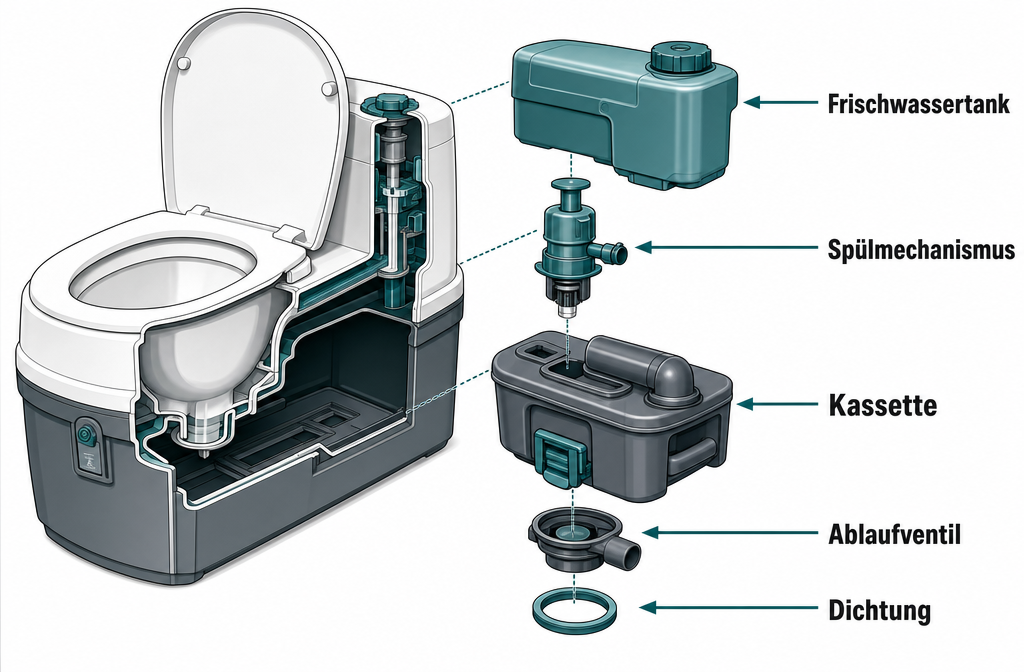
The most important differences at a glance:
| Characteristic | Cassette toilet | House toilet | Chemical Camping Toilet (Portable) |
|---|---|---|---|
| Installation | Secure in the vehicle | Firmly in the building | Portable, no installation required |
| Disposal | Service hatch, external | Sewerage | Manual, everywhere |
| Conditioner | Fresh water tank | Water pipe | Manual / no pressure |
| Hygiene | High | Very high | Medium |
| Kapazität | 15–21 Liters | Unlimited | 10–15 liters |
Detailed Construction — Cassette Toilet: Construction and Function Explained for Beginners:
The toilet consists of three core components:
- Upper part (seat unit): Contains the fresh water tank (approx. 10–15 liters), the flushing mechanism (pump or pressure flush), and the slide valve closure for the waste water tank.
- Waste water cassette: The removable container has a capacity of 15–21 liters. It has its own spout, a vent button for pressure-free opening, and a sturdy carrying handle.
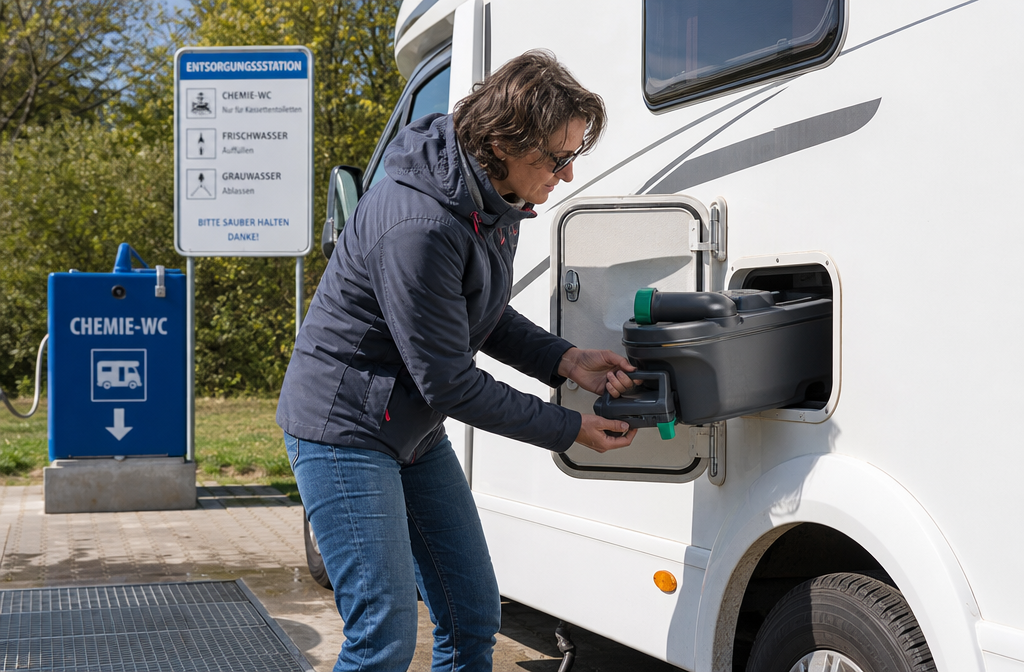
- Service hatch: A sealed exterior flap on the vehicle through which the cassette is removed without entering the vehicle interior.
Note: The slide valve between the upper section and the cassette is the most important seal in the entire construction. Keeping it closed whenever the toilet is not in use reliably prevents odors.
Which RVs and camping situations are best suited for cassette toilets?
Cassette toilets are the standard solution in most compact motorhomes and campervans. They fit anywhere where there is no fixed sewage connection and space is limited.
Ideally suited for:
- Alcove motorhomes and semi-integrated vehicles
- Campervans and converted vans
- Small motorboats and houseboats (for tips about life on the water: Your first houseboat adventure: guide for beginners - Campcruisers Blog)
- Weekend and short trip campers without fixed pitch infrastructure
- Travelers who prefer wild camping or remote campsites
Less suitable for:
- Permanent campers on pitches with sewage connections (a fixed-water toilet is worthwhile here)
- Families with more than 4 people on long-term trips (cassette needs to be emptied too often)
- People with reduced mobility who have difficulty carrying the cassette.
For those who want to rent a motorhome to try out the cassette toilet before buying: On Campcruisers.com Thousands of vehicles from various professional rental companies can be booked — from compact campervans to fully integrated motorhomes. This makes it easy to test the camping life.
How does the disposal and cleaning process work for a cassette toilet?
The cassette is removed, carried to the disposal station, emptied, rinsed, and reinserted. The entire process takes about 5–10 minutes for routine tasks.
Step-by-step instructions:
- Close the slide valve on the upper part (if not already closed).
- Open the service hatch on the outside of the vehicle.
- Unlock and pull out the cassette (carry by the handle).
- Press the ventilation button on the cassette before opening the spout—this prevents pressure buildup and splashing.
- Slowly empty contents into the disposal station (sanitary station at campsites, special rest stop facilities).
- Rinse with clear water until the water runs clear.
- Add fresh chemical (approx. 100 ml) and some water to the cassette.
- Reinsert the cassette, lock it in place, and close the service door.
Find disposal stations: Most campsites in Germany and Europe have their own disposal stations. Apps like Campercontact or Sanidump help you find them on the go.
What do I need to consider when disposing of waste?
Wastewater from cassette toilets in Germany and throughout the EU may only be disposed of at designated disposal stations. Emptying into normal toilets, gullies, or in nature is illegal and can be punished with fines.
Important rules:
- Dispose of only at official disposal stations (campgrounds, rest areas, special service points).
- Never empty into bodies of water, meadows, or public toilets without a disposal function.
- Biodegradable chemicals are subject to less strict regulations in some countries—always check local regulations, however.
- Campsites in South Tyrol and other popular regions sometimes have particularly strict environmental regulations. Current regulations regarding this can be found in the Camping News Overview for South Tyrol.
What costs do I need to budget for a cassette toilet?
The acquisition costs for a cassette toilet range from approximately €150 to €500, depending on the model and features. In addition, there are ongoing costs for chemicals and cleaning agents.
Cost Overview (Estimates, 2026):
| Cost element | Amount (approx.) |
|---|---|
| Entry-level model (e.g. Thetford C2) | 150–200 € |
| Mid-range (e.g. Thetford C223/C403) | €200–€350 |
| Premium model with electric flush | €350–€500 |
| Installation by a specialist company | 100–300 € |
| Chemicals (per season, estimate) | 30–80 € |
| Cleaning agents & Sealing care | 10–20 € |
Tip: Anyone renting a motorhome doesn't pay acquisition costs — the cassette toilet is included as standard. That's a good reason to rent first and then decide whether buying makes sense.
How difficult is a cassette toilet to install and maintain?
Installation is simple in vehicles with pre-installed fittings: insert the cassette, attach the top, fill the fresh water tank — done. Retrofitting in a vehicle without pre-installed fittings requires more effort.
Installation in the prepared vehicle: 30–60 minutes, no special knowledge required.
Retrofitting (no prepared installation bay):
- Cut service hatch into vehicle wall (metal work)
- Fastening and sealing of the upper part
- Total effort: 4–8 hours, recommended to be carried out by a specialist company
Maintenance - What needs to be done regularly:
- After each use: Close gate valve, fill fresh water tank.
- With each emptying: Thoroughly rinse the cassette and add fresh chemical.
- Monthly: Maintain seals and slide valve with special grease (e.g. Thetford lubricant).
- Seasonal: Clean entire unit, check for cracks or wear.
Are there environmentally friendly chemicals for cassette toilets?
Yes, and the market has developed significantly towards biodegradable products in recent years. Classic formaldehyde-containing chemicals are already banned or severely restricted in many European countries.
Overview of chemical types:
| Type | Effect | Environment | Price |
|---|---|---|---|
| Contains formaldehyde. | Very strong, odor-inhibiting | Bad, often forbidden | Inexpensive |
| Formaldehyde-free (conventional) | Good | Medium | Medium |
| Biodegradable | Good to very good | Very good | A little more expensive |
| Enzyme-based | Good, natural decomposition | Excellent | Mid-range |
Recommendation for beginners: Biodegradable products (e.g. from Thetford Bio or Dometic GreenCare) are a good choice — they work reliably, are approved on most campsites and are environmentally friendly. Formaldehyde products should generally be avoided.
What are the most common mistakes when using a cassette toilet?
Most problems with cassette toilets arise from improper use, not product defects. Those who know these mistakes will have a stress-free experience from the start.
The most common errors:
- Insufficient flushing water: Without enough water, residue sticks to the cassette and creates odors. Always flush generously.
- Leave the gate valve open. This is the most common cause of odors in the vehicle. Always close the valve immediately after use.
- Mixing the wrong chemicals: Never combine different products—this can trigger reactions and damage the seals.
- Do not overfill cassette: Empty when about two-thirds full, not when it is overflowing.
- Neglecting seals: Dry seals crack and become leaky. Regular maintenance with lubricant is a must.
- Use regular toilet paper: Only use special, fast-dissolving camping toilet paper — normal paper clogs the cassette.
What problems can occur when using a cassette toilet?
The most common problems are odors, leaky seals, and a blocked slide valve. Almost all of them can be prevented with regular maintenance and correct usage.
Troubleshooting Table:
| Problem | Probable Cause | Solution |
|---|---|---|
| Odors in the vehicle | Valve open, too little chemical | Close valve, refill chemical |
| Gate valve is stuck | Dry seal, contamination | Apply lubricant, clean |
| Cassette is leaking | Cracked seal | Replace seal (spare parts from the manufacturer) |
| Flush not working. | Fresh water tank empty, pump defective | Fill tank, check/replace pump |
| Strong odor despite the chemical. | Wrong chemical, too full | Empty cassette, change product |
What alternatives are there to cassette toilets in the camping and travel sector?
Cassette toilets aren't the best choice for everyone. There are several alternatives with different advantages and disadvantages.
Alternatives at a glance:
- Dry separating toilet (composting toilet): Separates solids and liquids, no water or chemicals needed. Ideal for eco-campers and van life. Higher initial costs (€200–€800), but very environmentally friendly.
- Fixed water toilet with waste water tank: Common in larger RVs. More comfortable, but less flexible and dependent on disposal stations for larger tanks.
- Portable Camping Toilet Affordable (from around €30), no installation required, but less hygienic and comfortable than a cassette toilet.
- Folding toilet / Emergency toilet: Only suitable for absolute emergencies, not for continuous use.
Decision rule: Anyone who does a lot of wild camping and values independence should consider a dry separating toilet. Anyone who mainly stays at campsites and appreciates comfort is best served with a cassette toilet.
What are the water requirements and space requirements of a cassette toilet?
A cassette toilet requires approximately 1–2 liters of fresh water per flush. The fresh water tank typically holds 10–15 liters, which is enough for 6–12 flushes. The space requirement is compact: most models measure approximately 35–45 cm in width and 50–70 cm in height.
Space requirement guidelines:
- Width: 35–45 cm
- Depth: 30–40 cm
- Height: 50–70 cm
- Cassette depth (external): approx. 30 cm (must be available as free space on the outside)
For campervans and converted vans—a segment that is growing strongly in 2026—the compact design is a real advantage. Anyone interested in current vehicle models will find them at new Hymer Redwood in the 6-meter class a good example of modern space utilization in the van segment.
Who is a cassette toilet suitable for, and who is it not suitable for?
A cassette toilet is the right choice for most occasional and active campers who travel with a motorhome or campervan. It is less suitable for people who are permanent campers or have physical limitations when carrying.
Cassette Toilet: Structure and Function Explained for Beginners — Who Benefits Most:
✅ Suitable for:
- Beginners in camping life
- Weekend and vacation camper
- Travelers at campsites and pitches
- All those who value comfort and hygiene on the go
❌ Less suitable for:
- Permanent camper with fixed water connection
- People with limited mobility (cassette weighs approx. 10–15 kg when full)
- Hardcore eco-camper (here the composting toilet is better)
FAQ: Cassette Toilet for Beginners
How often does the cassette need to be emptied?
Typically every 2–4 days for 2 people, depending on frequency of use and cassette size (15–21 liters).
Can I use normal household chemicals?
No. Only use products specially developed for cassette toilets. Household cleaners damage seals and can attack the plastic parts.
Does a cassette toilet in the vehicle smell?
With correct use (closing the valve, sufficient chemical, regular emptying) virtually none. Odors almost always arise from operator error.
Can I empty the cassette in a regular toilet?
Only in toilets that are explicitly designated as disposal stations. Normal household toilets are not suitable and disposal there is prohibited in many municipalities.
How long does a cassette toilet last?
With regular maintenance, easily lasts 10–15 years. Wear parts such as seals and valves are available as spare parts.
Do I need tools for daily use?
No. Removal, emptying and cleaning of the cassette are completely tool-free.
How much does disposal cost at campsites?
At most campsites, the use of the disposal station is included in the overnight price. At rest stops or separate service points, there is sometimes a charge of €1–3.
Can I use the toilet in winter as well?
Yes, but the fresh water tank can freeze in frost. In winter, either heat the vehicle or add antifreeze additive to the fresh water.
Which brands are recommended?
Thetford and Dometic are the most well-known manufacturers with a broad spare parts network in Europe — an important factor for long-term use.
Conclusion: Get started now and enjoy the freedom! 🚐
For camping newcomers, the cassette toilet is the simplest and most hygienic solution on the go. Once you understand the setup and function, you'll realize it's not rocket science. Close the slide valve, empty the cassette in good time, use the correct chemicals — these are the three golden rules.
Actionable Next Steps:
- Try it out before you buy: Rent a camper van with a cassette toilet for a weekend and familiarize yourself with its operation. On Campcruisers.com you can find vehicles from professional rental companies all over Europe — Rent a campervan has never been so easy.
- Plan route: Check in advance where disposal stations are located on your route.
- Get a starter set: Biodegradable chemicals, camping toilet paper and lubricant for the seals - that's enough to get started.
- Building a skincare routine: Maintain seals monthly, never overfill cassette.
Once you've started renting a camper and experienced the freedom of van life, you won't want to miss it again. Whether it's the Black Forest, South Holland, or Tuscany — with the right vehicle and a well-maintained cassette toilet, adventure awaits. For inspiration for your next route: Exploring South Holland by motorhome - Campcruisers Blog or Adventure Italy: Through Tuscany by motorhome - Campcruisers Blog.
Quellen
- Thetford Corporation: Product documentation and user manuals for cassette toilets (C-Series). thetford.com
- Dometic Group: Product specifications sanitary systems for vehicles. dometic.com
- ADAC: Motorhome Sanitary Facilities and Disposal Guide, 2023. adac.de
- German Environment Agency: Information on biodegradable chemicals in the camping sector, 2022. umweltbundesamt.de
Meta Title: Cassette Toilet: Structure & Function for Beginners
Meta Description: Cassette Toilet: Structure and Function Simply Explained. Costs, Disposal, Avoiding Mistakes and Alternatives — the Complete Guide for Camping Beginners 2026.
Tags: Cassette toilet, RV toilet, camping sanitation, rent a camper, rent an RV, camping beginner, Thetford cassette, chemical toilet, camping equipment, RV body, camping disposal station, camping toilet alternative


 English
  German
  Spanish
  Italian
  Polish
  Dutch
Dutch  French
  Danish