
Last updated: May 24, 2026
Quick Answer: Connecting to shore power with a rental RV means you connect the vehicle to the campsite's power supply using a CEE cable (blue 230V plug). This gives you full 230V household power for the refrigerator, air conditioning, coffee machine, and so on — all without the engine running or using the battery.
Key Takeaways 🔌
- CEE cable (blue, 16A) is the standard connection on European campsites — always check first to see if the rental RV has one.
- Most modern rental RVs have a built-in shore power inlet (230V socket on the outside of the vehicle).
- Shore power typically costs at European campsites 3–8 € per night Extra, sometimes included in the parking space price.
- Order of connection is crucial: first cable to the campsite distribution box, then to the RV — not the other way around.
- Too many devices at the same time = fuse blows. With a 16A connection, that's a maximum of approximately 3,500 Watts simultaneously
- Different plug types are used abroad (UK, USA, Australia) — Bring an adapter. or ask the landlord in advance.
- Those who don't have access to shore power can rely on Solar panels, power station or vehicle battery evade.
- When renting a motorhome: always check the rental agreement, which accessories are included.
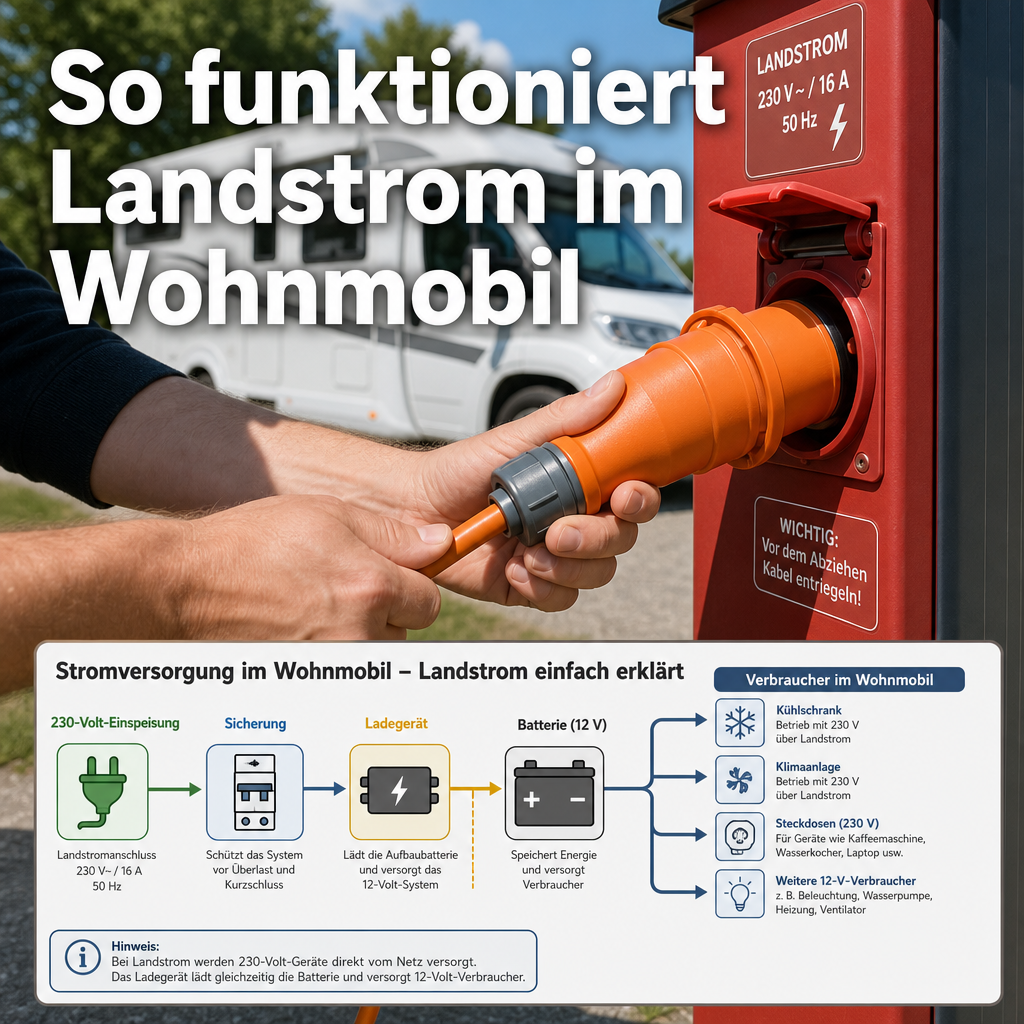
What is shore power and how does it work in a motorhome?
Shore power is simply the 230V alternating current from the campsite's electrical grid — the same as from the socket at home. In the motorhome, there is an external power inlet (a waterproof socket on the outside of the vehicle) through which the vehicle is connected to the campsite grid. As soon as the connection is established, everything that needs 230V runs directly via the grid — the vehicle battery is charged at the same time.
How the system works internally:
- The RV has a Shore power inlet (usually on the left or rear of the vehicle, often with a blue cap).
- Distributed internally a Fuse box the power to the individual consumers (sockets, air conditioning, charger).
- A Battery isolator or DC-DC charger ensures that the auxiliary battery is charged at the same time.
- As long as shore power is connected, the refrigerator automatically runs on 230V instead of gas or 12V.
Important for rental RVs: Not every vehicle is wired identically. Take a quick look at the rental company's instructions - they'll show you exactly where the connection is located.
What adapters do I need to connect shore power?
For European campsites, you generally need no adapter — the blue CEE-17 plug (also known as a "camping plug") is the EU standard. The appropriate cable is included with most rental motorhomes or is available for a fee.
If you do need an adapter:
| Situation | Connector type | Solution |
|---|---|---|
| Older campsites (DE/AT) | Schuko (Type F) | CEE to Schuko adapter |
| Great Britain | Type G (3-pin) | CEE to Type G adapter |
| USA / Canada | NEMA 14-30 or 5-15 | Special travel adapter (check 230V!) |
| Australia / New Zealand | Type I | CEE to Type I Adapter |
| France (older locations) | Type E | Usually CEE compatible, otherwise adapter. |
When renting a motorhome: Ask the landlord if there is a CEE cable (at least 10 meters) in the vehicle. If it is missing, you must bring or buy it yourself — a good 10m CEE cable costs around €20–40.
How much does a shore power connection cost at campsites?
Costs vary depending on the country, campsite, and season. At most European campsites, shore power is either charged as a flat rate per night or metered via an electricity meter at the pitch.
Typical costs (estimates, as of 2026):
- Flat rate per night: 3–8 € (most common variant in Germany, Austria, Netherlands)
- Consumption-based €0.30–€0.80 per kWh (at more modern pitches with a meter)
- Included in the pitch price: On some premium pitches or motorhome stopovers
- No power supply: Wild camping spots, simple natural sites
On the best campsites in Europe Shore power is now standard — but always ask in advance or check online.
Step by step: Connecting shore power in a rental camper van
This is easier than it sounds. Here is the correct order—the order matters, because otherwise you risk sparks or arcs.
Here's how it works:
- Turn off the circuit breaker at the campsite distribution box. (if available and accessible).
- CEE cable Remove from the storage compartment and check for damage (cracks, bare spots).
- Cable first into the campsite distributor. plug in (the red or blue column at the parking space).
- Then the other end. Plug into the shore power socket on the RV and let it latch.
- Turn on the circuit breaker at the distribution board. — the shore power indicator should now light up in the RV.
- Check: Test socket in the RV, refrigerator is running on 230V.
When disconnecting: reverse order – first cable from the RV, then from the distribution box.
How do I prevent electrical problems when connecting to shore power?
Most problems are caused by damaged cables, incorrect connectors, or overloading. With a few simple rules, this can almost always be avoided.
The most common causes and how to avoid them:
- Damaged cable: Check briefly before each trip – cracks in the casing are a no-go.
- Wet cable/plug: Only connect when plugs are dry. In case of rain, wait briefly or cover them.
- Incorrect plug size: CEE 16A (blue) for 230V — never use CEE 32A (red, that is three-phase current).
- Cable too tightly stretched. Always lay with a loop so there is no strain on the connector.
- Overload: Do not operate the air conditioner, kettle, and hair dryer at the same time (more on this below).
Safety rule: Never use an extension cord without a grounding conductor. Grounding is mandatory for motorhomes.
What mistakes am I making when connecting to shore power for the first time?
The same mistakes always happen the first time around - that's perfectly normal, but avoidable.
Top 5 Beginner Mistakes:
- Cable to the RV first. plugging in instead of connecting to the distribution block — increases the risk of arcing.
- Do not allow the cable to latch. — the CEE plug has a locking mechanism that audibly clicks into place.
- Cable too short brought along—10 meters is the minimum, 15–20 meters is better.
- Fuse not found in the RV. — she usually sits in a small box inside the vehicle (read the instructions!).
- Forgot to disconnect the cable. before you drive off - that rips the pants out of the vehicle.
Wer ein Rent a campervan, should always briefly show where the shore power connection is located and whether a cable is included when handing over the vehicle.
Can I use shore power with any RV?
Almost all modern rental RVs (built around 2005 or later) have a shore power connection as standard. Older vehicles or simple camper vans (converted vans) sometimes do not have it.
Motorhomes with shore power connection:
- Fully integrated motorhomes ✅
- Partially integrated motorhomes ✅
- Alcove Motorhomes ✅
- Modern panel vans (e.g. Fiat Ducato-based) ✅ (mostly)
- Simple DIY campervans ❌ (often only 12V system)
Differences between caravans and motorhomes: The principle is identical with caravans — they also have a CEE socket on the outside. The only difference: caravans don't have a vehicle battery that is charged via shore power. Motorhomes usually have a more sophisticated on-board system with battery management.
At the Rent a campervan At Campcruisers you can find professional rental companies that can tell you exactly which accessories are included in the vehicle in advance.
What happens when the shore power fuse blows?
The fuse blows when too much current flows at the same time—either because too many devices are running or because a device has a short circuit. This is not a defect, but a protective function.
What you do then:
- Switch off devices — at least one of the power-hungry devices (air conditioner, kettle, hair dryer).
- Check the fuse box in the RV — reset the tripped breaker (toggle switch or push button).
- Also check the distributor at the parking space — sometimes the fuse trips there.
- If she gets kicked out again immediately: Check the device for defects or contact the landlord.
How many electrical devices can I operate simultaneously using shore power?
With a standard 16A connection (230V), you have approximately: 3,680 Watts available. That sounds like a lot, but it's quickly used up.
Typical power consumption in a motorhome:
| Device | Power (approx.) |
|---|---|
| Air conditioning | 800–1,500 W |
| Kettle | 1,500–2,000 W |
| Hair dryer | 1,200–2,000 W |
| Coffee machine | 800–1,200 W |
| Refrigerator (230V) | 80–150 W |
| Chargers (Laptop, Cell Phone) | 20–100 W |
Rule of thumb: Air conditioning + refrigerator + chargers = no problem. Air conditioning + kettle at the same time = fuse at risk. Kettle and hair dryer never at the same time.
Shore power abroad - what do I need to consider?
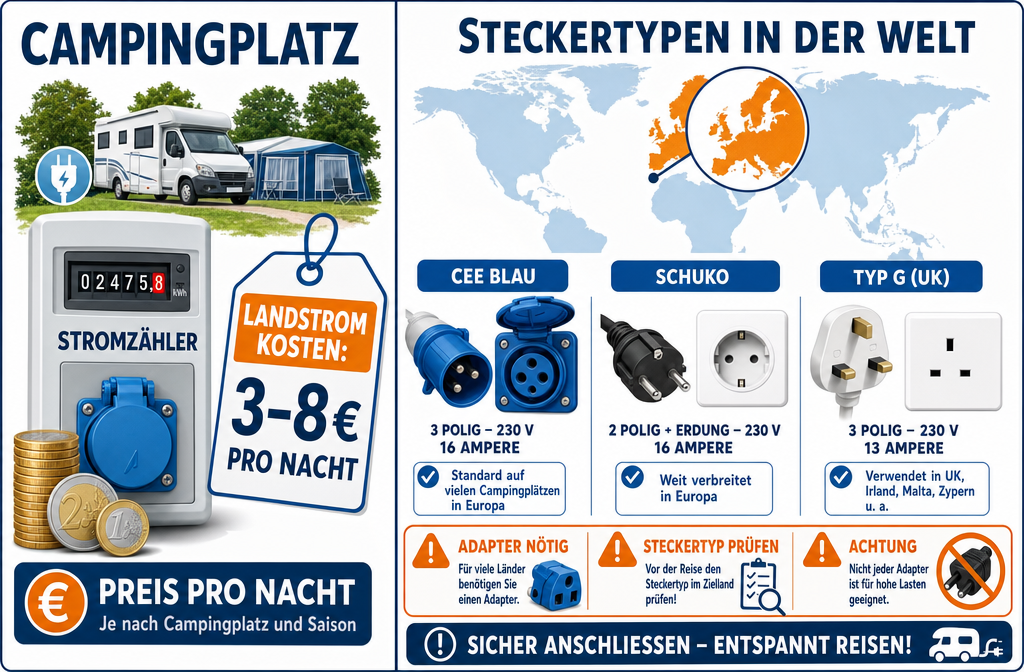
Within the EU, connecting to shore power is straightforward — CEE plugs are standard. Outside the EU, it gets more complicated.
Key points for traveling abroad:
- Great Britain: Type G plug, 230V — Bring a CEE to Type G adapter.
- USA/Canada: 120V system (not 230V!) — European 230V devices will not work here without a voltage converter. However, many campgrounds offer 240V connections (NEMA 14-30) for RVs.
- Australia: Type I, 230V — Adapter needed, voltage is compatible.
- Scandinavia: CEE standard, no problem.
- Morocco/Turkey: Schuko or CEE, usually 220–230V — often problem-free, but check the quality of the connections.
For example, if you're traveling in a motorhome through South Holland or the Tuscany travels, can rely on the CEE standard — no adapter needed.
Tip for long-distance travel: Ask the landlord in advance which adapters are recommended for the destination country. Professional rental companies on Campcruisers are familiar with the local conditions.
Alternative power supply when shore power is unavailable.
No shore power doesn't mean no power. There are several good alternatives — depending on your travel style and budget.
The best alternatives:
- Solar panels: Mounted on the roof, they charge the auxiliary battery during the day. Ideal for wild campers. Output: 100–400 Wp depending on the configuration.
- Portable Power Station (e.g. 500–1,000 Wh): Rechargeable via solar or outlet, provides 230V power for smaller devices. Practical and often retrofittable in rental RVs.
- Vehicle battery (12V system): Sufficient for lights, refrigerator (in 12V mode), USB chargers — but not for 230V devices.
- Gas operation: Refrigerators and heaters in most RVs also run on gas — independently of shore power.
- Generator: Allowed on some campsites, forbidden on others. Loud and not popular everywhere.
Those who want to know more about the equipment of their rental motorhome can find it at Campcruisers detailed vehicle descriptions from the respective rental companies.
Which RVs are best suited for shore power?
Fully integrated and semi-integrated motorhomes typically offer the most sophisticated 230V system—with multiple sockets in the interior, a powerful charger, and often even an inverter for battery operation without shore power.
Recommendation based on travel style:
- Camping vacationer: Fully integrated or partially integrated motorhome — large on-board system, many sockets, air conditioning included.
- Mix of campground and wild camping: Panel van with solar panel and lithium battery — flexible, well-equipped even without shore power.
- Pure wild campers: Converted camper van with solar system — no shore power needed, but also no 230V comfort.
FAQ: Shore Power in a Rented Motorhome
Do I have to pay extra for shore power?
Yes, almost always. Most campsites charge for electricity separately—either as a flat rate (3–8 € per night) or based on consumption. Sometimes it is included in the pitch price, which is stated in the site description.
Is the CEE cable always included in the rental RV?
Not necessarily. Some landlords provide one, others don't. Check before departure and buy one if necessary - a 10m CEE cable costs about €20-40.
Can I leave the RV plugged in while driving?
No. The shore power cable must be disconnected before departure. If you forget to do this, the socket on the vehicle can be damaged — and this will be at the renter's expense.
How long does it take to charge the leisure battery via shore power?
That depends on the battery size and charger. A typical 100Ah AGM battery is fully charged in 6–10 hours. Lithium batteries charge faster, in about 2–4 hours.
What do I do if the shore power connection at the campsite isn't working?
First check if the fuse at the distribution box has tripped. Then report it to the campsite reception — it's their infrastructure, they need to repair it.
Can I use a regular Schuko plug for shore power?
Only with a CEE-to-Schuko adapter and if the campsite has Schuko connections. Schuko is not weatherproof and less suitable for continuous outdoor operation — CEE is the better choice.
How do I know if shore power is connected to the RV?
Inside, there is usually an LED indicator or a symbol on the on-board computer/display. In addition, the refrigerator automatically switches to 230V mode.
Am I allowed to build an extension cable adapter myself?
No. Only use tested, certified adapters and cables. Homemade solutions are dangerous and not permitted in many countries.
What is the difference between a 16A and a 32A connection?
16A (blue CEE plug) = 3,680W, standard at campsites. 32A (red CEE plug) = three-phase/400V, not suitable and not compatible for RVs. Never confuse them.
Do I need an inverter if shore power is not available?
If you want to operate 230V devices without shore power, yes. An inverter converts 12V battery power into 230V — but it drains the battery quickly. Only suitable for short-term use.
Conclusion: Connecting to shore power is easier than you think
Connecting to shore power with a rental campervan is not rocket science — with the right cable, the right sequence, and keeping an eye on power consumption, everything runs smoothly. The most important thing: have a CEE cable with you, observe the correct sequence (first the distribution point, then the vehicle), and don't operate too many devices at the same time.
Your next steps:
- Ask the landlord.Whether a CEE cable (10–15m) is in the vehicle – otherwise buy your own.
- Check target country: EU: No adapter needed. Outside the EU: Research plug type.
- Planning your electricity needs: Air conditioning + refrigerator + chargers = no problem. Kettle and hairdryer not at the same time.
- Book a campsite with shore power — the best campsites in Europe Almost all have shore power connections.
Ready for your next RV adventure? On Campcruisers you'll find rental RVs from professional providers worldwide — including all the information about the vehicle's features, so you know what to expect. Rent a campervan now and get going! 🚐⚡
Quellen
- ADAC: Motorhome Electrics Guide, 2023 — adac.de
- DIN VDE 0100-708: Electrical installations in camping sites and similar locations, 2018
- Caravaning Industry Association (CIVD): Market Data Motorhomes, 2024 — civd.de
- Camping.info: Campsite Infrastructure Europe, 2023 — camping.info
Meta Title: Shore power connection: Supplying the rental camper with 230V
Meta Description: Connecting to shore power in a rental RV: CEE cable, adapter, costs & common mistakes. Step-by-step guide for camping beginners and professionals.
Tags: Shore power connection, RV power, CEE cable camping, 230V RV, campsite power supply, RV rental, camper rental, shore power adapter, RV electrics, camping electricity costs, shore power abroad, RV accessories


 English
  German
  Spanish
  Italian
  Polish
  Dutch
Dutch  French
  Danish