
Quick answer: Solar showers are simple, solar-heated shower bags or systems that heat water through direct sunlight - without electricity or gas. For campers, motorhome owners and outdoor enthusiasts, they are the cheapest and most straightforward way to shower warmly outdoors. High-quality models cost between 10 and 60 euros and provide reliable service on campsites or in nature.
The most important things at a glance:
- Solar showers heat water purely by solar radiation - no electricity, no gas, no infrastructure needed.
- Good models hold 10 to 20 litres and are sufficient for a thorough shower.
- The heating time is typically 2 to 4 hours in direct sunlight.
- Prices start at around 10 euros for simple bags, professional systems cost up to 60 euros.
- Dark materials (black or dark green) heat up faster than light ones.
- In winter or on cloudy days, solar showers are only suitable to a limited extent.
- Care is simple: rinse after each use, store dry.
- For campervan renters at CampCruisers, compact solar showers are a practical addition to the on-board equipment.
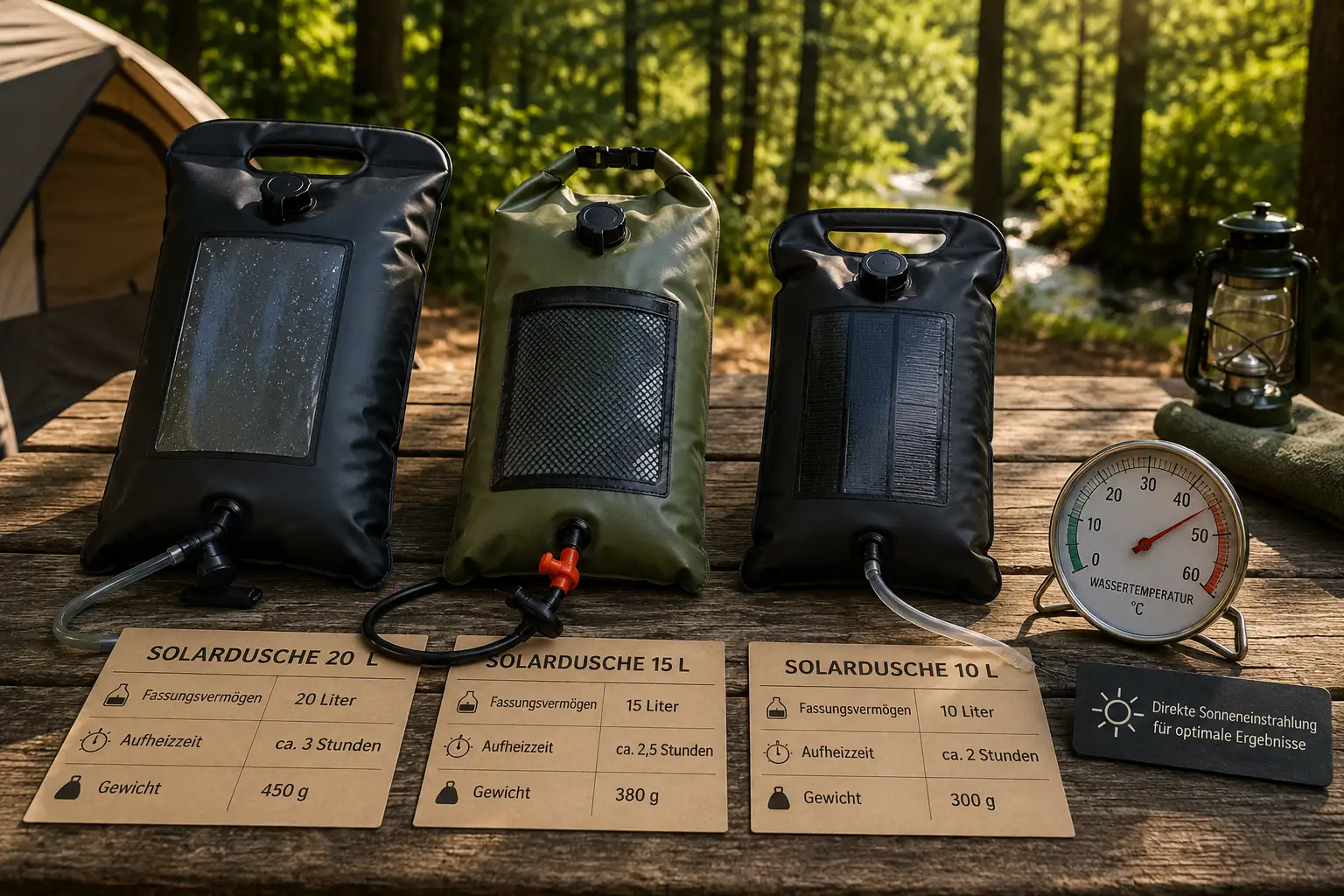
What are solar showers and how do they work?
Solar showers are shower systems that heat water using solar energy. The basic principle is very simple: a bag or container made of dark, heat-storing material is filled with water and placed in the sun. The material absorbs heat and releases it to the water - similar to a black car in the sun.
Most camping solar showers consist of a flat PVC or TPU bag with an integrated hose and shower head. Some models have a small thermometer that displays the water temperature. Higher-quality versions use double-walled constructions or special absorber films to increase efficiency.
Important to know: The water temperature depends directly on the solar radiation, the outside temperature and the colour of the bag. Black bags heat up significantly faster than grey or green ones.
Which solar showers are best for camping and outdoor activities?
For most campers, solar showers in the mid-price range (15 to 35 euros) are the best choice. They offer a good balance of capacity, heating performance and durability.
What matters when choosing:
- Volume: 10 litres are enough for a quick shower, 15–20 litres for a more comfortable one.
- Material: Reinforced PVC or TPU is more durable than thin films.
- Hose and shower head: A shut-off valve on the hose saves water. An adjustable shower head increases comfort.
- Thermometer: Practical, but not a must – those who don't want the water to be too hot appreciate this function.
- Hanging device: A sturdy hook or a wide loop makes hanging easier.
Recommendation logic: Those who travel a lot and want to save weight should opt for a 10-litre TPU bag. Families or motorhome owners who want more comfort are better off with a 20-litre model with a thermometer.
How much do good solar showers for camping cost?
Good camping solar showers are already available from around 10 euros, although models in the 20 to 40 euro range are significantly better made. Professional systems with a pump or solar collector can cost up to 150 euros.
| Preisklasse | Typische Merkmale | Für wen geeignet |
|---|---|---|
| 8–15 € | Simple PVC bag, 10–15 L | Gelegenheitscamper, Festivals |
| 15–35 € | Reinforced material, thermometer, 15–20 L | Regular campers, RVers |
| 35–60 € | Double-walled, pressure shower, accessories | Comfort-oriented outdoor enthusiasts |
| 60–150 € | Solar pump, collector, shower cubicle | Permanent campers, expeditions |
Rule of thumb: If you camp two to three times a year, a £20 model will do the job. If you travel more often or rent a campervan from CampCruisers and want to use the shower as a permanent addition, you should invest in a model from £30.
What do I need to consider when buying a solar shower?
When buying a camping solar shower, four criteria are particularly important: material quality, volume, handling and transportability. If you check these four points, you won't buy a bad model.
Checklist before buying:
- Is the material UV-resistant and food-safe (important for drinking water contact)?
- Does the bag have a wide opening for easy filling?
- Can the water flow be regulated on the hose?
- How heavy is the model when full? (20 litres = approx. 20 kg – this needs a stable branch or hook)
- Is there a bag or pack size that fits in the rucksack?
Common mistake: Many buyers underestimate the weight of a full bag. A 20-litre model will only hang securely if the suspension point is really stable.
How long does a solar shower take to heat the water?
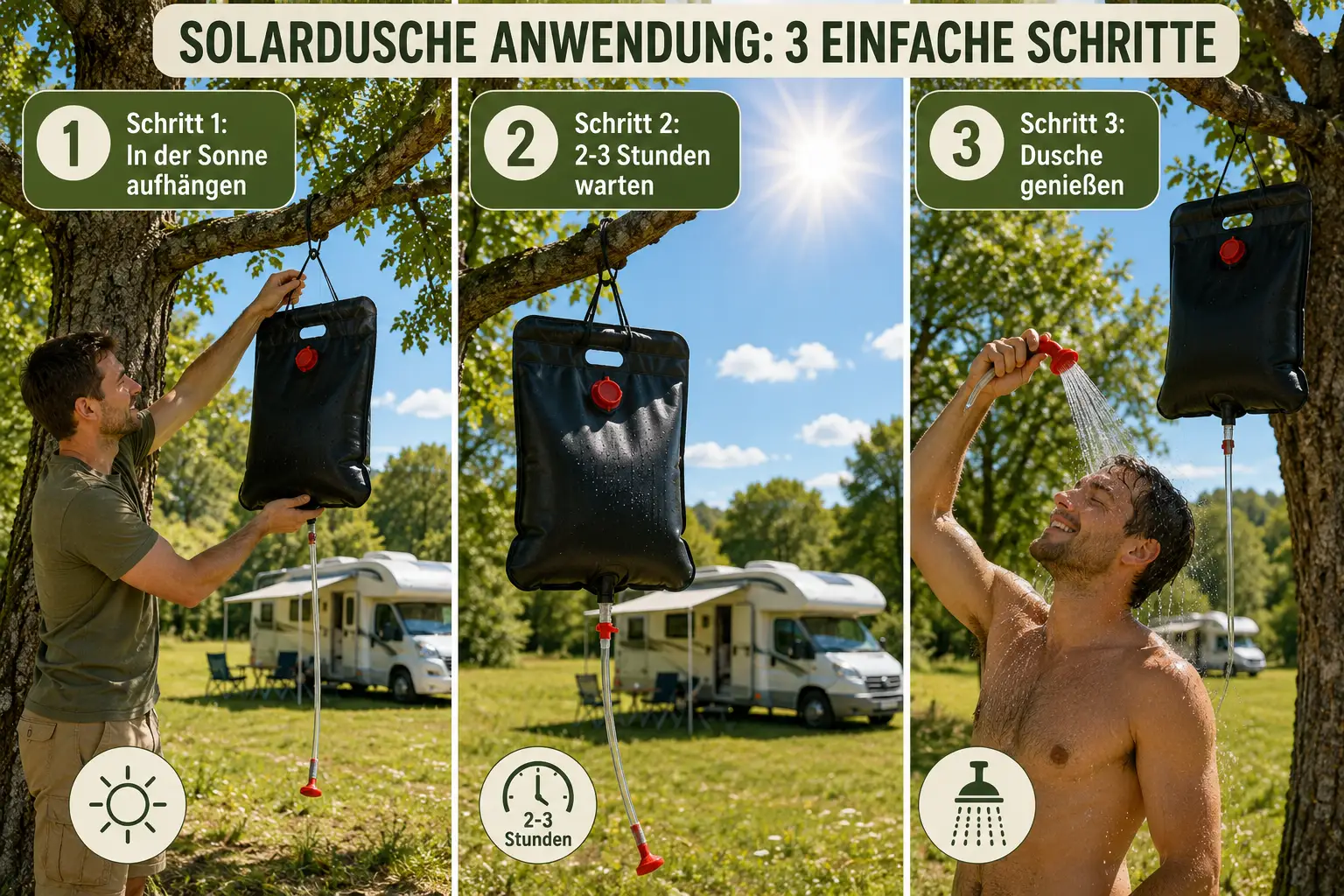
In direct sunlight and temperatures above 20°C, heating typically takes 2 to 4 hours. In strong midday sun in summer, a black 10-litre bag can also become warm in 1.5 hours.
Factors influencing the heating time:
- Sunlight (direct vs. partly cloudy)
- Outside temperature
- Bag colour (black heats up fastest)
- Bag volume (less water = heats up faster)
- Angle of inclination (perpendicular to the sun = optimal)
Tip: Hang the bag up in the morning at breakfast – then the water will be at a pleasant temperature by lunchtime or early afternoon.
What problems can occur with solar showers?
The most common problems are leaky hoses, too slow heating and too low water pressure. None of these are a reason to panic, but it's worth knowing them.
- Leakiness: Mostly at the joints between the bag and the hose. Test before first use.
- Too little pressure: Solar showers work by gravity – the higher the bag hangs, the better the pressure.
- Water does not get warm: Cloudy skies, incorrect angle of inclination or too light material are the most common causes.
- Odour in the water: Occurs after long storage with residual water. Empty the bag completely and allow to dry after each use.
What are common mistakes when using solar showers?
The biggest mistake is to hang the bag in the shade or position it at an angle to the sun. It is also often forgotten to check the water temperature before showering – it can be very hot immediately after several hours of blazing sun.
Other typical mistakes:
- Do not empty and dry the bag after use (leads to mould and odour)
- Choose too weak a suspension point (branch breaks, bag falls)
- Set up shower too close to the tent (splash water on sleeping bags or equipment)
- Place bag on hard surface instead of hanging it up (heat is lost)
Who are solar showers best suited for?
Solar showers are ideal for campers, motorhome drivers, festival-goers and anyone who travels in nature and doesn't want to go without a warm shower. Anyone who rents a campervan via CampCruisers and stays on campsites without sanitary facilities benefits in particular.
Less suitable for: People who expect daily comfort showers, camp in bad weather or travel in colder regions. For these cases, gas shower systems or electric camping showers are the better choice.
Are there alternative shower solutions for camping?
Yes – in addition to solar showers, there are gas shower systems, electric camping showers (12V or 230V) and simple pressure showers without a heating function. Each variant has its strengths.
| Type | Advantages | Disadvantages |
|---|---|---|
| Solar shower | Inexpensive, no consumables | Weather-dependent, low pressure |
| Gas shower | Quickly warm, high pressure | Gas cartridge required, more expensive |
| 12V-Elektrodusche | Funktioniert bei jedem Wetter | Requires vehicle power, assembly required |
| Druckdusche (manuell) | Kein Strom, kein Gas | Kein warmes Wasser |
Which solar showers are particularly lightweight and portable?
Ultralight solar showers made of TPU film weigh under 300 grams empty and fit folded into a jacket pocket. These models are ideal for backpacking, bikepacking or anyone who needs to save weight.
What to look for when buying lightweight models: Thinner materials are more sensitive to sharp objects. If you travel a lot, you should choose a model with reinforced seams, even if it is a bit heavier.
Can solar showers also be used in winter?
In winter, a solar shower has limited usability. At temperatures below 10°C and little direct sunlight, solar energy is usually not enough to bring the water to a comfortable temperature.
Exception: In southern regions (Spain, Portugal, southern France), there is enough solar radiation even in winter to operate a solar shower. Those who want to shower while winter camping in Central Europe are better off using a gas or electric system.
How do I properly clean and maintain my solar shower?
After each use, empty the bag completely, rinse with clear water, and let it air dry. For long-term storage, keep the bag dry and dark to prevent material fatigue from UV radiation.
Skincare steps at a glance:
- After each use: Drain any remaining water completely.
- Rinse the inside with clear water.
- Air dry, spread out (not in direct sunlight).
- Check the hose and shower head for limescale deposits - rinse with citric acid solution if necessary.
- Before storage: Loosely roll up the bag, do not crease.
With regular maintenance, good solar showers can easily last for several seasons.
Frequently Asked Questions (FAQ)
How much water do I need for a shower with a solar shower? 8–10 liters are enough for a short, economical shower. Those who want to shower longer need 15–20 liters.
Can I fill a solar shower with tap water? Yes, tap water is perfectly suitable. In the case of hard water, lime scale may deposit in the hose - regular rinsing with citric acid helps.
How hot does the water get in a solar shower? In direct summer sun, the water temperature can rise to 40–55°C. Always check the temperature before showering to avoid scalding.
Are solar showers suitable for children? Yes, but parents should always test the water temperature beforehand. A model with a thermometer is particularly practical here.
How long does a good solar shower last? With regular care and proper storage, high-quality models last 3 to 5 years.
Can I also use a solar shower as a hot water dispenser for other purposes? Yes – warm water from the solar shower is also suitable for washing dishes or laundry at the campsite.
What size is best for solo travelers? A 10-liter bag is perfectly sufficient for one person and is much easier to transport.
Do I need special mounting hardware? A sturdy branch, a camping frame, or a roof rack on the vehicle will suffice. It is important that the suspension point safely supports the weight of the full bag (up to 20 kg).
What's next
Anyone looking to buy a solar shower should first clarify their own usage profile: How often will they be camping, in which regions, and how much weight can the luggage have? Anyone who rents a motorhome through CampCruisers and heads for campsites without permanent sanitary facilities will find that a 15 to 20-liter solar shower in the mid-price range is the best addition to the vehicle equipment.
Concrete next steps:
- Set the volume (10 L for individuals, 20 L for couples or families).
- Define a budget - plan for at least 20 to 30 euros for regular use.
- Prefer a model with a thermometer and shut-off valve.
- Test for leaks at home before first use.
- Scout out the first hanging point at the campsite as soon as you arrive – south side, full sun, sturdy branch.
Outdoor camping showers don't have to be expensive or complicated. With the right solar shower in your luggage, a warm shower in the open air is one of the simplest pleasures of camping life.


 English
  German
  Spanish
  Italian
  Polish
  Dutch
Dutch  French
  Danish