
Georgia is one of the few countries in Europe where wild camping is largely tolerated by law and camping fees hardly play a role. Anyone travelling through Georgia by camper gets spectacular mountain landscapes, medieval monasteries and one of the most hospitable cultures in the world for comparatively little money. This guide answers all the important questions: from the best routes to road conditions, visas and safety.
The most important things at a glance:
- Georgia is visa-free for campers from the EU, Germany, Austria and Switzerland (up to 365 days).
- Wild camping is not explicitly prohibited in Georgia and is largely tolerated on public land.
- Fuel is cheaper than in Western Europe: petrol costs the equivalent of approx. €0.90–1.10 per litre (estimate 2026, prices fluctuate).
- The best time to travel for camping tours is May to October.
- Mountain roads in Svaneti and Tusheti require an off-road vehicle or at least high ground clearance.
- Camper rentals in Georgia are limited but available; many travellers rent via specialised platforms such as Campcruisers in Germany.
- Food and camping supplies are cheap; well-equipped outdoor shops are mainly in Tbilisi.
- Mobile phone reception is good in cities and on main roads, but hardly available in remote mountain regions.
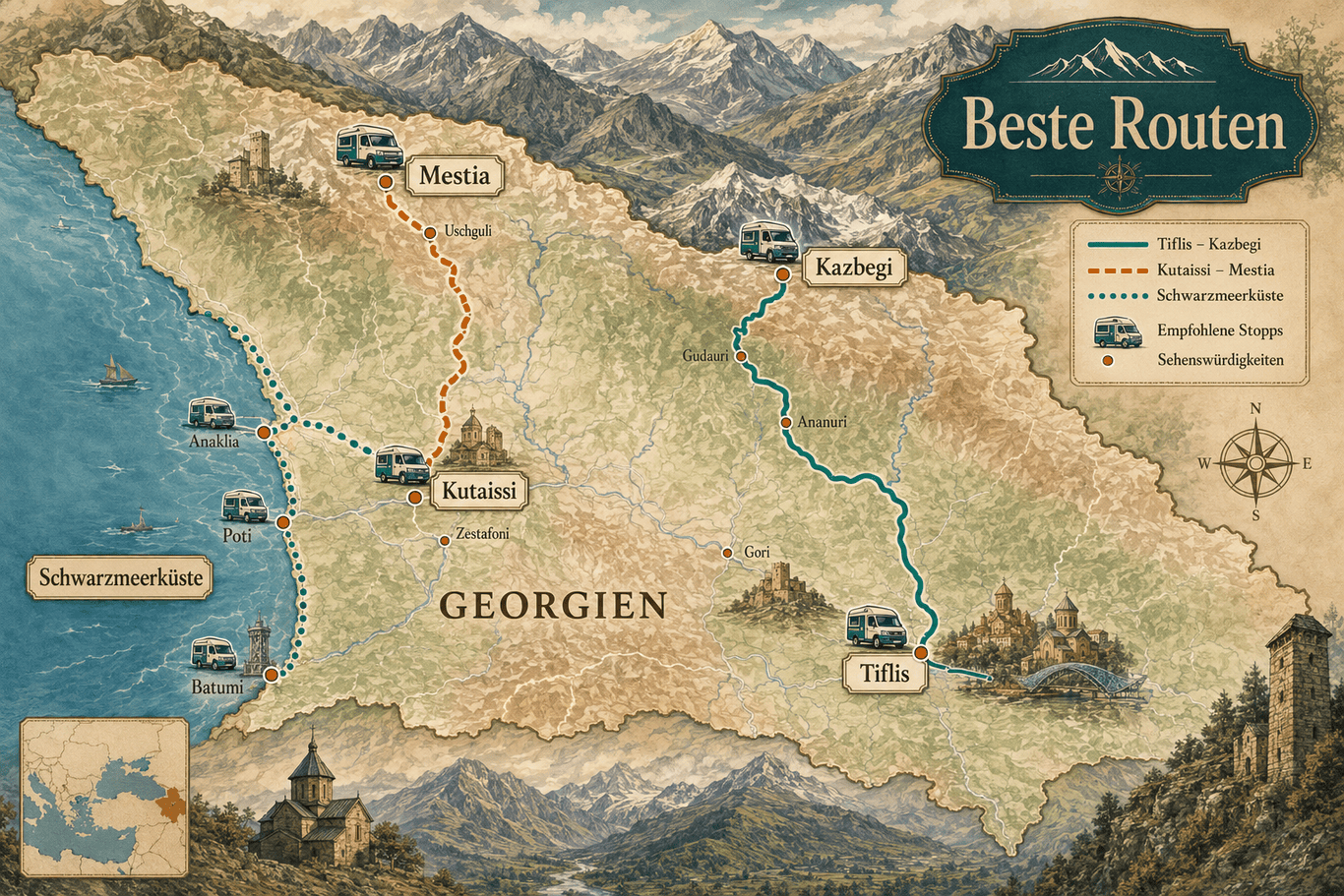
Which routes are best for a camper trip through Georgia?
The three classic routes for a camper trip through Georgia are the Georgian Military Road from Tbilisi to Kazbegi, the west route along the Black Sea coast via Kutaisi to Batumi, and the challenging Svaneti route to Mestia. If you have more time, combine all three into a round trip of two to four weeks.
The most important routes at a glance:
| Route | Länge (ca.) | Schwierigkeit | Highlights |
|---|---|---|---|
| Tbilisi → Kazbegi (Georgian Military Road) | 150 km | Medium | Gergeti Monastery, Cross Pass |
| Tbilisi → Batumi (Black Sea Coast) | 380 km | Easy | Kutaisi, Kobuleti, Batumi |
| Kutaissi → Mestia (Svaneti) | 230 km | Difficult | Ushguli, Svanetian towers |
| Tiflis → Sighnaghi (Kakheti) | 110 km | Easy | Wine region, Alazani Valley |
| Tiflis → Tusheti | 180 km | Very difficult | Abano Pass (4×4 essential) |
Recommendation: Beginners start with the Georgian Military Road and the Black Sea coast. Experienced off-road campers should plan Svaneti and Tusheti, but only with a suitable vehicle.
How much does a camping holiday in Georgia cost?
If you rent a campervan in Georgia, you should factor in the following costs in addition to the flight costs:
- Campervan hire (estimate 2026): 80–150 € per day depending on vehicle type and season
- Fuel in Georgia: approx. 0.90–1.10 € per litre of petrol (estimate, depending on exchange rate and market situation)
- Campsites: 5–15 € per night on organised sites; wild camping free
- Food: significantly cheaper than in Germany, approx. 15–25 € per person per day
Rule of thumb: A two-week campervan trip through Georgia (for two people, incl. travel and hire) is realistically plannable from approx. €2,500–3,500. Without hire costs, the daily budget in the country itself is €30–50 per person.
Is Georgia safe for campervans and road trips?
Georgia is considered one of the safest travel destinations in the Caucasus for Western tourists. Petty crime against travellers is rare, and campers consistently report great hospitality from the local population.
Some points to note that remain relevant:
- Abkhazia and South Ossetia are de facto autonomous regions and should be avoided with a campervan. Entering via these areas will lead to entry problems in Georgia.
- Border regions with Russia (except for official crossings): keep your distance.
- Break-ins into campervans are rare, but securing valuables on busy car parks in Tiflis should be a matter of course.
- In remote mountain regions, there is hardly any mobile phone coverage and no breakdown service. Satellite emergency communication (e.g. Garmin inReach) is recommended for tours to Tusheti.
What camping equipment do I need for Georgia?
For a campervan trip through Georgia, standard equipment for Central Europe with a few additions is sufficient. If you are heading to mountain regions, you must be prepared for temperature fluctuations: In summer it can be over 35 °C during the day, but below 5 °C at night at high altitudes.
Checklist for the Georgia campervan trip:
- Sleeping bag down to -5 °C (even in summer for mountain locations)
- Water filter or water purification tablets (spring water is often drinkable, but be careful in livestock areas)
- Offline maps (Maps.me or OsmAnd with Georgia download)
- Tyre repair kit and spare tyre (gravel roads are sharp)
- Portable gas stove with spare cartridges (gas cartridges available in Tiflis, hardly available in remote areas)
- First aid kit incl. altitude sickness medication (Acetazolamide) for tours over 3,000 m
- Cash in Georgian Lari (GEL): Card payment unreliable outside of cities
Which campsites are particularly recommended in Georgia?
Georgia does not have a comprehensive campsite network like Western Europe, but there are increasingly good options. The best organised campsites are concentrated in tourist hotspots.
Recommended campsites (as of 2026):
- Kazbegi / Stepantsminda: Several small camps directly overlooking the Gergeti Monastery; approx. 8–12 € per night
- Mestia (Svaneti): Guesthouses with camping in the garden; approx. 5–10 €
- Batumi area: Campsites along the Black Sea coast, some with electricity and showers
- Borjomi: Quiet spots on the edge of the national park; good as a stopover
- Kakheti (wine region): Wild camping possible near vineyards, occasional farm camping
Is wild camping legal in Georgia?
Wild camping in Georgia is not explicitly prohibited on public land (outside of protected areas and private property) and is widely tolerated in practice by authorities and locals. This is one of the biggest advantages of a camper trip through Georgia.
Important restrictions:
- National parks (e.g. Borjomi-Kharagauli, Kazbegi National Park) have their own rules; wild camping is sometimes only permitted in designated areas.
- Private property is taboo, but Georgians often willingly allow camping on their land if you ask.
- Making fires is prohibited during dry periods and near forests and should always be handled with caution.
What are the road conditions like for campers in Georgia?
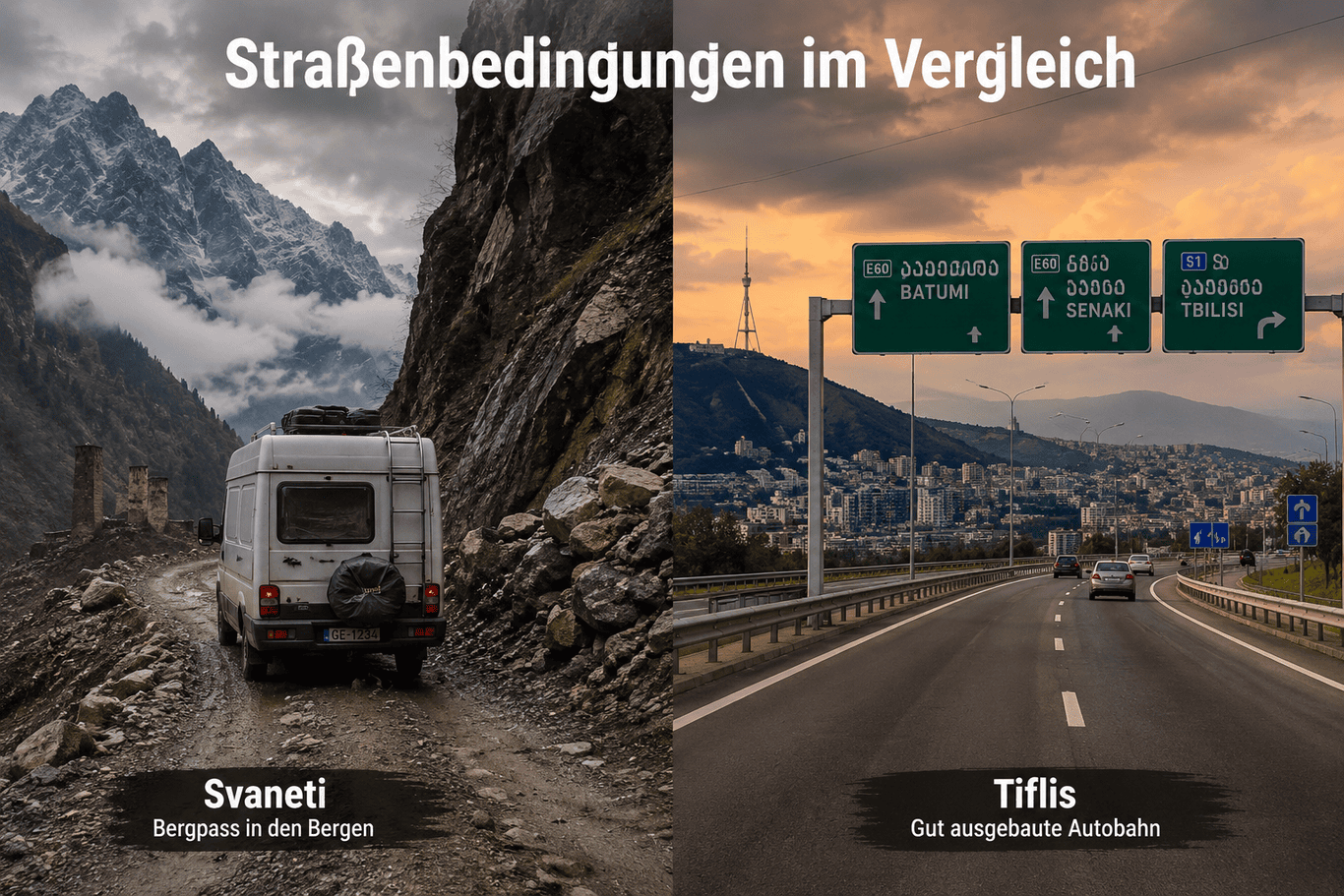
Road conditions in Georgia vary greatly. Main roads and the Georgian Military Road are well paved and easily accessible for normal campers. Remote mountain regions such as Tusheti require a four-wheel drive vehicle.
Road categories at a glance:
- Main roads (SH network): Well developed, partly newly asphalted, suitable for all types of campers
- Regional roads: Varying quality, often gravel or asphalt in need of repair; low ground clearance can be problematic
- Mountain tracks (e.g. Abano Pass to Tusheti): Only with 4×4 and all-wheel drive; unsuitable for normal motorhomes
Common mistake: Travellers underestimate the length and condition of Georgian mountain roads. 50 km on a gravel track can take three hours.
How difficult is it to drive a camper in Georgian mountain regions?
Driving in Georgian mountain regions is feasible for experienced drivers, but challenging. Narrow hairpin bends, lack of guardrails, oncoming lorries and loose scree on the road surface are normal conditions on mountain roads.
Anyone driving through Georgia in a camper for the first time should not plan Swaneti and Tusheti as their first tour. The Georgian Military Road and the Black Sea coast offer spectacular landscapes without extreme driving requirements.
What time of year is best for a camper trip?
May to October is the best time to travel for a camper trip through Georgia. Spring (May/June) and autumn (September/October) offer pleasant temperatures, fewer tourists and green landscapes.
- May–June: Ideal for mountain regions; snow on high passes mostly melted
- July–August: High season; hot in Tbilisi (up to 38 °C), pleasant in the mountains; campsites full
- September–October: Golden autumn in Kakheti (grape harvest), cooler temperatures, quieter
- November–April: Many mountain roads closed; only for experienced winter campers with appropriate equipment
What visa do I need for Georgia?
Citizens from Germany, Austria and Switzerland can enter visa-free for up to 365 days to Georgia. A valid passport is sufficient; an identity card is not sufficient. Important: Proof of international health insurance must be provided upon entry.
Which areas should I avoid with the camper?
Campers in Georgia should generally avoid three areas:
- Abkhazia: Separatist territory, not internationally recognised as Georgian; entering via Abkhazia makes onward travel in Georgia legally problematic.
- South Ossetia: Also a separatist territory; no tourist infrastructure, security critical.
- Immediate Russian border regions (except official crossings such as Kazbegi/Lars): Military restricted zone, no access for tourists.
Common mistakes tourists make when camping in Georgia
Anyone travelling through Georgia with a camper can quickly fall into avoidable traps without preparation:
- No cash on you: Card payment is unreliable outside of Tbilisi and Batumi. Always carry sufficient Lari (GEL).
- Underestimation of driving times: Georgian mountain roads are short on the map, but time-consuming. Allow plenty of time.
- Not carrying enough water: In remote areas, there are no petrol stations or supermarkets.
- Driving without offline maps: Mobile phone coverage is completely absent in many mountain regions.
- Incorrect tyre choice: Summer tyres wear out quickly on gravel tracks; a spare tyre is essential.
- No travel insurance with mountain rescue: There is no free mountain rescue service in Georgia, unlike in Austria.
How expensive are fuel and camping supplies in Georgia?
Georgia is significantly cheaper compared to Western Europe. Fuel costs are estimated at €0.90–1.10 per litre (petrol, 2026 estimate based on current GEL/EUR exchange rate and historical prices). Diesel is similarly cheap.
Camping supplies such as gas cartridges, basic tools and staple foods are readily available in Tbilisi. Specialised outdoor equipment (trekking poles, sleeping bags, camping stoves) can be found in some sports shops in Tbilisi, but the selection is limited. Recommendation: Bring specialised equipment from Germany.
Frequently Asked Questions
Can I drive to Georgia with a normal campervan?
Yes, a normal campervan can be used without any problems on the main roads and the Georgian Military Road. An off-road vehicle with high ground clearance is required for Svaneti and Tusheti.
How do I get to Georgia with a camper?
The most common route is via Turkey (Istanbul, Trabzon) and the Sarpi border crossing. Alternatively, there are ferry connections across the Black Sea (Odessa or Poti), but these are weather-dependent and time-consuming.
Are there campsites with electricity in Georgia?
Yes, but only in a few tourist centres such as Batumi, Kazbegi and Mestia. If you rely on electricity, you should carry a solar panel or a second battery.
Is tap water drinkable in Georgia?
In Tbilisi and larger cities, tap water is considered drinkable. In rural areas, it is better to boil or filter it.
What language is spoken in Georgia?
Georgian is the official language. Russian is understood by many older people. English is increasingly common in tourist areas, but hardly present in remote villages. Basic knowledge of the Cyrillic alphabet helps with road signs.
Can I pay with a credit card in Georgia?
Yes, in Tbilisi, Batumi and other cities. In the countryside and at petrol stations off the main roads, cash (Georgian Lari) is essential.
How long should a camper trip through Georgia last at least?
Two weeks is a good minimum for a route with the Georgian Military Road, the Black Sea coast and Kakheti. Plan at least five additional days for Svaneti.
Plan now and get started
Travelling through Georgia with a camper is as attractive as ever in 2026: low cost of living, visa-free entry for DACH travellers, spectacular landscapes and a camping freedom that hardly exists in Western Europe anymore. If you start well prepared, you will experience one of the most rewarding camping destinations of all.
Concrete next steps:
- Book a camper: Book early at Campcruisers as off-road vehicles are quickly snapped up.
- Set the route: For first-timers, the Georgian Military Road + Black Sea coast is recommended as a basic route.
- Download offline maps: OsmAnd or Maps.me with complete Georgia download before departure.
- Get cash: Exchange Lari at Tbilisi airport or in the city (exchange rates there are better than in Germany).
- Secure vehicle authorisation: Request it from the rental company in good time if the vehicle is not registered in your own name.
Georgia rewards anyone who is willing to accept a few gravel tracks with experiences that are hardly repeatable elsewhere.


 English
  German
  Spanish
  Italian
  Polish
  Dutch
Dutch  French
  Danish