
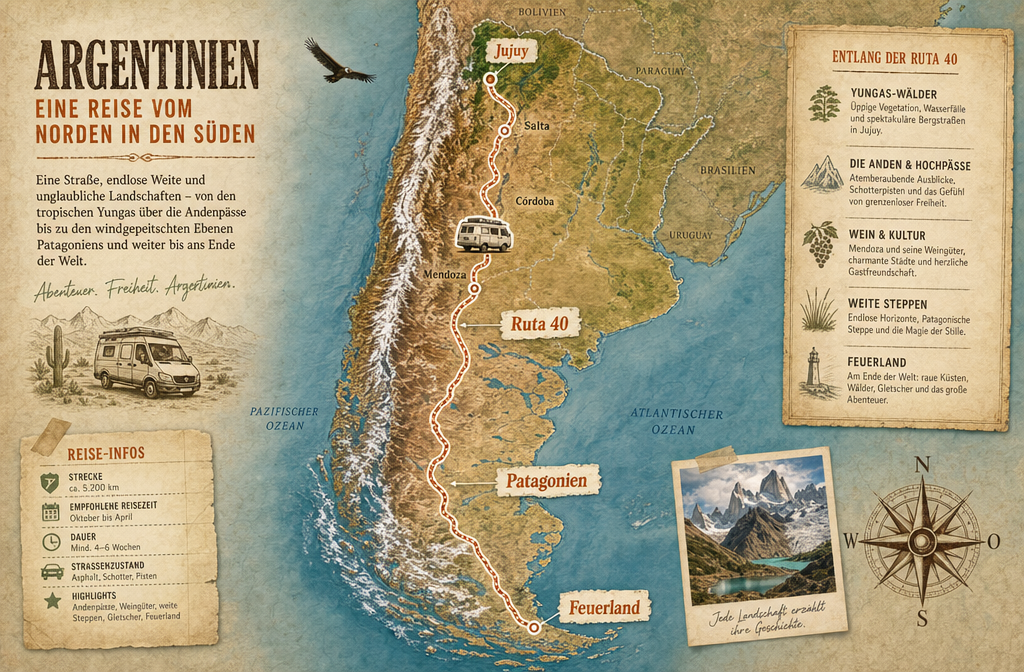
Argentina is the eighth largest country in the world and extends over more than 3,700 kilometres from north to south. Anyone travelling through Argentina by motorhome, from the tropics to Tierra del Fuego, covers one of the most scenic routes that the American continent has to offer: from subtropical jungles in Jujuy to the vineyards of Mendoza to the glaciers of Patagonia and the end of the world in Ushuaia.
The most important things at a glance:
- The route from northern Argentina to Tierra del Fuego is between 5,000 and 6,500 kilometres depending on the route.
- Campervan rentals in Argentina cost roughly between 80 and 200 USD per day depending on the vehicle class and provider (estimated value, depending on season and equipment).
- The Ruta Nacional 40 is the classic backbone route for motorhome travellers.
- Argentina does not have a nationwide camping obligation, wild camping is legal in many regions, but regulated differently regionally.
- Diesel and Nafta (petrol) are available on most main roads, but sometimes with large gaps in Patagonia.
- For rental motorhomes, an international driving permit is recommended, but not a general mandatory document.
- The best time to travel the entire route is October to March (southern summer).
- Campcruisers is a global booking platform with reliable local campervan hire companies in Argentina.
- Border crossings to Chile (e.g. for Patagonia loops) require special vehicle documents.
- Tierra del Fuego/Ushuaia is accessible all year round, but with significant restrictions in winter (June–August).
What do you need to know about driving a motorhome in Argentina?
Argentina is generally motorhome-friendly, but there are some special features that you should be aware of. The road network is well developed on the main routes, but often unpaved (Ripio) outside of these. Anyone travelling through Argentina in a motorhome, from the tropics to Tierra del Fuego, should be prepared for a mix of asphalt, gravel and occasionally poor road conditions.
Important basic rules:
- Driving licence: A national EU driving licence is generally accepted, but an international driving permit (IDP) is recommended and often mandatory for rental vehicles.
- Vehicle documents: Rental vehicles need a so-called Habilitación (permission from the rental company) to cross provincial and national borders.
- Traffic rules: Drive on the right, speed limits mostly 60 km/h in built-up areas, 110 km/h on national roads. Drinking and driving is strictly prohibited (limit: 0.5 per mille).
- Toll: There are toll stations (Peajes) on some national roads and motorways; cash payment in pesos is common.
- Insurance: Liability insurance is mandatory; always check the sum insured for Patagonia and Tierra del Fuego for rental vehicles.
Decision rule: Anyone planning to drive on gravel roads (Ripio) should definitely choose a vehicle with increased ground clearance and robust tyres. A normal panel van motorhome without all-wheel drive will reach its limits on Ruta 40 in Patagonia.
How much does it cost to rent a campervan in Argentina?
Motorhome hire in Argentina roughly ranges from 80 to 200 USD per day, depending on the vehicle type and season (estimated value, as of 2026, high season October–March). In addition, there is a deposit, kilometre allowances and optional additional equipment.
Typical price categories (estimated values):
| Vehicle type | Daily rate (approx.) | Suitable for |
|---|---|---|
| Compact campervan (2 pers.) | 80–110 USD | Couples, flexible routes |
| Medium-sized motorhome (4 pers.) | 110–160 USD | Families, longer stages |
| Expedition 4×4 camper | 150–200+ USD | Patagonia, off-road |
Campcruisers is also a provider specialising in Argentina, which equips vehicles for the typical north-south routes and includes border crossing documents for Chile. This is particularly relevant for travellers planning Patagonia loops via Chilean territory.
Additional costs to budget for: fuel (approx. 0.8–1.2 USD/litre diesel, estimated value 2026), camping fees (0–15 USD/night), national park entrance fees (Patagonia/Glaciares: approx. 20–40 USD/person) and ferries (e.g. Strait of Magellan).
Which routes are best for motorhome travellers through Argentina?
The classic route for motorhome travel through Argentina from the tropics to Tierra del Fuego follows the Ruta Nacional 40 as a common thread, supplemented by regional detours.
Recommended stage structure (north to south):
- Jujuy & Salta (Northwest): Quebrada de Humahuaca, Salinas Grandes, subtropical Yungas forests. Good infrastructure, warm climate.
- Córdoba & Cuyo: Mendoza wine region, Aconcagua foothills. Asphalt roads, many campsites.
- Neuquén & Lake District: Bariloche, Seven Lakes Route, Nahuel Huapi National Park. Very motorhome-friendly.
- Patagonia (Ruta 40 South): El Chaltén, El Calafate, Perito Moreno Glacier. Gravel roads, large distances between petrol stations.
- Feuerland: Ferry across the Strait of Magellan or overland via Chile, Ushuaia as the endpoint.
Alternative East Coast Corridor: Anyone who prefers more asphalt and the Atlantic coast can travel south via Buenos Aires, Mar del Plata and the Atlantic coast of Patagonia (Ruta 3). Less spectacular than Ruta 40, but easier to drive.
How long does the journey from the tropics to Tierra del Fuego take?
Pure driving time from Jujuy to Ushuaia on a direct route: about 60–80 hours of driving (approx. 5,000–5,500 km). Realistically planned with stops, national parks and rest days, the total journey takes 6 to 12 weeks, depending on the pace.
- Minimal version (Highlights only): 4–5 weeks, very tight
- Relaxed trip: 8–10 weeks, recommended for first-time visitors
- Extensive expedition: 3–6 months, for those who want to delve deep into the regions
What vehicle do you need for Argentina's road conditions?
Not every motorhome is suitable for all parts of the route. On Ruta 40 in Patagonia, gravel roads over hundreds of kilometres are not an exception, but the rule.
Vehicle recommendations by region:
- North Argentina & Cuyo: Normal high-roof panel van is sufficient, asphalt dominates.
- Lake District Bariloche: Good roads, standard vehicles without any problems.
- Southern Patagonia & Tierra del Fuego: Increased ground clearance recommended, all-wheel drive a clear advantage, spare canister for diesel makes sense.
Tyre choice: At least all-terrain tyres for Patagonia, no normal road profile. A spare wheel (better two) is mandatory.
What camping sites and wild camping rules apply in Argentina?
Argentina generally allows wild camping on public land, but with regional differences. Wild camping is prohibited in national parks; there are designated camping zones there.
Camping options at a glance:
- National park camping sites: Booking often required in advance (especially El Chaltén, Nahuel Huapi). Fees: approx. 5–20 USD/night.
- Municipale Campingplätze: Available in almost every small town, cheap (0–8 USD), often with electricity and water.
- Private wild camping: Only with the permission of the owner on private land.
- Public wild camping: Tolerated in large parts of Patagonia, as long as no fire pits are created and no rubbish is left behind.
Important for Tierra del Fuego: There are fixed camping zones in the Tierra del Fuego National Park; wild camping is prohibited outside. Making fires is strictly regulated throughout Patagonia and Tierra del Fuego, often completely prohibited during dry periods.
Safety tips for motorhome travellers in Argentina
Argentina is generally considered safe for motorhome travellers, but some precautions are advisable. In large cities like Buenos Aires or Mendoza, you should not stay overnight in public places; in rural regions and Patagonia, the level of security is much more relaxed.
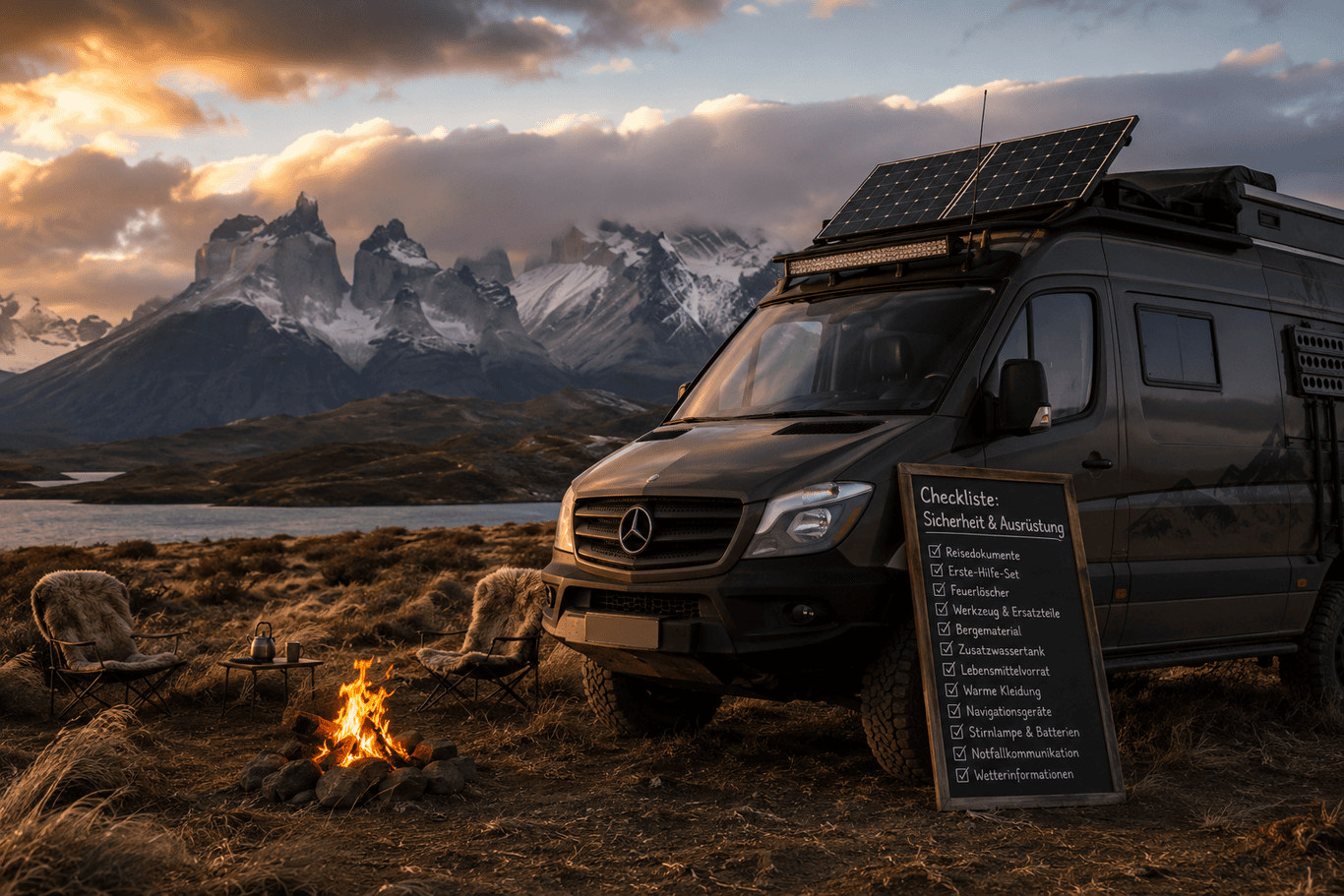
Practical safety rules:
- Do not leave valuables visible in the vehicle, especially in cities.
- Do not drive on unknown gravel roads at night without orientation.
- Save emergency contacts for the Argentine police (101) and the Red Cross.
- Always carry enough water, food and spare parts in Patagonia (distances between towns: sometimes 200+ km).
- Take out travel insurance with international protection and breakdown assistance.
- Check weather forecasts in Patagonia daily; windstorms can endanger motorhomes.
Fuel and petrol stations: What motorhome travellers need to know
Diesel is the cheapest and most widely available fuel for motorhomes in Argentina. Petrol stations are easily accessible on main roads and in cities; in Patagonia, distances can be between 150 and 300 kilometres.
Tank strategy for Patagonia:
- Always fill up when a petrol station is in sight.
- Carry a spare canister (20–30 litres).
- Credit cards are accepted at most YPF petrol stations, but keep cash in pesos as a backup.
- Fuel prices vary depending on the province; state-owned YPF stations often have more uniform prices.
How do you prepare a campervan for Argentina's climate zones?
From the subtropical temperatures in the north (up to 40°C in summer) to the storms and sub-zero temperatures in Tierra del Fuego, a campervan for this route needs a wide range of equipment.
Checklist for climate preparation:
- Air conditioning or good ventilation for the north
- Heating (diesel or gas heating) for Patagonia and Tierra del Fuego
- Solar panels for off-grid power supply
- Water tank with sufficient capacity (at least 60 litres) for wild camping stages
- Wind protection and guy ropes for Patagonia's storms
- Winter tyres or all-terrain tyres for Tierra del Fuego (snow possible even in October/November)
Are there specialist campervan rental companies for Argentinian routes?
Yes. There are numerous campervan rental companies in Argentina, many of which can be found on the platform Campcruisers book – with spare canisters, off-road tyres, border crossing documents for Chile and full camping equipment.
Anyone planning to travel the route from the tropics to Tierra del Fuego by campervan should explicitly ask the rental company for permission to travel to Patagonia, Tierra del Fuego and Chilean border crossings, as not all providers cover these routes.
How to make your campervan trip through Argentina a success
Travelling through Argentina by campervan, from the tropics to Tierra del Fuego, is one of the most challenging and rewarding routes in the world. The route requires good preparation, the right vehicle and realistic time planning, but rewards you with a diversity of landscapes that few other countries offer.
Concrete next steps:
- Set the route: Choose Ruta 40 (west, more adventure) or Ruta 3 (east, easier) as the main axis.
- Book a vehicle: At least 3–6 months before departure, especially for the high season (October–March). Contact Campcruisers for specialised Argentina routes.
- Obtain documents: International driving licence, travel insurance, clarify border crossing permits.
- Pre-book national park campsites: El Chaltén and Nahuel Huapi are quickly booked out in season.
- Plan your fuel strategy: Download a map of petrol station distances for Patagonia (Maps.me or iOverlander are proven apps).
- Set up weather apps: Check the Patagonia weather daily, build flexibility into your daily planning.
If you work through these points, you will start with a solid basis for an unforgettable journey to the end of the world.
Frequently Asked Questions (FAQ)
Do I need an international driving licence for Argentina?
An EU driving licence is generally accepted in Argentina, but an international driving licence (IDP) is often mandatory for rental vehicles and helpful for police checks. Costs and application from the ADAC or AvD in Germany.
Can I enter Argentina with a German campervan?
Yes, but importing your own vehicle is bureaucratically complex (temporary import permit, Carnet de Passages). For most travellers, renting on site is much less complicated.
Is wild camping legal in Argentina?
Wild camping is legal and largely tolerated on public land outside national parks in most regions. It is prohibited in national parks and on private property without permission.
How safe is Patagonia for campervan travellers?
Patagonia is considered one of the safest regions in Argentina for travellers. The greatest risks are weather conditions (storms, snow) and the large distances between towns, not crime.
Which app is best for navigation in Argentina?
Maps.me (can be used offline) and iOverlander (campsites and wild camping spots) are the most popular among campervan travellers. Google Maps works well on main roads, but not on remote gravel tracks.
Do I have to book national park entrance fees in advance?
Online pre-registration is recommended for popular parks such as Los Glaciares (Perito Moreno) and Nahuel Huapi during the high season. Campsites in El Chaltén should definitely be reserved in advance.
How cold does it get in Tierra del Fuego?
In Ushuaia, temperatures often range between 5 and 15°C even in summer (December–February). In winter (June–August), temperatures below -10°C are possible. A well-insulated heater in the campervan is mandatory.
Can I cross the Strait of Magellan by campervan?
Yes, by ferry from Punta Arenas (Chile) to Porvenir or from Primera Angostura to Bahía Azul. The ferries take vehicles; booking in advance is recommended in the high season.
How much cash should you take with you in Patagonia?
At least 200–300 USD in peso equivalent as a reserve, as card payment is not always possible in remote areas and at small petrol stations.
What are the total costs for an 8-week trip?
A rough estimate for two people: vehicle rental (8 weeks × 130 USD/day) approx. 7,300 USD + fuel approx. 800–1,200 USD + camping approx. 400–600 USD + national parks approx. 300–500 USD + food approx. 1,000–1,500 USD. Overall range: approx. 10,000–11,000 USD for two people (estimated value 2026, strongly dependent on vehicle choice and travel style).
What is the most common mistake in planning?
Not planning enough time. Many travellers underestimate the distances in Patagonia and rush through the most beautiful regions. At least 6 weeks for the entire route is realistic.


 English
  German
  Spanish
  Italian
  Polish
  Dutch
Dutch  French
  Danish