
Last updated: May 24, 2026
Quick Answer: Renting a motorhome abroad according to the fly-&-camp principle means: book a flight, pick up a camper at your destination and drive off. In the USA, Canada and New Zealand, this is possible for German tourists with a normal class B driving license. Depending on the country and vehicle class, rental prices start at around 80–180 USD/CAD/NZD per day, plus insurance, mileage packages and camping fees.
Key Takeaways
- 🚐 Fly & Camp Works smoothly in all three countries: pick up the camper at the airport, start the road trip.
- 🪪 The German driving licence class B is recognized in the USA, Canada and New Zealand — an international driving permit is recommended, but not required everywhere.
- 💰 Daily rates for rental motorhomes roughly range between 80 and 180 USD/CAD/NZD Net, depending on the season and vehicle size.
- 📋 Important documents: Passport, driver's license, international driver's license (recommended), credit card for deposit, booking confirmation.
- 🛡️ One Comprehensive insurance with liability is mandatory – the landlord's basic insurance is often insufficient.
- 📅 Best travel times: USA (spring/autumn), Canada (June–August), New Zealand (October–April for Southern Hemisphere summer).
- ⚠️ Common mistakes: too short rental period, missing additional insurance, wrong vehicle class for families.
- 🗺️ Family-friendly routes are available in all three countries — planning determines comfort and experience.
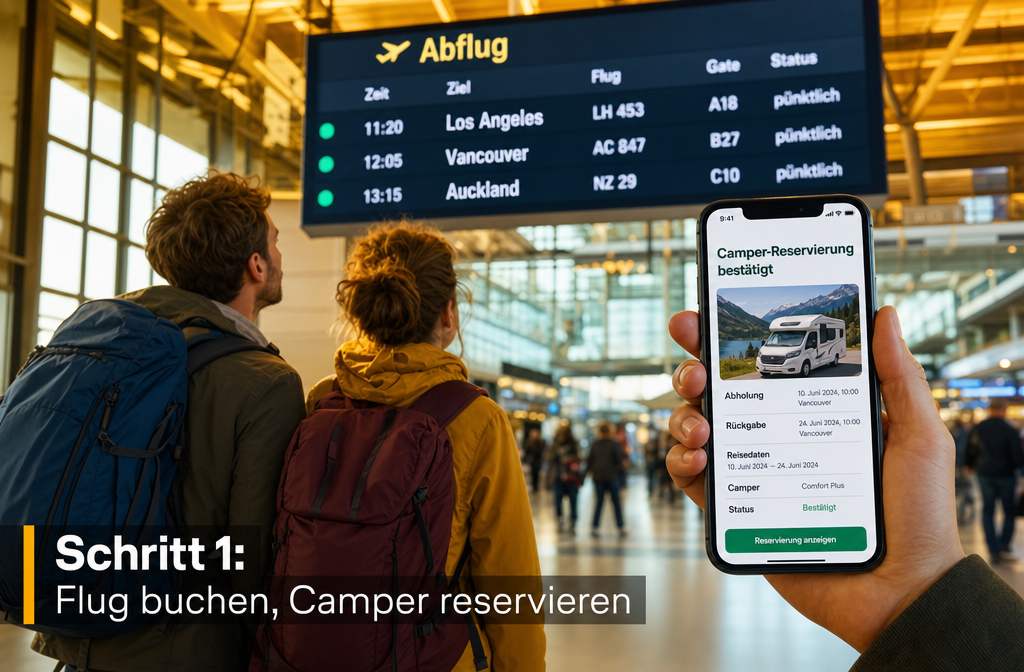
How does Fly & Camp work with a motorhome?
Fly & Camp is incredibly simple: You fly to your destination country, pick up your rental camper directly at the airport or at a nearby rental station, and start your road trip. No trailer, no need to ship your own vehicle — just you, your luggage, and the open road.
Here's how the process works in concrete terms:
- Book flight — ideally in a large city with a wide range of rental properties (e.g. Los Angeles, Vancouver, Auckland).
- Reserve your motorhome online. — ideally 3–6 months in advance, especially during peak season.
- Pickup — usually directly at the airport or via shuttle to the rental station (5–20 minutes).
- Vehicle familiarization — the landlord explains technology, tanks and special features.
- Drive off — Book campsites in advance or head there spontaneously, depending on the country and season.
Tip: After a long-haul flight, plan at least one night at a quiet campsite near the pickup station before driving the first long leg. Jet lag and a 7-meter vehicle are not a good combination.
Those who want to conveniently handle the booking from Germany can find offers from professional rental companies worldwide via Campcruisers compare and book directly — without language barriers and with a transparent price overview.
How much does it cost to rent an RV in the USA per day?
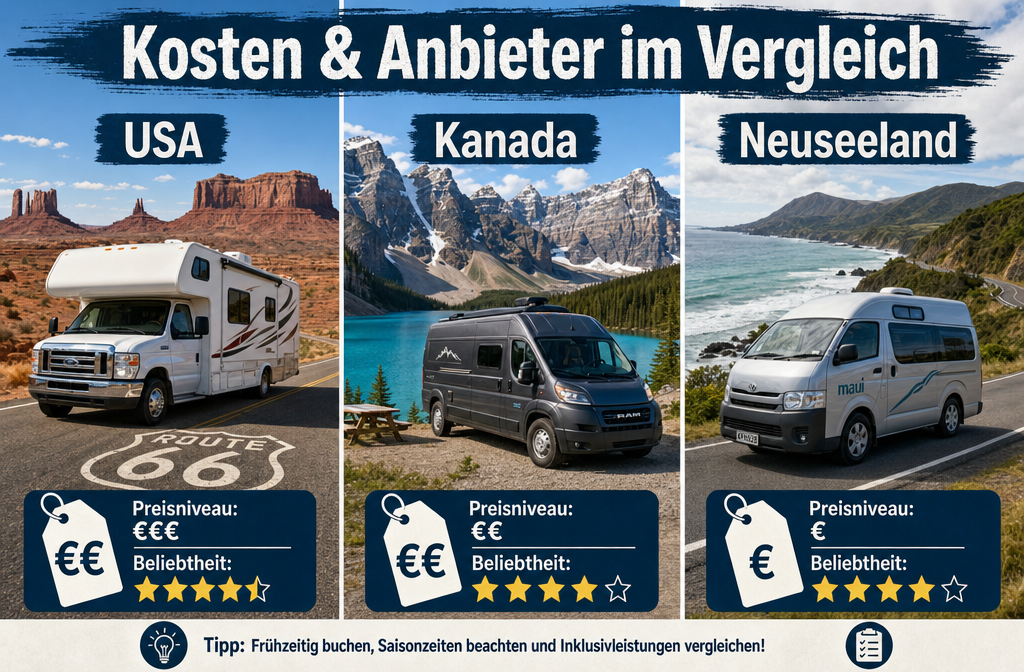
In the USA, RV rental prices range between depending on the vehicle class and season. 80 and 250 USD per day (Base price without extras). Compact campervans are cheaper, large Class C motorhomes are more expensive.
Typical price ranges (estimates, high season):
| Vehicle type | Low season | High season |
|---|---|---|
| Compact campervan (2 pers.) | approx. 80–110 USD/day | approx. 130–180 USD/day |
| Class C Motorhome (4 pers.) | approx. 120–160 USD/day | approx. 180–250 USD/day |
| Large Class A Motorhome | approx. 180–250 USD/day | approx. 280–400 USD/day |
Additional costs that quickly add up:
- Mandatory insurance / Liability insurance: 20–40 USD/day
- Comprehensive insurance upgrade: 15–30 USD/day
- Generator usage: $3–5/hour or daily flat rate
- Camping fees: $15–60/night (depending on campground)
- Fuel: Gasoline in the USA is cheaper than in Germany, but large vehicles consume a lot.
Rule of thumb: Calculate for a USA RV trip with total costs of $150–300 USD per day (Rent + insurance + camping + gas), dependent on vehicle class and route.
Similar structures apply in Canada and New Zealand — Canada is slightly cheaper than the USA in terms of price, while New Zealand is often a little more expensive per day due to the smaller supply and island location.
What documents do I need for a camper trip to Canada?
For an RV trip in Canada, you will need your German passport, your EU driver's license, and a credit card for the rental deposit. While an international driver's license is not legally required in Canada, it is recommended by many rental companies and authorities.
Complete document list for Canada:
- ✅ Valid passport (valid for at least 6 months beyond the end of the trip)
- ✅ Original EU/German driving licence
- ✅ International Driving Permit (recommended, available from ADAC)
- ✅ Credit card in the name of the main driver (for deposit, usually 500–1,500 CAD)
- ✅ Booking confirmation from the motorhome rental company
- ✅ Travel and Vehicle Insurance Certificate
- ✅ eTA (Electronic Travel Authorization) for entry into Canada from Germany — apply online, approx. CAD 7
Important: The eTA must be applied for before departure and is linked to the passport. No eTA, no boarding.
Can I camp in the USA and Canada with a German driver's license?
Yes — the German Class B driver's license is officially recognized in the USA and Canada. For most rental RVs up to 3.5 tons, Class B is completely sufficient. Different regulations may apply for larger vehicles (over 3.5 t).
What to consider when getting a driver's license:
- USA: Class B is sufficient for campervans and most Class C motorhomes. Some rental companies also require an international driver's license as a translation.
- Canada: Class B accepted. International driving permit recommended, especially in remote provinces.
- New Zealand: Class B accepted for up to 12 months. An international driving permit or an official English translation is required if the driver's license is not issued in English.
Anyone wanting to learn about the current EU driving license regulations will find a helpful overview on the Campcruisers blog regarding the new driving licence regulations in the EU.
Practical tip: Apply for an international driving permit from ADAC — it costs little, is quick and saves you from discussions at the rental station or during a police check.
What insurance do I need for a rental RV vacation?
Every rental RV vacation abroad requires at least liability insurance (usually included in the rental price) and comprehensive insurance with an acceptable deductible. The basic coverage provided by the rental company is usually not sufficient.
Insurance modules at a glance:
| Type of insurance | Necessary? | Note |
|---|---|---|
| Liability (Third Party) | Duty | Usually included in the rental price |
| Fully comprehensive (CDW) | Highly recommended | Deductible often $1,000–$3,000 USD |
| Travel cancellation insurance | Recommended | Protects against flight cancellation and illness |
| Travel health insurance | Duty | Statutory health insurance (GKV) does not cover USA/Canada/NZ |
| Breakdown Assistance / Assistance | Recommended | Especially in remote areas |
Common mistake: Many travelers underestimate the deductible with comprehensive insurance. In the event of damage, $2,000–3,000 USD can quickly become due if no upgrade has been booked. Check whether your credit card offers rental vehicle comprehensive coverage — some premium cards do, but often only for cars, not for RVs.
Differences between campervan rental companies in New Zealand
In New Zealand, there is a manageable number of professional RV rental companies, which mainly differ in vehicle class, age of the fleet, and price structure. Basically, the providers are divided into premium renters with newer vehicles and budget providers with older but functional campervans.
What to consider when comparing:
- Vehicle age: Budget providers often have vehicles with 100,000+ km. For families or long journeys, a newer vehicle is worthwhile.
- Mileage restriction: Some landlords have daily limits (e.g. 100–200 km/day), others offer unlimited tariffs.
- One-Way Options: New Zealand often offers affordable one-way fares between the North and South Islands — ideal for a road trip without a return journey.
- Inclusive services: Compare what's included in the price: Bed linen, camping chairs, GPS, child seats, kitchen equipment.
- Station network: Anyone ending up on the South Island needs a rental company with a branch in Queenstown or Christchurch.
Best time to travel for a campervan tour through New Zealand
The best time to travel to New Zealand is the austral summer from October to AprilDuring these months, the temperatures are pleasant, the mountain passes are open, and the days are long enough for extensive drives and hikes.
New Zealand Travel Time Overview:
- October–November: Spring, fewer tourists, cheaper prices, nature in full bloom.
- December–February: Peak season, best weather conditions, but higher prices and full campgrounds — book early.
- March–April: Autumn, quieter, beautiful colors, still good weather on the South Island.
- May–September: Winter, South Island passes partially closed, less suitable for campervan travel.
Applies to the USA: Spring (April–May) and fall (September–October) are ideal for avoiding heat in the Southwest and crowds in the national parks. Canada clearly has its peak season in June to August — outside of that, many campsites may be closed.
Are American campgrounds safe for German tourists?
Yes, American campgrounds are safe for German tourists. The USA has a well-developed network of state campgrounds (National Parks, State Parks) and private RV Parks, all of which are reputable and well-organized.
What German campers should know:
- KOA Campgrounds (Kampgrounds of America) are a reliable chain with a uniform standard, good sanitary facilities and often additional offers such as pools and playgrounds.
- National Park Campgrounds are popular and often need to be reserved months in advance (recreation.gov).
- Boondocking (Wild camping on BLM land) is legal in the USA in certain areas and free of charge—but requires experience and self-sufficiency.
- Security: Stick to designated campsites, especially in urban areas. In national parks and rural areas, the security situation for tourists is consistently good.
Additional costs when renting a motorhome abroad
In addition to the daily rate, there are often additional costs for renting a motorhome abroad that can significantly impact the budget. Knowing these costs allows for more realistic planning.
Typical additional costs at a glance:
- One-Way Fee: 150–500 USD/CAD/NZD when picking up and returning at different stations
- Additional driver: $5–15 USD/day per additional person
- Child seat: $5–10 USD/day (or bring your own)
- Camping chairs/tables: Often bookable for an additional charge
- Generator Usage: Flat rate or per hour
- Cleaning fee: 50–150 USD upon return in poor condition
- Fuel: Vehicle usually must be returned with a full tank.
- Exceeded kilometer limit: 0. 15–0.35 USD/km above the agreed limit
Note: The advertised daily rate is rarely the actual price. Always expect a surcharge of 30–50% due to mandatory extras.
Typical mistakes when renting a campervan abroad
The most common mistakes don't happen on the road, but when booking. Knowing them saves money and nerves.
The 7 most common mistakes:
- Book too short a rental period — Many countries have minimum rental periods (often 7 days), and the most beautiful routes take time.
- Underestimating insurance — Just take the basic insurance and then pay $2,500 for a scratch.
- Choose a vehicle that is too large — A 9-meter motorhome sounds comfortable, but it's a problem on narrow mountain roads in New Zealand.
- Do not pre-book campsites — During peak season, popular spots are booked weeks in advance.
- Ignore fuel costs — Large motorhomes consume 15–20 liters per 100 km.
- Underestimating Jet Lag Driving off immediately after landing is dangerous.
- Did not read return conditions. — Time, fuel level, cleaning status — everything is in the fine print.
Anyone wondering how to stay well-connected while on the go will find useful information on the Campcruisers Blog. Rent a motorhome without internet — because you don't have to be offline, even on road trips.
Recommendations for family-friendly camper routes
Routes suitable for families with children combine short daily stages, varied stops, and well-equipped campsites. All three countries offer excellent options.
USA — Pacific Coast Highway (Short Version):
- Los Angeles → San Francisco (approx. 600 km, 7–10 days)
- Highlights: Morro Bay, Big Sur, Monterey Aquarium, Muir Woods
- Campgrounds: KOA stations along the route, well-equipped
Canada — Icefields Parkway:
- Banff → Jasper (approx. 230 km, 5–7 days)
- Highlights: Lake Louise, Athabasca Glacier, Wildlife Viewing
- Campgrounds: Parks Canada Campgrounds, reservations via reservation.pc.gc.ca
New Zealand — North Island Round Trip:
- Auckland → Rotorua → Tongariro → Wellington (approx. 700 km, 10–14 days)
- Highlights: Hobbiton, geysers, volcanic landscape, ferry crossing
- Campgrounds: Holiday parks with playgrounds and kitchens, family-friendly
Rule of thumb for families: Plan a maximum of 150–200 km per travel day so that the children do not arrive overtired and still have energy for activities.
FAQ: Renting a Motorhome Abroad
Do I need an international driving permit for the USA?
Not legally required, but many landlords request it as a translation of your German driver's license. The ADAC issues it cheaply and quickly — just take it with you.
How far in advance should I book?
At least 3 months before the start of the trip, and preferably 5-6 months in peak season (summer in USA/Canada, December–February in New Zealand).
Can I return a campervan in Canada to a location other than the pick-up location?
Yes, one-way rentals are possible, but they incur a fee. Popular routes (e.g. Calgary → Vancouver) are often cheaper than the reverse.
Which credit card is best suited for the security deposit?
A credit card with a high credit limit (at least $2,000–$3,000 USD/CAD/NZD), as landlords block the security deposit. Prepaid cards are often not accepted.
Is wild camping (boondocking) allowed in New Zealand?
Only in designated Freedom Camping areas and with a certified self-contained vehicle. Many local councils have restricted freedom camping.
How much fuel does a typical rental RV consume?
Class C motorhomes in the USA consume about 15–20 liters per 100 km. Compact campervans get 10–13 liters. Factor that into your budget.
Is my German international health insurance valid in the USA?
Statutory health insurance does not pay in the USA, Canada and New Zealand. Private international health insurance is mandatory — ideally with repatriation coverage.
Can I drive an RV from the USA to Canada?
Basically yes, but you must inform the landlord in advance. Not all rental agreements allow cross-border travel. Additional proof of insurance may be required.
What happens if the RV breaks down?
Reputable landlords offer 24/7 roadside assistance. Emergency numbers are in the rental agreement. Save the number in your mobile phone before the trip.
Is Fly & Camp also worth it for shorter vacations of less than 2 weeks?
For the USA and Canada, Fly & Camp makes little sense for trips shorter than 10 days—traveling to and from the destination alone takes 2 days. New Zealand can be explored meaningfully in 10–12 days if the route is well planned.
Conclusion: Plan now and get started!
Renting a motorhome abroad using the fly-&-camp principle is not rocket science — but good preparation makes the difference between a stressful adventure and an unforgettable road trip. The most important points summarized again briefly: Book early, choose the right insurance, apply for an international driving license, and plan realistic daily stages.
Whether it's Route 66 through the American Southwest, the Icefields Parkway through the Canadian Rockies, or the coastal roads of New Zealand's South Island — all three destinations offer experiences that cannot be experienced as intensely with any other form of travel.
Your next step: Compare current RV rental deals in the USA, Canada and New Zealand directly on Campcruisers — there you will find offers from professional rental companies worldwide, clearly arranged on one platform. Rent a campervan and the adventure begins with the booking. 🚐✈️
Anyone looking for more inspiration for international camping adventures will also find a detailed report on the Campcruisers blog about RV trip through Argentina from Buenos Aires to Ushuaia — for anyone who, after their North America trip, already has their sights set on the next faraway destination.
Quellen
- Parks Canada, Campground Reservations, parks.canada.ca (2024)
- Recreation.gov, National Park Campground Booking System (2024)
- ADAC, International Driving Permit, adac.de (2023)
- New Zealand Tourism, Freedom Camping Regulations, newzealand.com (2024)
- U.S. Department of State, Entry Requirements for Germany, travel.state.gov (2024)
- Government of Canada, eTA Requirements, canada.ca (2024)
Tags: Rent a motorhome abroad, Fly and Camp, rent a camper in the USA, motorhome Canada, New Zealand road trip, campervan trip, rental motorhome insurance, international driving license for camping, campsites in the USA, family motorhome trip, motorhome costs, book a camper


 English
  German
  Spanish
  Italian
  Polish
  Dutch
Dutch  French
  Danish