
Short answer: Seasickness on a houseboat in inland waters is significantly rarer than on the open sea, because rivers, canals, and inland lakes rarely produce the long, deep wave movements that throw the balance system off kilter. Those who wonder if they can get seasick on a houseboat can rest assured in most cases. With a few simple tricks, the residual risk can be further minimized.
The most important things at a glance
- Seasickness arises from a contradiction between what the eyes see and what the inner ear feels.
- Inland waters create far less rocking motion than coasts or the open sea, which is why getting seasick on a houseboat is a real exception.
- Wide, flat houseboats (pontoon boats) are particularly stable and hardly rock.
- Children between 2 and 12 years old are statistically more susceptible to motion sickness than adults.
- Ginger, fresh air, and a steady gaze at the horizon help prevent it.
- Medications such as dimenhydrinate (e.g., Vomex) or scopolamine patches are effective but have side effects.
- Those traveling on calm German lakes or canals generally do not need medication.
- Most common mistakes: heavy meals directly before departing, alcohol, reading indoors.
- Seasickness on inland waters usually lasts only minutes to a few hours and disappears immediately upon docking.
- Those who are really sensitive should choose a spot midship, where the movements are least.
What is seasickness and how does it occur?
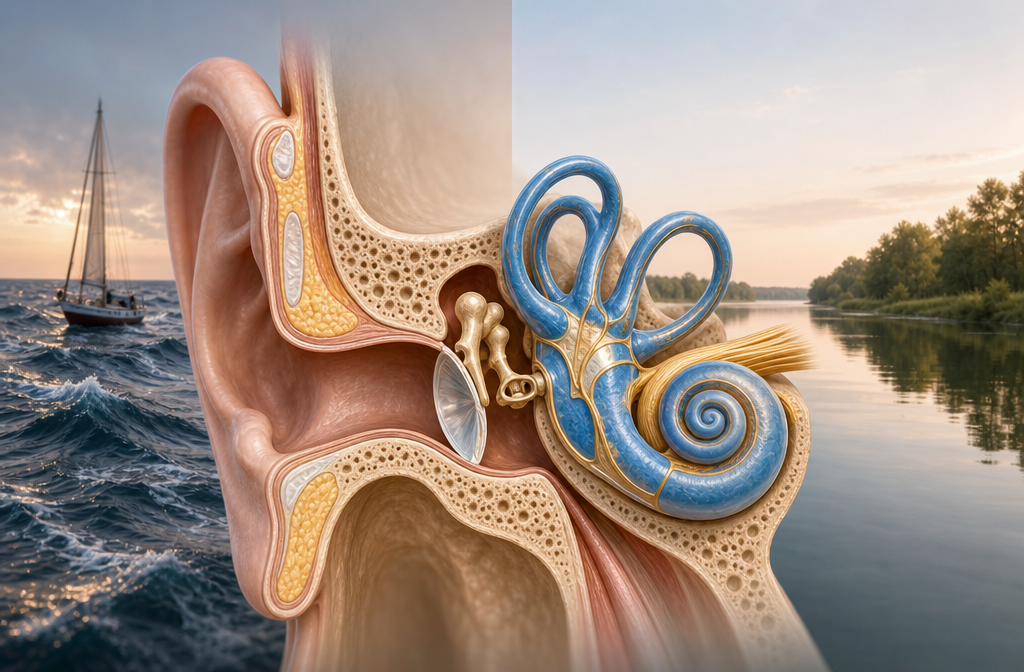
Seasickness is a form of motion sickness (kinetosis) that occurs when the brain receives conflicting signals from the eyes, inner ear, and proprioceptors in the body. The inner ear registers movement, but the eyes, for example, see the seemingly stationary interior of the boat. This conflict triggers nausea, dizziness, and in more severe cases, vomiting.
The mechanics behind it:
- The vestibular system in the inner ear (vestibular apparatus) reacts particularly sensitively to slow, rhythmic wave movements between 0.1 and 0.3 Hz.
- These are precisely the frequencies that occur with long ocean waves, but hardly on inland lakes or canals.
- Psychological factors also play a role: people who are afraid of getting seasick are more likely to do so.
Seasickness is not a disease in the medical sense, but a normal protective reaction of the body that can adapt over time.
Why do people get seasick less on houseboats?
On houseboats in inland waters, seasickness is rarely experienced for a simple physical reason: rivers, canals, and inland lakes do not have long ocean waves. The wave height on a typical German inland lake is usually less than 30 cm even with wind, while sea waves can be several meters high.
Specific differences:
| Type of water | Typical wave height | Rocking motion | Seasickness risk |
|---|---|---|---|
| Ocean/North Sea | 1–5 m (and more) | Strong, slow | High |
| Baltic Sea (coastal) | 0.5–2 m | Medium | Medium |
| Large inland lake | 0.1–0.5 m | Low | Low |
| Canal/River | Almost 0 | Minimal | Very low |
Those who wonder if they can get seasick on a houseboat should know: On a canal or a calm lake like Müritz National Park, the risk is so low that most people won't even notice it.
Differences between seasickness at sea and on inland lakes
The crucial difference lies in the wave frequency and amplitude. On the open sea, long, deep waves hit the boat, setting the entire vessel into a slow rolling motion. It is precisely this motion that most overburdens the balance system.
On inland lakes, wind does create short, steep waves that can shake the boat slightly, but the characteristic slow rolling motion of the ocean is almost entirely absent. Canals are even calmer because they are protected from wind by banks and locks.
When can it become unpleasant even on inland waters:
- With strong winds on large lakes (e.g., Lake Constance, Chiemsee)
- With very fast speeds on small, light boats
- If the houseboat is built very narrow and high (rare for modern rental boats)
Which houseboats are particularly stable?
Wide pontoon boats with flat hulls are the most stable houseboats for inland waters and cause practically no noticeable rocking motions. Modern rental boats for houseboat holidays are built this way almost without exception.
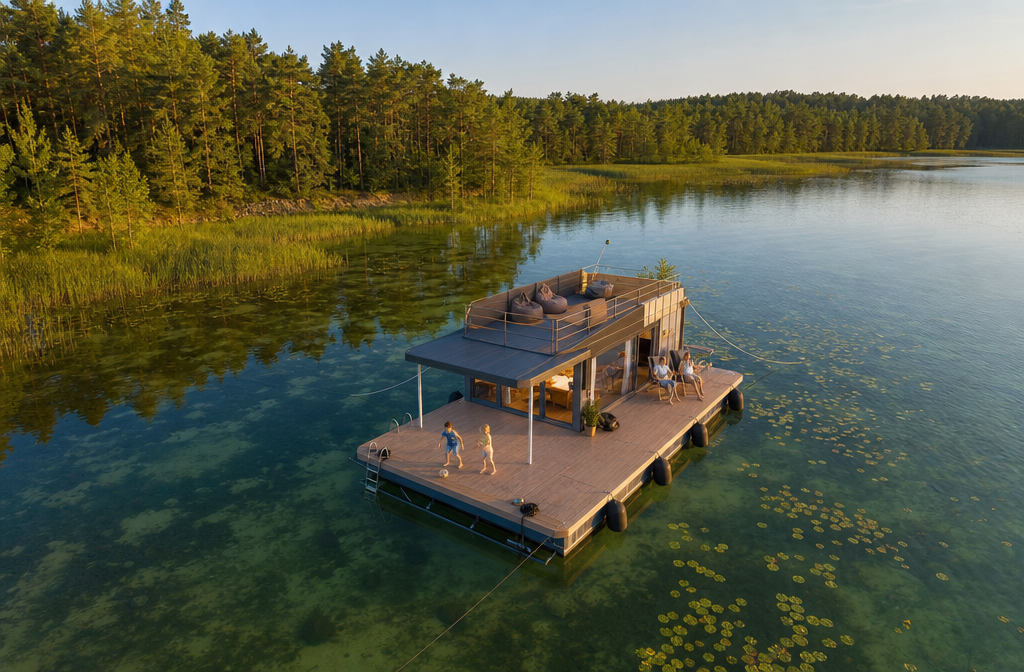
Features of a stable houseboat:
- Wide, flat pontoon hull (catamaran principle)
- Low center of gravity due to flat superstructure
- Width of at least 4–5 meters
- Weight distributed over two parallel floats
Narrower, deeper boats rock more, but are also much more stable on inland waters than at sea. Those who are particularly sensitive should ask for "pontoon houseboat" or "catamaran hull" when booking.
Tips against seasickness on a boat holiday
Seasickness on inland waters can almost completely be avoided with simple rules of conduct. The most effective measures cost nothing and do not require a pharmacy.
Before setting off:
- Eat a light meal, no alcohol, no fatty foods
- Sleep sufficiently, fatigue increases sensitivity
- Take ginger tea or ginger capsules 30 minutes beforehand
While underway:
- Stay on deck and fix the horizon
- Stay midship, movements are least there
- Do not read or look at screens
- Fresh air is better than closed interiors
- Drink small amounts of water regularly
What many do wrong:
- Setting off immediately after eating
- Sitting indoors and reading maps
- Using alcohol as a "sedative" (worsens symptoms)
- At the first signs of nausea, go to the cabin and lie down (better: fresh air and horizon)
Which medications help against seasickness?
For truly sensitive individuals, there are several proven medications that should be taken before the trip. All work best prophylactically, i.e. before nausea sets in.
Overview of the most common options:
- Dimenhydrinate (e.g., Vomex, Dramamine): Available without a prescription, works well, but causes drowsiness. Not for children under 2 years.
- Meclizine (e.g., Antivert): Less drowsy, requires a prescription in Germany.
- Scopolamine patches (Scopoderm): Very effective for longer trips, requires a prescription, can cause visual disturbances.
- Promethazine: Stronger, requires a prescription, for severe cases.
For a relaxed houseboat vacation on German inland lakes, most people don't need any of these remedies. However, those who know they are generally sensitive to motion can pack Vomex as a precaution.
Are there natural home remedies for seasickness?
Ginger is the best-documented natural remedy for motion sickness. Several clinical studies (including Mowrey & Clayson, 1982, published in The Lancet) have shown that ginger is effective for mild to moderate seasickness without causing the typical drowsiness of antihistamines.
Natural alternatives at a glance:
- Ginger (capsules, tea, candied): Effective for mild nausea
- Peppermint tea: Soothes the stomach, helps with nausea
- Acupressure wristbands (P6 point on the wrist): Scientifically controversial, but found helpful by many
- Fresh air and horizon view: The simplest and most effective non-medication method
Can seasickness be completely prevented?
It cannot be completely prevented in every person, but the risk can be drastically reduced. On inland waters, the risk is already so low that preventive measures are purely precautionary for most people.
Those who suffer chronically from motion sickness can develop a tolerance through regular exposure. The brain learns to ignore the conflicting signals over time. A houseboat vacation on calm canals is even a good starting point for this, as the stimuli are so weak that the body can process them without difficulty.
For whom is seasickness particularly problematic?
Certain groups of people react more sensitively to motion stimuli. Children between 2 and 12 years old are the most susceptible, while infants are hardly affected. Women report seasickness more often than men, which suggests hormonal factors.
Risk groups at a glance:
- School-aged children (2–12 years): Highest sensitivity
- People with migraines or balance disorders
- People under severe stress or sleep deprivation
- Pregnant women (generally increased sensitivity to nausea)
For these groups: The risk is still low on inland waters. A wide pontoon houseboat on a calm lake is also well suited for sensitive individuals.
How do children behave with seasickness?
Children often show seasickness differently than adults. They become pale, quiet, and lose their appetite before expressing nausea. Parents should pay attention to these early signs and immediately take the child into fresh air.
Practical tips for families:
- Let children play on deck, not indoors
- Take light snacks with you (saltine crackers, ginger biscuits)
- Plan regular breaks on the shore
- For children under 6 years old, use medication only after consulting a doctor
On a houseboat with a large sundeck, as is common with modern rental boats, children have plenty of outdoor space anyway, which significantly reduces the risk.
How long does seasickness typically last?
Seasickness on inland waters usually only lasts as long as the boat is in motion, often only minutes. As soon as the boat docks or the motion stops, the symptoms disappear for most people within 20 to 30 minutes.
On the open sea, seasickness can last longer because the balance system has been more severely disturbed. This is hardly an issue on inland lakes. Anyone who suffers from dizziness for hours after docking should see a doctor, as other causes are more likely then.
Frequently asked questions on the topic
Can I get seasick if the houseboat is just anchored? Hardly. A moored or anchored houseboat moves so minimally on inland waters that seasickness is practically ruled out. Only during strong storms can slight rocking occur.
Is a houseboat holiday also suitable for people with migraines? Yes, usually. Inland waters are calm enough that migraine sufferers don't have to expect worse discomfort than usual. However, it doesn't hurt to pack an antihistamine as a precaution.
Does alcohol help against seasickness? No. Alcohol impairs the coordination of the balance system and intensifies nausea. It is one of the most common mistakes in preventing seasickness.
Should I lie down if I get seasick? On inland waters, it's better to go out into the fresh air and fix your gaze on the horizon. Lying down might help short-term, but it prolongs the symptoms because the brain doesn't receive new reference points.
Can seasickness be cured through training? Yes, through regular exposure, the brain can learn to ignore the signals. Many experienced sailors report that they were still susceptible in their first season but had hardly any problems afterwards.
What is the best place on a houseboat for sensitive individuals? Midship and as close to the water level as possible. The movements are least there. The stern and the bow rock more.
Are Scopolamine patches necessary for inland waters? In the vast majority of cases, no. Scopolamine patches are designed for long sea voyages. For a houseboat holiday on German inland lakes, ginger and fresh air are sufficient.
Can I still go on a houseboat holiday despite known seasickness? Absolutely. Houseboats on inland waters are one of the best ways for sensitive individuals to get to know boat life because the motion stimuli are so low.
Conclusion: Board relaxed
Getting seasick on a houseboat on German inland lakes, canals, and rivers is the great exception, not the rule. The calm waters, the wide, stable pontoon boats, and the short travel times make houseboat holidays one of the most relaxing forms of travel on the water. However, those who want to play it safe should bring ginger, stay on deck, and keep their gaze fixed on the shore.
Anyone who has traveled on a calm canal or a quiet Mecklenburg lake quickly understands why houseboat holidays fascinate so many people: the water carries, rocks gently, and nature passes by in slow motion. This is not a reason for nausea, but for genuine anticipation.
Ready for your houseboat holiday? Book your houseboat now with Campcruisers and experience how truly relaxing travel on the water is.
Quellen
- Mowrey, D.B. & Clayson, D.E. (1982). Motion sickness, ginger, and psychophysics. The Lancet, 319(8273), 655–657.
- Golding, J.F. (2006). Motion sickness susceptibility. Autonomic Neuroscience, 129(1–2), 67–76.
- Reason, J.T. & Brand, J.J. (1975). Motion Sickness. Academic Press, London.


 English
  German
  Spanish
  Italian
  Polish
  Dutch
Dutch  French
  Danish