
Around 70 percent of houseboat travelers in Europe, according to a survey by the European Boating Industry from 2023, state that environmental friendliness plays an important role in choosing their next vacation. Sustainable houseboat vacation: Solar boats and electric drives on the rise is no longer a niche topic, but a real movement that is changing water tourism in Germany and all of Europe. Those who book a houseboat today no longer have to choose between comfort and conscience.
What you should know about this topic
- Solar boats and electric houseboats produce no direct CO2 emissions during operation and are significantly quieter than diesel boats.
- Rental costs for e-houseboats in 2026 are often only 10–20 percent higher than for comparable diesel boats, while operating costs are considerably lower.
- Electric houseboats are also suitable for beginners, as they are easier to steer and require less maintenance.
- The range of modern e-houseboats on German rivers is between 60 and 150 kilometers per charge, depending on the model and current.
- Germany, the Netherlands, France, and Sweden offer particularly well-developed infrastructures for sustainable houseboat routes.
- Typical beginner mistakes can be easily avoided with a short briefing and careful route planning.
- Campcruisers offers a growing selection of sustainable houseboats for holidays in Germany and Europe.
What are the environmental impacts of traditional houseboats?
Conventional diesel houseboats emit between 1.5 and 4 kilograms of CO2 per operating hour, depending on engine power, in addition to noise, exhaust fumes, and the risk of fuel leaks into the water. This is a considerable burden on river ecosystems, especially on busy waterways like the Rhine, Moselle, or Müritz.
Specific environmental problems of traditional boats:
- Exhaust emissions directly pollute the air and water surface.
- Noise disturbs wildlife and fellow travelers alike.
- Fuel leaks endanger fish stocks and drinking water sources.
- Oil change waste requires elaborate disposal.
Those who take sustainable houseboat holidays seriously are therefore increasingly choosing alternatives with solar or electric propulsion.
What are the advantages of solar boats on holiday?
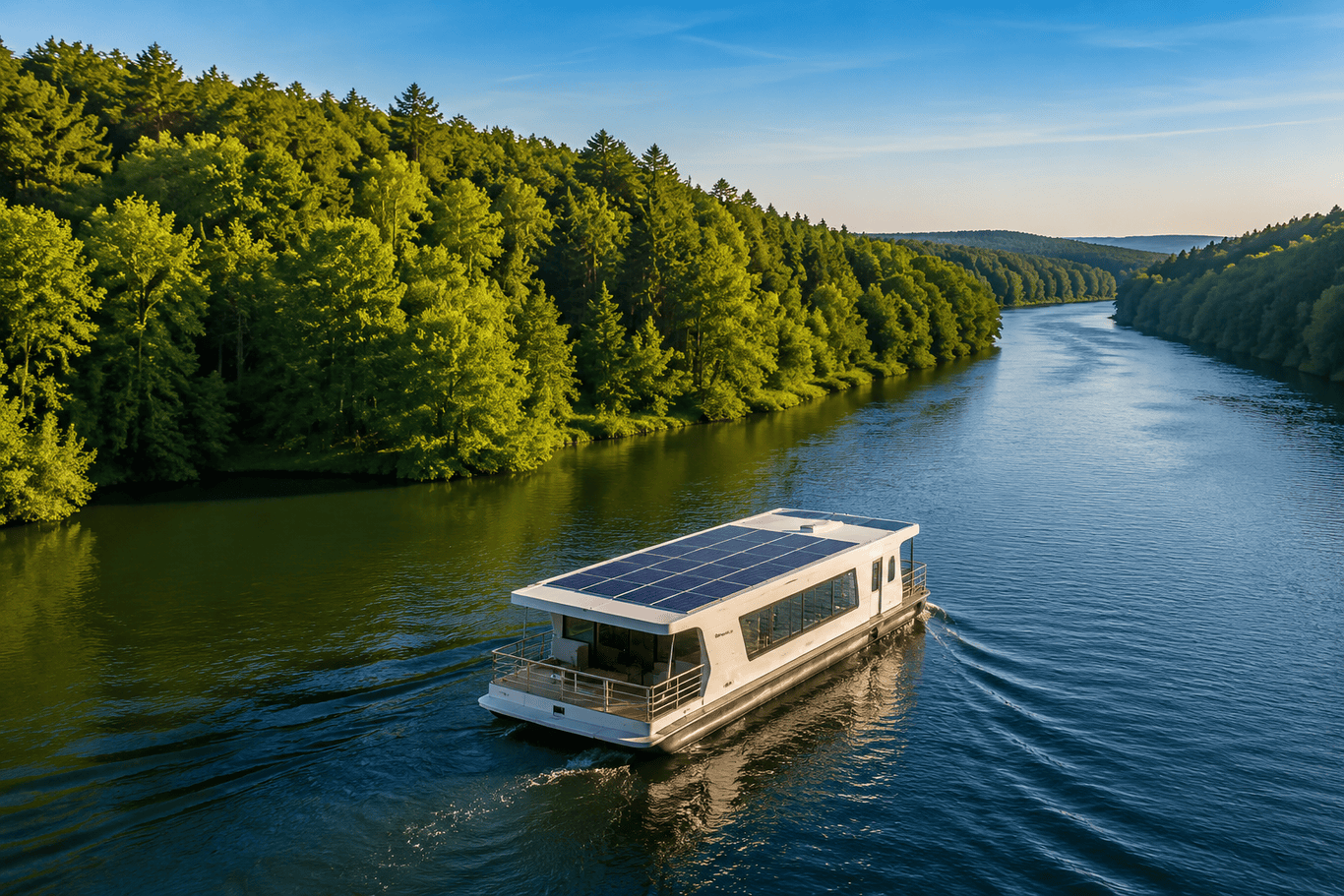
Solar boats combine independence from power outlets with emission-free propulsion, offering a quiet, relaxed driving experience. For holidaymakers, this means: no exhaust fumes on deck, no engine noise during breakfast, and the good feeling of enjoying nature without harming it.
Key advantages at a glance:
- Quietness makes wildlife observation and relaxation on deck truly possible.
- Free energy from the sun significantly reduces running costs.
- Low-maintenance operationbecause electric motors have fewer moving parts than combustion engines.
- No fuel stops necessary, as long as the route and the weather are suitable.
- Higher social prestige among fellow travelers and in marina communities.
Choose a solar boat if you prioritize peace, nature experience, and low operating costs over maximum range.
How expensive are electric houseboats compared to normal boats?
When renting, the surcharge for an electric houseboat compared to a comparable diesel model is currently around 10 to 20 percent per week. When purchasing, the acquisition costs are higher, but the operating costs decrease significantly in the long term.
| Category | Diesel houseboat | E-houseboat |
|---|---|---|
| Weekly rental price (approx.) | 1,200–2,000 EUR | 1,350–2,400 EUR |
| Fuel/electricity per week | 150–300 EUR | 20–60 EUR |
| Maintenance per year | high | low |
| CO2 emissions | high | zero (operation) |
Calculated over a week, the price difference is often offset by the significantly lower energy costs. Those who book for several weeks often even save money in the end.
What is the range of electric houseboats on rivers?
Modern electric houseboats achieve a range of 60 to 150 kilometers per full charge on German inland waterways, depending on motor power, current, load, and weather conditions. Combined solar battery systems significantly extend this range in sunshine.
Factors influencing range:
- Current: Against the current, the range decreases by up to 30 percent.
- Load: More luggage and passengers increase energy demand.
- Solar radiation: On sunny days, solar panels recharge while driving.
- Driving speed: Slow driving saves significant energy.
For houseboat routes on the Müritz, Havel, or Lake Constance, the range of modern e-boats is easily sufficient for typical daily stages of 30 to 50 kilometers.
Are solar boats also suitable for beginners?
Yes, electric houseboats and solar boats are even particularly beginner-friendly. They respond more gently to steering commands, have no complicated gear shifting, and are easier to control due to lower noise levels.
What beginners should know:
- Most rental companies offer a free orientation of 1 to 2 hours.
- Electric motors allow more sensitive maneuvering when docking.
- A license is required in Germany from a certain engine power, but many e-houseboats are below that.
- Route planning is more important than with diesel boats, as charging stations must be planned.
Choose an e-houseboat as a beginner if you value uncomplicated driving and a stress-free holiday experience.
Where can you rent sustainable houseboats in Germany?
In Germany there is a growing number of providers for electric and solar-powered houseboats, especially in the Mecklenburg Lake District, on the Havel, the Moselle and at Lake Constance. Campcruisers lists a selection of sustainable houseboats for various regions and budgets.
Popular regions for sustainable houseboat holidays in Germany:
- Mecklenburg Lake District: Shallow water, many nature reserves, well-developed marinas.
- Havel and Spree: Ideal for trips to Berlin combined with a nature experience.
- Mosel: Picturesque wine landscape, calm current.
- Lake Constance: International flair, border crossings with Austria and Switzerland possible.
Ready for your houseboat holiday? Book your houseboat now at Campcruisers and choose a sustainable route that suits your pace.
Which countries offer the best routes for sustainable houseboats?
The Netherlands, France (Burgundy and Camargue), Sweden and Germany are among the best destinations for sustainable houseboat holidays with electric propulsion in 2026. These countries have invested heavily in charging infrastructure and environmentally friendly marinas in recent years.
- The Netherlands: Dense canal network, many charging stations, shallow waters ideal for e-boats.
- France: Canal du Midi and Burgundy offer fantastic scenery and growing fleets of e-boats.
- Sweden: Götakanal as a classic, increasingly electric options available.
- Germany: Best infrastructure for beginners, clear regulations, many rental options.
What do I need to consider when driving an e-houseboat?
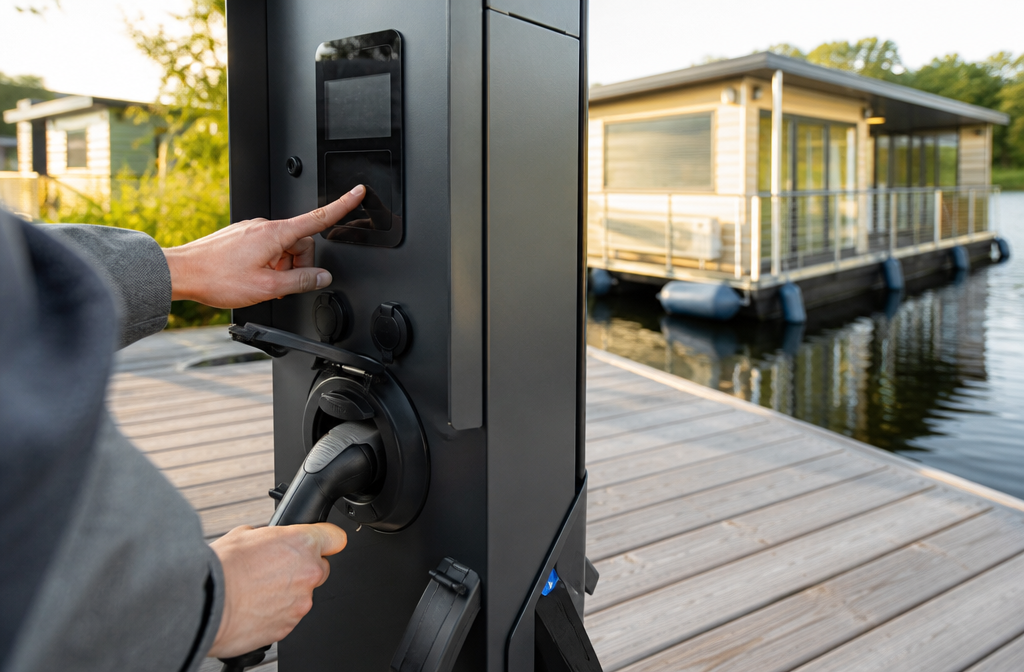
When driving an electric houseboat, route planning is paramount. Those who know charging stations in advance and calculate stages realistically will not experience any unpleasant surprises on the water.
Important points for the journey:
- Charging infrastructure check before departure and plan intermediate stops.
- Battery level observe regularly, especially against the current.
- reduce speedwhen the battery drops below 30 percent.
- do not cover solar panelsso they can recharge during breaks.
- Weather forecast pay attention: Cloud cover noticeably reduces solar performance.
Common mistake: Overly ambitious daily distances without buffer for charging stops. Plan 20 percent less distance than stated until you know the boat and its range.
What are typical mistakes on the first trip with an e-houseboat?
The most common mistakes on the first e-houseboat vacation are overly ambitious routes, forgetting charging stops, and underestimating energy consumption against the current. With a little preparation, all three can be easily avoided.
Typical beginner mistakes:
- Daily distances too long without regard for battery charge.
- Charging stations not pre-bookedeven though some marinas have limited capacity.
- Solar panels misaligned or shaded by sun sails.
- Skipped introductionbecause one thinks boating is intuitive.
- No offline map saved, in case the mobile internet fails on the river.
Are solar boats really cheaper to operate and how long does the battery last?
In operation, solar boats are significantly cheaper than diesel boats, as solar energy is free and electric motors require little maintenance. The battery life of modern lithium-ion batteries in houseboats, depending on the manufacturer and usage, is between 8 and 15 years or 1,000 to 3,000 charging cycles.
What this means for your vacation:
- Rental boats are regularly maintained and have fresh batteries.
- For private ownership, it is worth looking at the warranty conditions of the battery pack.
- Combined solar and mains charging systems significantly extend the effective service life.
- Daily electricity costs are between 5 and 15 EUR, compared to 30 to 80 EUR for diesel.
Who are sustainable houseboats best suited for?
Sustainable houseboats with solar or electric propulsion are particularly well-suited for families with children, nature lovers, couples looking for quiet water routes, and anyone who values an environmentally conscious travel experience. They are less suitable for travelers who want to cover very long distances daily or rely on areas without charging infrastructure.
Ideal for:
- Families who appreciate safety and tranquility.
- Nature enthusiasts who want to observe birds and enjoy silence.
- Beginners without boating experience.
- Travelers who live sustainability as a value.
Less suitable for:
- High-speed water tours.
- Remote routes without charging infrastructure.
- Very large groups with high energy requirements.
Frequently Asked Questions
Do I need a boat license for an electric houseboat in Germany? This depends on the engine power. Many electric houseboats are below the 15 hp (11 kW) license-free limit on inland waterways. The rental company will clarify this when booking.
How long does it take to charge an e-houseboat? At a fast charging station, a full charge takes 4 to 8 hours, at a normal socket 10 to 16 hours. Solar panels provide continuous charging during the day.
Can I also sail with a solar boat in cloudy weather? Yes, but solar power drops to 10 to 30 percent of maximum output in cloudy weather. The battery then takes over the main supply, making charging stops more important.
Are e-houseboats childproof? Electric houseboats are even safer for children than diesel boats due to the absence of exhaust fumes and quieter operation. Basic safety rules on the water still apply, of course.
How much does a week's houseboat holiday with e-drive cost in Germany? Including boat rental, electricity, and mooring fees, total costs of approximately EUR 1,500 to 2,800 are realistic for a week in the Mecklenburg Lake District, depending on boat size and season.
Are there government subsidies for sustainable houseboat travel? There are currently no direct travel subsidies, but some federal states support marinas in setting up charging infrastructure, which indirectly improves availability.
How many solar panels does a typical solar houseboat have? Most rental solar houseboats have 4 to 12 panels with a total output of 800 watts to 3 kilowatts, sufficient for propulsion and onboard power on sunny days.
Concluding thoughts
Sustainable houseboat holidays with solar boats and e-drives will no longer be a compromise solution in 2026, but often the better choice: quieter, cheaper to operate, beginner-friendly, and with growing infrastructure across Europe. Anyone who has glided silently down a German river with the chirping of birds instead of the roar of a diesel engine will not want to miss it again anytime soon.
The next steps are simple: choose a region, roughly plan your route, check charging stations, and then simply book. Ready for your houseboat holiday? Book your houseboat now with Campcruisers and experience how good sustainable travel on the water can be.


 English
  German
  Spanish
  Italian
  Polish
  Dutch
Dutch  French
  Danish