
Quick answer: The best shading solution depends on the type of use. Those who stay permanently on a pitch benefit most from an awning. For flexible day trips and spontaneous stops, a canopy is the most practical choice. A sun sail is best suited as a complementary, inexpensive solution for quiet, windless days.
The most important things at a glance
- Canopies are the most versatile solution for motorhome drivers: quick to set up, weatherproof and permanently mounted.
- Awnings offer the most living space, but are more complex to set up and more expensive to purchase.
- Sun sails cost the least, but offer no protection from rain and are problematic in windy conditions.
- For caravan owners, a suitable awning is often more sensible than for motorhome drivers.
- The cheapest shading option is a sun sail (from about 20 euros), the most expensive a complete awning (up to over 1,000 euros).
- Canopies can be retrofitted, but should be professionally installed.
- Wind stability is the decisive criterion: sun sails fail in gusts, canopies with a valance hold out much more.
- Those who rent a motorhome via platforms such as CampCruisers should check in advance whether a canopy is already included.
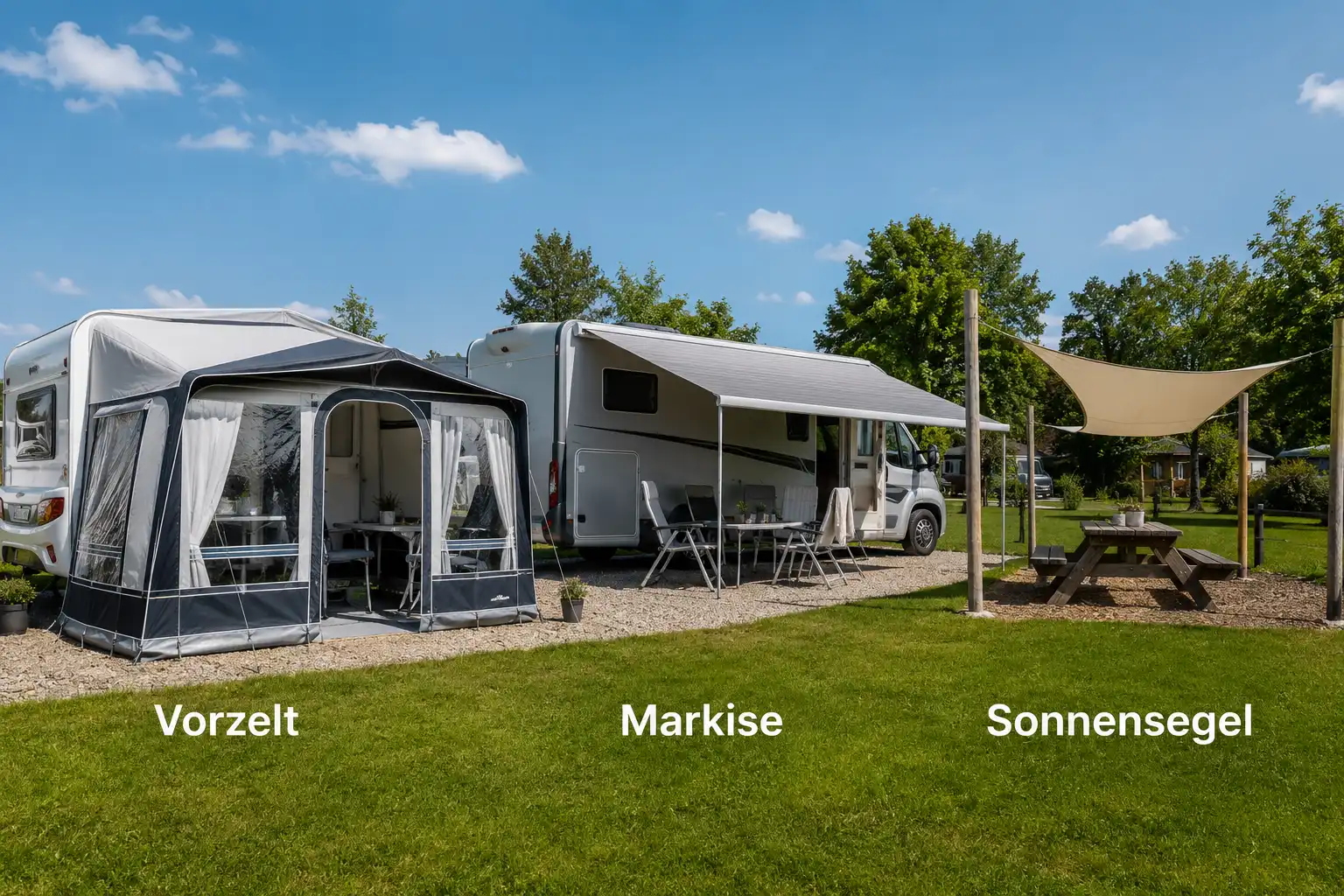
What is the difference between a canopy and a sun sail?
A canopy is permanently mounted on the vehicle and can be extended and retracted by a crank or motor. A sun sail is a freely stretched cloth that is attached between masts, trees or vehicle parts.
The most important difference lies in the attachment and weather resistance. Canopies are usually made of coated acrylic or polyester fabric, water-repellent and UV-resistant. Sun sails are often made of lighter HDPE fabric (High-Density Polyethylene), which filters UV radiation but does not guarantee rainwater drainage. With a canopy, the water remains at the roof edge, with a sun sail it collects in the middle of the cloth if it is not sufficiently stretched.
Choose a canopy if: you camp regularly, want quick assembly and disassembly and cannot rule out rain. Choose a sun sail if: you only need shade occasionally, have a very limited budget and are mainly travelling in summer in stable weather conditions.
How much does a good awning for camping cost?
A solid awning for caravans or motorhomes costs between 300 and 1,200 euros, depending on size, material and brand. Entry-level polyester models are available from around 300 euros, while high-quality models made of aluminium poles and coated fabrics (e.g. from Outwell, Dorema or Kampa) quickly cost 700 to 1,000 euros.
In addition, there are accessory costs:
- Carpet/groundsheet: 30–80 euros
- Pegs and guy ropes: 15–40 euros
- Inflatable frame (air awning): 50–150 euros surcharge compared to pole models
Rule of thumb: Anyone who spends more than 20 nights a year on the campsite will quickly amortise a good awning. A canopy is more worthwhile for occasional campers.
Which shading solution is best for the motorhome?
For motorhome drivers, the canopy is the best choice in most cases. It is permanently mounted on the vehicle, can be extended in seconds and offers reliable protection from sun and light rain.
An awning is technically possible on a motorhome, but significantly less useful than on a caravan, because:
- Motorhomes change location more often
- Setting up an awning can take 30–90 minutes
- Attachment to the motorhome is more complex without a rail
Sun sails can be useful as a supplement to the canopy, for example to extend the seating area to the side. As a sole solution, they are rarely sufficient for motorhome drivers.
Practical tip: Those who rent a motorhome via CampCruisers should explicitly ask for an integrated canopy during the booking process. Many vehicles are equipped with it, but not all.
Which shading is the cheapest?
The sun sail is the cheapest option, with prices starting at 20 euros for simple models and 80–200 euros for higher quality versions with UV protection 50+ and tear-resistant fabric.
Cost comparison at a glance:
| Solution | Entry price | Good quality | Professional range |
|---|---|---|---|
| Sun canopy | from £20 | £50–£150 | £150–£300 |
| Awning (manual) | from £150 | £300–£600 | £600–£1,200 |
| Awning (electric) | from £400 | £700–£1,200 | £1,200–£2,500 |
| Awning | from £150 | £350–£700 | £700–£1,200 |
Important: Cheap sun canopies from discount stores often only last one season. A sun canopy for £80–£120 with reinforced eyelets and UV-resistant material is a better investment in the long run.
Are awnings waterproof?
High-quality awnings are water-repellent to waterproof, but not all models offer the same protection. The water column of the fabric is crucial: For camping, manufacturers recommend at least 3,000 mm water column for roof and wall areas.
Cheaper models under £300 are often around 1,500–2,000 mm, which is not sufficient in heavy, continuous rain. Seams should also be welded or sealed with seam sealing tape. Awnings with inflatable poles (Airbeam technology) are generally tighter because they have fewer seams at critical points.
Typical mistake: Setting up awnings without a groundsheet. Even if the roof is tight, moisture will creep in from below.
How do I install an awning correctly?
An awning is attached to the side wall of the vehicle or to the roof edge. With experience, assembly takes about 1–2 hours and requires two people.
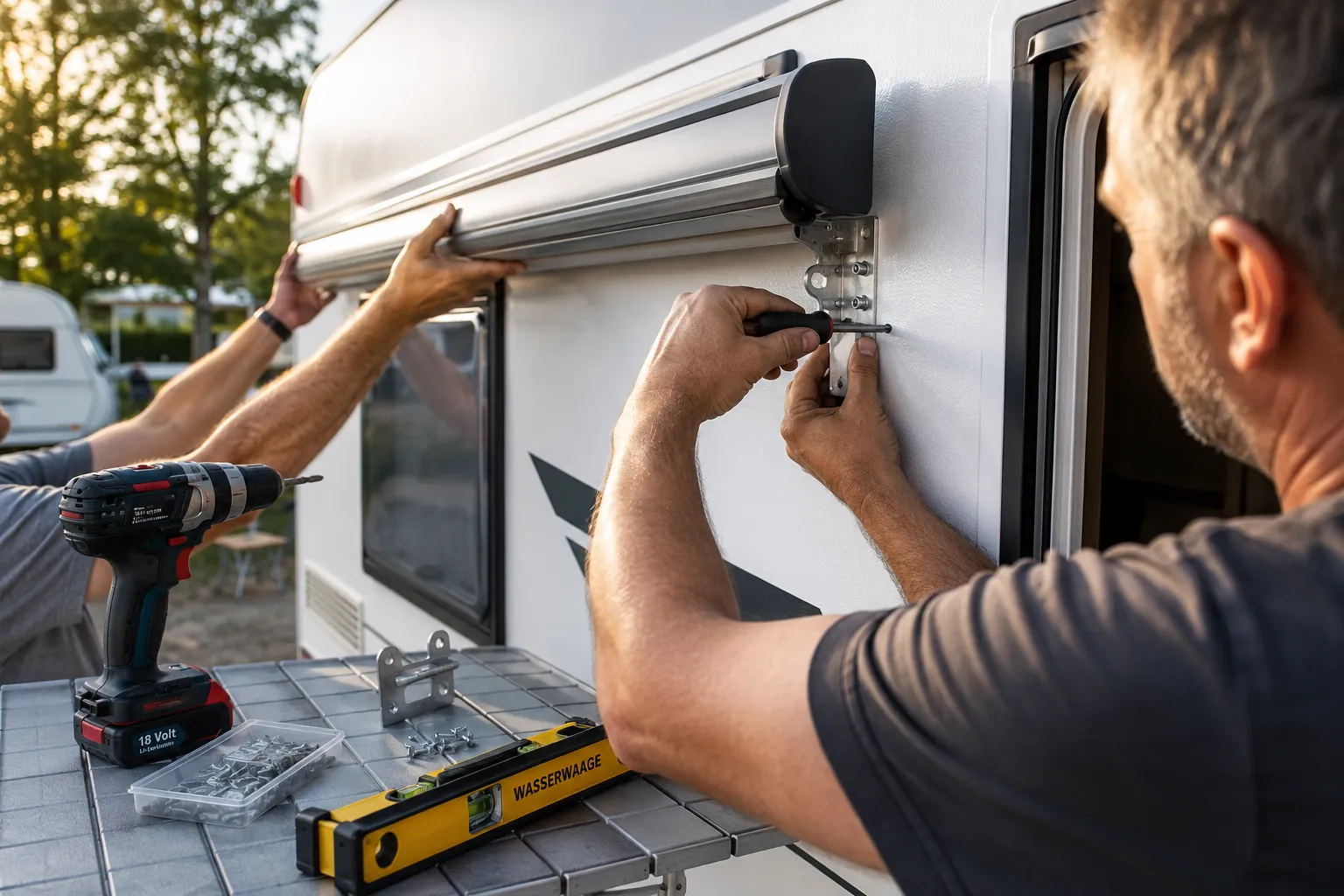
Step-by-step:
- Determine mounting position: The rail should sit at least 5 cm below the roof edge so that water can run off.
- Set drill holes: Distances according to manufacturer's plan, usually every 30–40 cm. Pay attention to cavities and lines in the vehicle frame.
- Apply sealant: Seal each hole with body sealant before screwing in the screw to prevent corrosion and water ingress.
- Attach rail: Tighten evenly, not too tight (risk of deformation with plastic walls).
- Hang awning roller: According to the manufacturer's instructions, usually by sliding it into the rail from the side.
- Check function: Extend and retract the awning completely, check for smooth running and correct stop.
Common mistake: Aligning the awning too steeply upwards. A slight slope forwards (approx. 5–10 degrees) ensures that rainwater runs off instead of accumulating.
Which shading is the most stable in wind?
Awnings with a valance and storm poles are the most stable. Sun canopies are the weakest option in wind and can become dangerous in gusts from wind force 4–5.
Stability ranking in wind:
- Awning with frame and guy ropes (most stable option, but complex)
- Awning with storm poles and valance (good balance of stability and comfort)
- Awning without storm poles (sufficient in light wind)
- Sun canopy (only suitable for calm days)
Anyone who frequently camps in exposed pitches or in windy regions should choose an awning with integrated storm poles or use an awning with sufficient pegs and guy points.
Which awning fits my caravan?
The awning needs to match the length of the vehicle side it's being fitted to. Standard sizes range from 2.5m to 6m wide. The projection (how far the awning extends) is usually between 1.5m and 3m.
What's important:
- Width: At least as wide as the sliding door or the main entrance of the caravan
- Mounting rail: Check whether there is already a rail on the vehicle or whether one needs to be retrofitted
- Weight: Lighter awnings (under 15 kg) are better suited for caravans with thin walls
- Brand compatibility: Not every awning fits every rail. Thule, Fiamma and Dometic sometimes have proprietary systems
Recommendation: If in doubt, have it measured by a specialist dealer before ordering online.
Typical mistakes when choosing camping shade
Many campers regret their choice because they made one of these mistakes:
- Buying a sun sail as an all-weather solution: Only works in dry weather and with little wind.
- Ordering an awning without checking measurements: Not every awning fits every caravan. The dimensions (circumference, height) must be exactly right.
- Choosing the cheapest awning: Cheap models with thin poles bend in the wind or after a few seasons.
- Installation without sealant: Leads to water damage to the vehicle wall in the long term.
- Not retracting the awning in a storm: Even high-quality awnings are not designed for storms and should always be retracted in strong winds.
Who really benefits from an awning?
An awning is worthwhile for anyone who camps regularly and values quick, uncomplicated comfort. Specifically: Anyone who spends more than 10–15 nights a year in a motorhome or caravan will have amortised the investment in a good awning after 2–3 seasons.
For whom an awning is less useful:
- Occasional campers with 1–2 trips per year (a sun sail or a cheap awning is sufficient here)
- People who mainly do transit trips and rarely stay longer than one night
- Renters who only use a vehicle sporadically (awning is usually already present)
Can I attach a sun sail myself?
Yes, a sun sail can easily be attached yourself. Most models are attached to trees, masts or special sun sail masts with ropes and snap hooks. For attachment to the vehicle, there are suction cup adapters or roof rail clamps.
Important points for self-assembly:
- Use at least three attachment points so that the fabric is evenly stretched
- Stretch the sail slightly at an angle so that rainwater runs off
- Do not attach to moving vehicle parts (antenna, roof vent)
- Always remove in wind, even if it's only briefly
Frequently asked questions
Can an awning be retrofitted to a motorhome? Yes, awnings can be retrofitted in most cases. The prerequisite is a sufficiently stable vehicle wall and the appropriate rail size. Installation should be carried out by a specialist workshop or an experienced camper.
How long does a good awning last? High-quality awnings from brands like Fiamma, Thule or Dometic last 10–15 years with regular care. The fabric must be treated occasionally with special waterproofing spray.
Is an awning better than an awning for families? For families with children, an awning offers significantly more usable space, as it can be used as a complete living area. An awning only offers a covered outdoor area without side walls.
What is an air awning? An air awning has inflatable air beams instead of metal poles. Assembly takes only a few minutes with a pump. Air awnings are lighter and easier to transport, but cost more than comparable pole models.
Can you leave a sun sail up in the rain? Only if it is stretched at a sufficient angle and the material is water-repellent. In heavy rain, it is recommended to remove the sun sail, as water can collect in the middle and damage the fabric.
Which awning is the easiest to use? Electric cassette awnings with remote control are the most comfortable. Manual crank awnings are cheaper and require less maintenance, but require a little more effort when extending.
Do I need a special rail on the caravan for an awning? Yes, most awnings are attached to the caravan via a piping or profile rail. This is often already present on newer caravans. It must be retrofitted on older models.
How do I clean an awning properly? With lukewarm water and a soft brush. Do not use a high-pressure cleaner, as this will damage the coating. Always allow to dry completely before rolling up to prevent mould growth.
Conclusion: Making the right choice
The question „awning, tent or sun shade: What is the best choice?“ cannot be answered in general terms, but with clear criteria, you can quickly come to the right decision.
Specific recommendations:
- Motorhome drivers with regular trips: Awning (manual or electric), preferably with storm poles
- Caravan owners with permanent pitches: Awning for maximum comfort and living space
- Occasional campers and budget-conscious people: Sun shade as an entry-level option, later as a supplement to the awning
- Families: Awning or tent with side windbreaks
If you are still unsure, you can first test a sun shade and then specifically invest in an awning or tent as soon as your own camping habits are clearer. If you rent a motorhome from CampCruisers, it often already has an awning on board, which makes it possible to get started without investment risk.


 English
  German
  Spanish
  Italian
  Polish
  Dutch
Dutch  French
  Danish